
August Lunar Eclipse 2026: Here's how to watch the celestial phenomenon that could turn the moon red - exact time and where to look
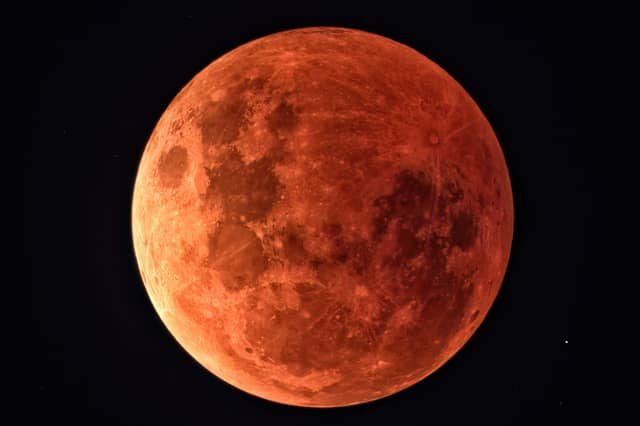

Fingers crossed the clouds stay away.
The skies above Scotland have been a dramatic place in the last year - we’ve had Northern Lights, meteor showers, planetary processions and a near-total eclipse of the sun (if you could avoid the cloud).
And next up is a partial eclipse of the moon - which always happens shortly after a solar eclipse.
Here’s everything you need to know.
What is a lunar eclipse?
A lunar eclipse occurs when when the Moon aligns directly behind the Earth relative to the Sun. This alignment causes the moon to pass through Earth's shadow. A total lunar eclipse sees the Moon entirely covered by the Earth’s shadow, while a partial eclipse means only part of the Moon is affected.
What does a lunar eclipse look like?
At the start it looks like a small ‘bite’ has been taken out of the moon, as the Earth’s shadow starts to fall upon it. The ‘bite’ gets bigger and bigger and can make the moon appear to be red in colour, before it recedes.
When is the August lunar eclipse in Scotland?
Scotland will see a lunar eclipse in the early hours of Friday, August 28 - so you’ll need to set an alarm clock if you want to see it.
What time will I be able to see the lunar eclipse in Scotland?
The lunar eclipse will start at about 2.33am. It will be at its maximum at around 5.12am.
Unlike the relatively speedy solar eclipse, the lunar eclipse is a slow business taking around five hours, which can be spit into five hour-long phases as follows:
- Penumbral lunar eclipse: the full moon enters Earth's penumbra and begins to dim.
- Partial lunar eclipse: the full moon begins to enter Earth's umbra and begins to turn reddish
- Total lunar eclipse (lunar totality): the entire moon is inside Earth's umbra.
- Partial lunar eclipse: the full moon begins to exit Earth's umbra and begins to lose its reddish color.
- Penumbral lunar eclipse: the full moon begins to exit Earth's penumbra and regains its glare.
Where in the sky will the moon be during the lunar eclipse?
The moon will fairly low in the western horizon when the eclipse is at its most dramatics so you’ll need to be in a spot where there are no buildings or other obstructions blockin the view. Your best bet is to find an elevated spot with a clear view of the western horizon.
How rare are lunar eclipses?
Partial lunar eclipses take place a couple of times a year, but it’s far rarer to two complete eclipses in a single year - as will happen in 2025.
When is the next total lunar eclipse in Scotland?
You have a fair wait for the next total lunar eclipse, which will take place on December 31, 2028. That will be a Hogmanay to remember.
Make sure you don't miss a moment of breaking news from across Scotland by signing up to our free newsletter here.
Comments
Want to join the conversation? Please or to comment on this article.