
Full Moons 2026: Here's when all 13 full moons of the year take place and their names - including a Blue Moon
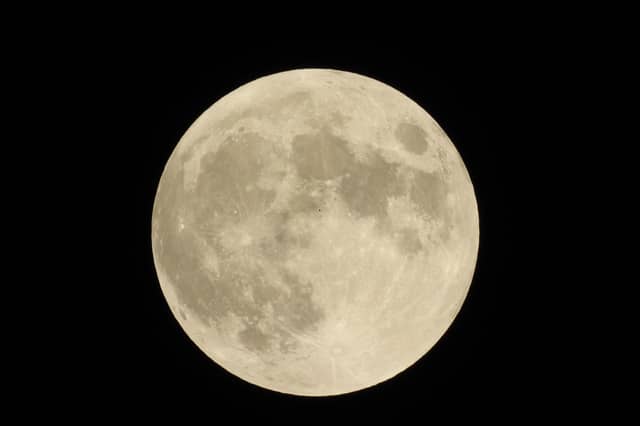

We’ll be treated to a Blue Moon in 2026.
It's a sight that has inspired myths, superstitions and awe through the centuries - when the night sky is lit up by the seemingly-perfect glowing sphere of a full moon.
We experience one full moon every month, with each one given a different evocative name.
And in 2026 we have a bonus ‘Blue Moon’ in May, giving us 13 in total.
Here’s everthing budding astromoners need to know.
What is a full moon?
A full moon is when moon appears as a complete circle in the sky. The moon produces no light of its own, so this only happens when the moon is on the opposite side of the Earth to the Sun - meaning the whole of the near side of the moon is fully lit up.
What is a Supermoon?
A Supermoon is a phenomenon that occurs when the full moon or new moon coincides with the moon's closest approach to Earth in its orbit, known as perigee. Because the moon is closer to Earth during this time, it appears larger and brighter than usual, hence the name. It means that the moon appears up to 14 per cent larger and 30 per cent brighter than when it’s at its furthest from Earth.
What is a Blue Moon?
Despite the phrase ‘once in a Blue Moon’, it’s not actually that rare.
It’s the term given to the the third full moon of a season that contains a total of four full moons (a season typically only contains three full moons). It means you get a Blue Moon every couple of years - but it’s actually not blue.
Some people also - incorrectly - say that a Blue Moon is when you get two full moons in the same month, which also happens every couple of years.
Why do full moons have different names?
Full moon names are often attributed to Native American tribes that would give full moons nicknames to keep track of them as they didn’t record time using months found in the Julian or Gregorian calendar. Most of the names were linked to a specific event, for example the Worm Moon relates to a time of year when the ground starts to thaw and worms are able to wriggle up to the surface.
Other moons like the blood moon were thought to be caused by Jaguars who attacked the moon and left it bleeding hence the red colour. These lunar systems and their names differed between tribes but it seems Colonial Americans adopted some of these names and incorporated them into their own calendar systems.
When are the full moons in 2026?
Here’s a full list of all the full moons in 2026 - and their names:
January 2 - ‘Wolf Moon’
February 1 - ‘Snow Moon’
March 3 - ‘Worm Moon’
April 2 - ‘Pink Moon’
May 1 - ‘Flower Moon’
May 31 - ‘Blue Moon’
June 30 - ‘Strawberry Moon’
July 29 - ‘Buck Moon’
August 28 - ‘Sturgeon Moon’
September 26 - ‘Harvest Moon’
October 26 - ‘Hunter’s Moon’
November 24 - ‘Beaver Moon’
December 24 - ‘Cold Moon’
Make sure you don't miss a moment of breaking news from across Scotland by signing up to our free newsletter here.
Comments
Want to join the conversation? Please or to comment on this article.