
Readers Letters: Does anyone really believe SNP could run Scotland's buses?
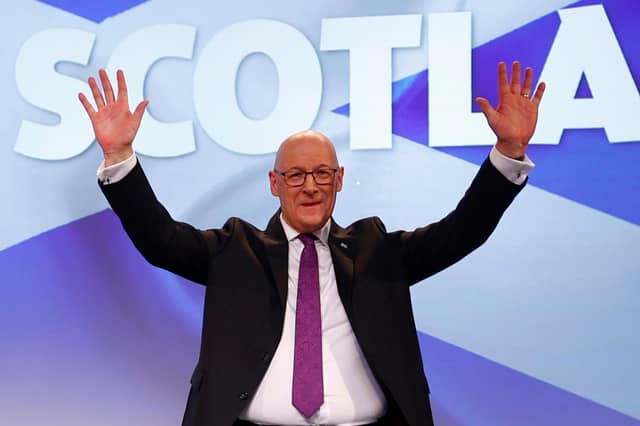

Was John Swinney’s announcement the Scottish government will take bus services in hand just the ticket for readers?
Apparently, the audience at the SNP conference was moved forward to disguise the fact that the numbers there were rather low.
So, I suppose that isn't any surprise when I read Brian Monteith's damning article (Perspective, 20 October). He highlights what we all know. The SNP has run out of ideas and its track record is a catalogue of failure on all fronts.
I may be missing something, but Brian mentioned the SNP’s astonishing policy, which seemingly came out of nowhere, to “nationalise” McGill’s and other bus companies. They might argue it isn't full nationalisation, but it means that they will take control of, and run, all the bus groups in Scotland. Taking things from people used to employ the word “theft” and trying to dignify it with the communistic “nationalisation” tag doesn't get away from that.
What surprised me was the photo of John Swinney beaming at the First Bus stand at the conference. Did he let on about the proposed theft before or after the photo-shoot, I wonder? It isn't just that, either. If we consider what a “Horlicks” the SNP has been making on all fronts for two decades and with no business experience anywhere on their benches, I would ask what experience of running a bus company Mr Swinney's Merry Band can bring along to persuade us of their credentials? Don't all shout at once. It's a totally round numeral.
Peter Hopkins, Edinburgh
All talk
The utter incompetence of the SNP administration grows ever bigger with every ill-thought-out policy “announcement”.
John Swinney announces food price caps during the election campaign. Months later and no detail. He says he wants to bring bus services into public control – no detail. He wants to cut public health bodies from 14 down to two. Yet again, no detail except somehow if you cull 12 authorities, there will be no compulsory redundancies?
Swinney is clearly “shooting from the hip” and ultimately these supposed policies will fall by the wayside.
Richard Allison, Edinburgh
Stars look down
The First Minister John Swinney believes that “the stars are aligning” in favour of independence. Would those stars happen to be the well-known supporters of separation, Allan Cumming, Martin Compston, Elaine C Smith and actor Brian Cox?
Mark Openshaw, Aberdeen
Sporting chance
Further to The Scotsman’s report on Meadowbank businesses threatened by Edinburgh's new bus lane regulations (“Edinburgh businesses say trade has been hampered by 7-7-7 bus lanes”, 20 October), I would extend concerns on behalf of the Stadium users. Edinburgh councillors, on commissioning their multi-million pound showcase, thoughtfully included fewer than 30 parking places for sportsmen and women and spectators.
In one evening hour alone, 42 people can be using the seven-a-side pitches. Parking has therefore been difficult from the outset but the new bus lane rules make it virtually impossible for early evening players, such as my club, Reith Rovers FC.
For several members of our club from outside the city, like me, who have provided income for Meadowbank since 1982, public transport is not an option. I would urge a return to the 6.30pm bus watershed, which was workable for us.
Kit Fraser, Dunbar, East Lothian
Problems abound
France is graphically displaying what happens in a time of intense cultural upheaval. France has huge problems with integration, vast public debt and failing public services. This is exactly the same situation as we have here both in Scotland and England.
Add in our somewhat soft justice and early prison release schemes and it all adds up to a simmering resentment from the general public, and taxpayers in particular. Governments both in Westminster and Holyrood are ignoring the reasonable demands of the population in favour of the politicians' own pet projects.
We have a cost of living crisis here too, yet governments continue to fritter away taxpayers’ money that could be better used elsewhere.
Meantime, Andy Burnham is fixated with Ukraine and Gaza and John Swinney is fixated with independence. What can possibly go wrong?
Gerald Edwards, Glasgow
Lessons unlearned
“We want deep learning not cheap learning” (your report, 19 October) is the cry from Deputy First Minister Jenny Gilruth about reform of Scottish education.
Complete with all her platitudes, she tries to discredit the PISA scoring system as merely rote learning. In practice, though, PISA assesses students' ability to apply reading, mathematical and scientific skills to unfamiliar, real-world problems rather than solely relying on memorisation.
No doubt Scotland's downward trend in the PISA rankings is at the back of MS Gilruth’s mind. However, she does ask, “are PISA scores the only measure we look at?” and points our attention towards the Curriculum for Excellence (CfE) overseen by Education Scotland. I would suggest she considers some of the results from the 2025-26 diet of examinations.
In particular, that fewer than two in five pupils in the S4 cohort achieved at least a C pass at National 5 in both English and Mathematics, and at least 50 per cent were not presented at Nat 5 level for both these exams – evidence that vast swathes of our school population do not possess the basics to progress onto higher education.
CfE has not delivered and on the basis of serial failures by successive Education Secretaries in Scotland (including Ms Gilruth), I am not hopeful for the future.
Alastair Neilson, Edinburgh
Update the fibs
How often does Grant Frazer (Letters, 20 October) need to be told that Scotland is not qualified to join the EU and has had no invitation to do so? Yet his letters bear the hallmarks of dishonest and unrealistic SNP propaganda.
On financial criteria alone, Scotland falls far short of EU membership requirements, in terms of currency, central bank, lender of last resort, deficit.
And he needs to look closely at his “prosperous and expansive EU’s” economic performance in recent years, before one mentions the recent febrile political scenes in its erstwhile giants, France and Germany.
I have been, and continue to be, a Remainer, from an emotional standpoint but there is no point in pretending we continue to live in the Kohl/Mitterrand or Merkel eras when we don’t. Please will the SNP bring its propaganda up to date and give us all a break from its ineffably silly lies?
Jill Stephenson, Edinburgh
Scotland in chains
“Myopic”, “separatist” and “zealots” were among the derogatory (some would also say divisive) words employed in the Letters page on Saturday (17 October) to describe the Scots who want Scotland to be able to determine its own future.
Ignoring the fact that the people of Scotland were sold out by a “parcel of rogues” “for English gold”, Scotland is supposed to be in a voluntary union from which it should be able to withdraw whenever the people of Scotland choose.
In reality, a single person outwith Scotland can apparently legally, and totally undemocratically, block the will of Scotland’s people, without even offering a legitimate route to democratically exercising that will. This situation is an affront to all who genuinely believe in democracy and no amount of name-calling can change that fact.
With the far right knocking on the door of Number 10, democrats in Scotland must decide if they want to live in a society where people are free, and have the democratic means, to exercise their choices, or, alternatively, perhaps have their lives largely dictated by an authoritarian government representing foreign billionaires.
Stan Grodynski, Longniddry, East Lothian
Trafalgar pride
Today (21 October) marks Trafalgar Day, the 221st anniversary of the 1805 Battle of Trafalgar, in which Scots played a major role.
Far from being an English victory, epitomised by the famous "England expects" signal, five of the 27 captains of the fleet were Scottish, and George Duff of Banff, captain of the Mars, was one of only two captains killed.
A substantial proportion of the fleet’s crew came from Scottish towns and fishing villages, and the woman who helped embalm his body after his death, Mary Buick, was from Dundee.
Scottish industry also played a major role, providing iron and manufacturing cannon at the Carron Works in Falkirk. Charcoal from the forests of north Argyll fuelled the gunpowder that fired the cannons, and timber from Scotland’s woods built the fleet of participating ships.
For some, this victory symbolises a great British triumph over the French and the Spanish; for others, it epitomises English imperialism, with Scots as unwilling, press-ganged accomplices.
However, we cannot disregard the prolific and willing role Scottish men and women played in a naval encounter that changed the course of European history, a history we in Scotland cannot simply turn a blind eye to.
Alex Orr, Edinburgh
Write to The Scotsman
We welcome your thoughts – NO letters submitted elsewhere, please. Write to [email protected] including name, address and phone number – we won't print full details. Keep letters under 300 words, and in the body of the email – no attachments – and avoid 'Letters to the Editor/Readers’ Letters' or similar in your subject line. If referring to an article, include date, page number and heading. No poems or open letters.
Comments
Want to join the conversation? Please or to comment on this article.