
Buyer beware
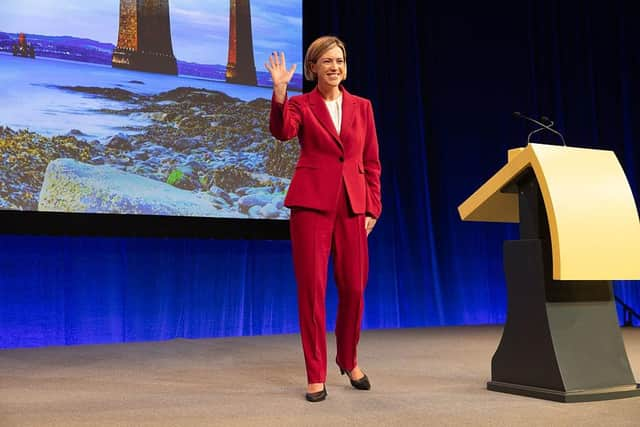
Deputy First Minister Jenny Gilruth fails to convince readers of SNP plans
I'm beginning to wonder if Deputy First Minister Jenny Gilruth has a side-hustle as the deliverer of terms and conditions at the end of commercial radio adverts.
It certainly seemed like it on the BBC Sunday Show as she projected a tornado of obfuscations about the SNP's proposed local government changes.
Not an easy job when you consider Andy Burnham has set the scene for a constant drip of ideas and leapfrogging funding and “partnering” initiatives onto confused and scattered Scottish local authorities lying prostate on their deathbeds as politicians, unions, media, businesses, SNP faithful and private individuals gather round try to make sense of, influence or sabotage poor old Ivan McKee's half -baked plans.

Caveat emptor, as they say.
Allan Sutherland, Stonehaven, Aberdeenshire
Workings out
Jenny Gilruth has donned her old education hat (like all the Scottish portfolios, a much-used garment) to blame Michael Gove's English school achievements for Scotland's decline. Could I remind her, before this grasshopper takes off again, of her pre-election April promise for keeping mobile phones out of classrooms: “We have an action plan.”
That new phrase impressed me as it sounded a couple of steps up from the usual prevaricating equivocation, such as putting out a consultation. Make something central to our future actually happen please.
R Brodie, Dundee
Crocodile tears
Prime Minister Andy Burnham says youth unemployment is a catastrophe and a moral failure.
In that he is quite correct, but which government made it increasingly expensive for employers to take on young people by hiking National Insurance, lowering the NI threshold, increasing the Living Wage and adding more and more employment laws that discourage employers from taking on young people? Mr Burnham’s very own Labour Party.
And in England, who burdens employers with additional business rates – yes, Mr Burnham’s Labour Party. And in Scotland, who burdens employers? Well, the two-decade-old SNP government, who not only burden employers, but choose to use Barnett formula funds from hospitality relief not to help hospitality, but on their own pet projects.
There is no point in either Labour or the SNP shedding crocodile tears for unemployed youths until they understand that the way to help youths gain employment is to reduce the cost of employers employing them.
Until then, all the words about catastrophes and moral failure are just words. We need action to help youth Neets, not words.
Brian Barbour, Haddington, East Lothian
Labour failures
At a buoyant and packed SNP conference, whichAndy Burnham could have visited after a gracious invitation was extended, Independence was central to events. This refreshing, honest and proactive PM had previously accepted that the Scottish people should decide their own future and agreed that there were “circumstances” in which another independence referendum could take place.
However in talks with recently damaged Scottish Labour, Andy is now apparently advocating “solidarity and not separation”. Also, failed Scottish Labour leader Anas Sarwar accepted a lucrative seat in The House of Lords, which he has long campaigned to abolish!
Scotland has repeatedly elected a majority of Holyrood MSPs, committed to independence. In fact if Holyrood operated Westminster's outmoded voting system, SNP would have outright control of the Scottish Parliament. As always Scotland’s future, like that of the Republic of Ireland, lies in a prosperous and expansive EU and not in an uncertain and insular UK.
Grant Frazer, Newtonmore, Highland
Let's get drilling
The Scotsman reports (19 October) that David Whitehouse of OEUK says 111 oil and gas projects worth £50 billion to the UK economy await the go-ahead should Jackdaw and Rosebank initiate.
That's an opportunity not to be missed. The fact is we will need hydrocarbons for the next 100 years simply because without them civilisation as we know it would collapse. Hydrocarbons are essential for the plastics, gases, lubricants, fuels, and thousands of derivatives made from them without which modern life would be impossible.
The argument that this will speed up climate change does not hold water, firstly because the impact would be minimal, and secondly because it's more carbon intensive to import oil and gas from abroad while pipelines emit no CO2.
We now depend on Norwegian pipelines for half our gas needs while Norway is developing new fields and re-developing old ones. That country shows the way forward. Let's get drilling.
William Loneskie, Oxton, Lauder, Berwickshire
Counting sheep
The Scotsman story “A warmer St Kilda could be changing the fate of its famous sheep” (October 8) gave the impression the dire situation faced by the sheep on St Kilda was improving: the population is increasing in size and the so-called “crashes” appear to be less extreme as climate change increases the grazing available in summer and autumn.
From an animal welfare point of view, this is misleading: an increasing population will mean more lambs being born and therefore, in the absence of any management, more animals will inevitably die of starvation in late winter. The trend for the mortality graph, like that for the population size, is one of increase. Things are getting worse for the sheep, not better.
In any case, an absence of the “crashes” is irrelevant to the number of animals suffering and dying of starvation. If the August count were the same each year, thereby producing a straight, horizontal, population graph-line, it would mean 35 per cent of the sheep counted at the August census would die every winter, rather than that figure being the yearly average calculated over a number of years.
The story (of climate change affecting numbers of sheep) was presumably provided as news by the University of Edinburgh's Soay Sheep Project, though it was first described in the project’s annual reports in 2014 and 2015 and published in the scientific literature more than two years ago. Some might suggest this “news” is in reality “spin”, to counteract the story printed two days previously, of Councillor Gordon Murray raising legitimate animal welfare concerns regarding the St Kilda sheep at a recent Comhairle nan Eilean Siar meeting (“Hundreds of sheep die on St Kilda each year as welfare concerns mount”, 6 October).
David Buckland, Graham Charlesworth, South Uist
Train changes
Stephen Jardine laments a three-hour journey time by train from Aberdeen to Edinburgh recently (Perspective, 17 October).
I believe his train was diverted via the longer Dunfermline route due to work in Fife to upgrade and electrify the railway. The normal journey time via Kirkcaldy is about 2h 28m, with seven stops (ScotRail's 0710 departure). This is similar to a car journey. Coaches take more than an hour longer.
ScotRail plan to introduce Meridian trains from 2027 that can reduce journey times, and electrification will support further reductions in future. Options to consider that could reduce journey times in the future would be further electrification, fewer stops, tilting trains and infrastructure upgrades. Some of these will depend on the new Great British Railways from next year, who will take over infrastructure responsibility from Network Rail, and will also operate the direct services that run between Aberdeen, Edinburgh, London and Plymouth.
Chris Gibb, former chairman, ScotRail, Prestwick, South Ayrshire
Matter of faiths
Glasgow City Council has advised us that Glasgow’s Cenotaph “honours all those lost… regardless of faith or belief”. Can they then explain why it is necessary for the memorial to be adorned so prominently with a gold-plated Christian cross with Biblical inscriptions in a public square?
Our aim is to ensure that the memorial visibly commemorates everyone who gave their lives in war, including people of all faiths and none, as the secular war memorial in Whitehall does.
Even if the Council will not consider removing the cross, we ask there to be historical interpretation explaining the memorial’s origins, symbolism and political context, consistent with the contextual approach being taken to other controversial statues in George Square.
The Council has described this as “a place of Civic Pride”. But considering the vast sums spent on monuments after the First World War, the concept of “civic pride” rings hollow when contrasted with the reality of many veterans. At remembrance parades, some famously wore their pawn tickets instead of medals, having been forced to pawn their military honours just to buy food.
Housing this memorial in a major public square flanked by lions without historical context remains a glaring anomaly. The Cenotaph was cynically positioned in the square to weaponise the memory of the fallen, as the Glasgow Corporation gambled that protestors would hesitate to demonstrate in front of a monument to lost veterans.
This evolving friction in public spaces is why the historical context of the Cenotaph needs urgent reconsideration.
Neil Gregory, Chair, Scottish Secular Society, Broxburn, West Lothian
Write to The Scotsman
We welcome your thoughts – NO letters submitted elsewhere, please. Write to [email protected] including name, address and phone number – we won't print full details. Keep letters under 300 words, and in the body of the email – no attachments – and avoid 'Letters to the Editor/Readers’ Letters' or similar in your subject line. If referring to an article, include date, page number and heading. No poems.
Comments
Want to join the conversation? Please or to comment on this article.