
Glasgow-London derailment: Investigators find similarities to Stonehaven crash in probe update

Drainage design to be examined after Cumbria crash which injured four people
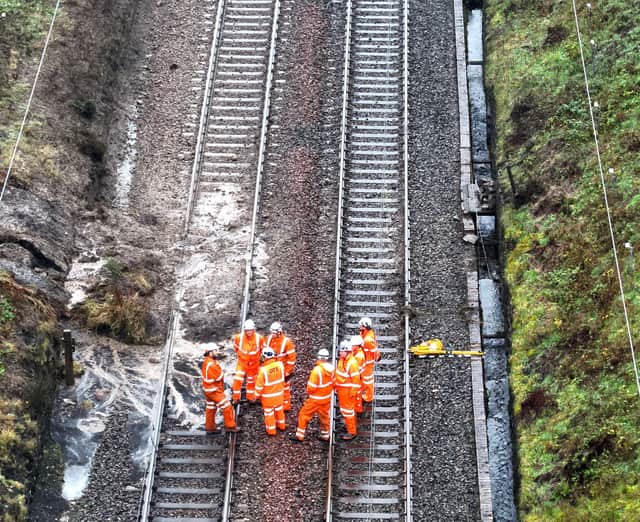
An overwhelmed drainage channel led to the landslide that derailed a Glasgow-London train in which four people were injured, investigators have reported.
They said the channel was unable to cope with the volume of water, leading to the slope above the west coast main line in Cumbria becoming saturated, “initiating the landslip”.

The initial findings from the UK Department for Transport’s Rail Accident Investigation Branch (RAIB) into the incident on November 3 come five years after the fatal ScotRail derailment at Carmont near Stonehaven, which also involved an overwhelmed drain.
The RAIB said its investigation into the Shap derailment, north of Kendal, would examine factors such as the “design, maintenance and management of earthworks and drainage in this area” and the “effectiveness of on-site monitoring equipment”.
The Scotsman has reported an industry source a day after the incident observing that sensors installed to detect movement in the slope above the line appeared to have failed to avert the derailment.
The RAIB said it would also look at “the operational response to adverse weather warnings” and how the Avanti West Coast Pendolino train performed during the derailment.
.png?trim=45,0,45,0&crop=&width=640&quality=65)
In an update published on Wednesday, the RAIB said the train derailed after striking the debris that had been washed onto the track about 6.10am, three miles south of Shap, while travelling around 83mph.
The RAIB said the front wheels of the train, carrying 86 passengers and nine staff, were lifted off the rails to the right before running derailed for some 560m. Four people were treated for minor injuries.
The report said: “The landslip occurred during a period of heavy and sustained rainfall. RAIB’s preliminary examination found that a drainage channel, which runs across the slope above the washed-out material, was unable to accommodate the volume of water which was present.
“This led to the slope material below becoming saturated, initiating the landslip.”
An industry source told The Scotsman: “The performance of the monitoring equipment is key. This is pretty new equipment and is being widely installed.
“So learning lessons and getting it as effective as possible is vitally important as Network Rail struggles to cope with climate change impacts in an efficient and timely manner.”
Network Rail has installed tilt meters or “inclinometers” to detect soil and rock movement since 2022, starting in Scotland, following the Carmont crash.
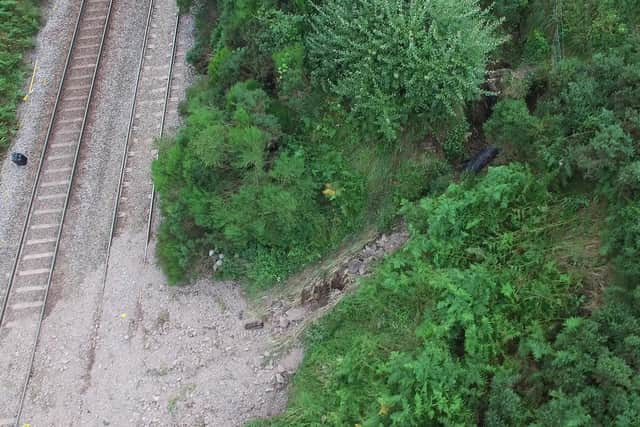
In that incident, an Aberdeen-Glasgow train derailed and hit a bridge parapet, in which the driver, conductor and a passenger died.
The RAIB concluded that a wrongly-built drainage trench was overwhelmed during heavy rain, washing gravel onto the line.
The body said if the drain had been built as designed, “it would have been capable of safely accommodating the flow of surface water that occurred on the morning of August 12, 2020 without causing gravel to be washed away down the steeply sloping trench towards the track”.
In 2023, Network Rail was fined £6.7 million - a record for for safety failings - over what was the worst British train crash for 13 years.
These included over the construction, inspection and maintenance of drains, and adverse and extreme weather planning.
Comments
Want to join the conversation? Please or to comment on this article.