
John Swinney's food price cap plans branded 'undeliverable' as SNP poised for Westminster clash



John Swinney has tabled a flagship policy to cap the price of essential foods on public health grounds.
John Swinney’s flagship plan to cap the price of essential foods has been branded “undeliverable” by the UK Labour government - placing the policy in doubt just hours after it was tabled by the SNP leader.
Mr Swinney has vowed to cap the price of essential supermarket foods to tackle the cost of living crisis and improve public health, but the move has put the SNP on course for another stand-off with Westminster.
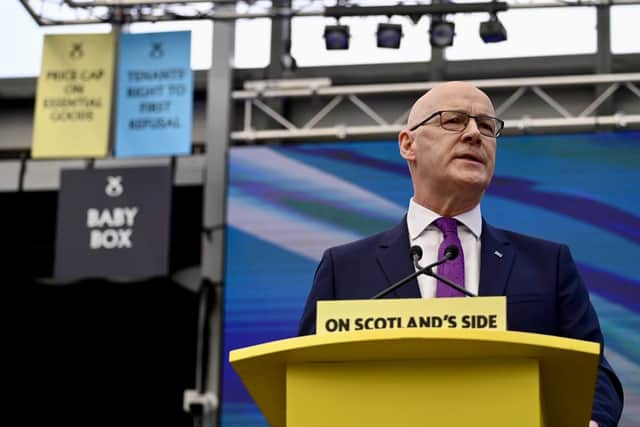
Mr Swinney made the policy pledge in Glasgow while unveiling the SNP’s manifesto ahead of the Holyrood election.
The SNP leader also delivered a commitment to cap bus fares at £2 and set up a £200 “culture pass” for people who turn 18. He also vowed to freeze income tax in the next parliament.
The First Minister’s manifesto also includes a pilot minimum income guarantee for artists, with creatives poised to secure almost £15,000 a year if the SNP is re-elected to office.
Speaking in Glasgow, Mr Swinney argued that “the cost of living is hammering people”, warning that “inflation has come down, but prices have not”.
He said: “People are, quite simply, struggling to afford food. In a rich country like Scotland that is a moral outrage.
“For some, the cost of food is so high, it is hitting their health and wellbeing.”
Mr Swinney admitted that “with the current powers of our Parliament, I cannot normally set prices at the till”, but has argued that “things have got so tough, it is now impacting upon our nation’s nutrition”.
The SNP leader stressed that the situation “is a public health issue”.
“I have public health powers”, he added.

Mr Swinney said: “If re-elected, your SNP government will use our public health powers to set a maximum price for essential food items.”
The First Minister specifically mentioned “bread, milk, cheese, eggs, rice, chicken” for potentially being included in the basket of items that would be subject to the cap.
The cap would not cover the lowest quality, already-cheapest items, with a focus on nutrition. It would also only cover supermarkets and not be extended to small retailers, with Mr Swinney arguing the large supermarkets could “shoulder” additional costs.
He said the policy would “place an obligation on the larger supermarkets…to have an essential basket of items individuals could reliably afford”.
But the policy could be blocked by the UK government, and would require an exemption under the controversial internal market act. Mr Swinney believes his public health argument would mean Labour will not stand in his way and give his plans “legitimacy”.
Mr Swinney added: “I’m making it clear in the manifesto that the UK government has a dimension here that I want to make sure they do not use to undermine the exercise of our properly-constituted public health powers.”
A senior SNP source said: “I assume a Labour government of all colours would not be in the business of keeping food for our poorest people more expensive.”
But a senior UK government source, while not confirming Labour ministers would block Mr Swinney’s plans, branded the proposal “an incoherent and undeliverable policy that risks costing the Scottish government millions in legal bills”.
The source added: “John Swinney has invented a policy more likely to put money in the pockets of lawyers than the pockets of working people.
“The UK government is focused on taking immediate action on the cost of living – like cutting fuel bills now.”
Retail leaders have also criticised the SNP’s plans.
Ewan MacDonald-Russell, deputy head of the Scottish Retail Consortium, claimed that “supermarkets have always run on very slim margins, especially when compared with other parts of the food supply chain”, adding that “profits have fallen significantly in recent times”.
He added: “Even so, retailers continue to invest heavily to keep prices down, expand their affordable food ranges, lock in the price of many essentials, and raise pay for staff.
“Many of the costs keeping shop prices high are now arising from the muddle of new regulations and taxes coming from government policies. Rather than recreating 1970s-style price controls and potty gimmicks, public policy should get serious and focus on cutting retailers’ costs so that resources can be directed to keeping prices as low as possible for customers.”
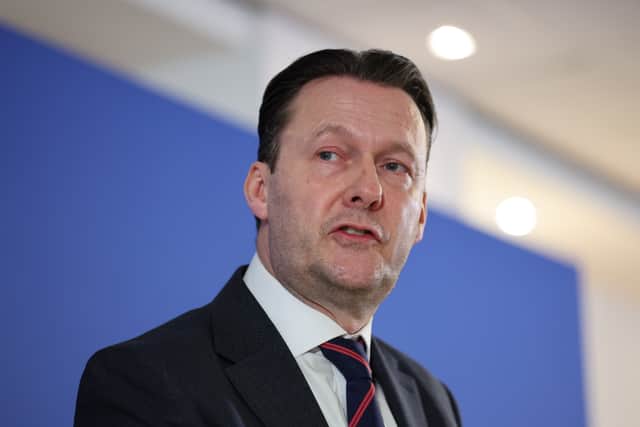
Scottish Conservative leader Russell Findlay said that if Mr Swinney “was serious about tackling the cost-of-living crisis then he wouldn’t have made Scots poorer by hitting them with the highest tax bills in the UK”.
The SNP manifesto also vows not to increase the rates of income tax, or the amount of bands, with the promise to “simplify” the tax regime in a bid to help people struggling with the cost of living.
It is understood merging the bottom three income tax bands could be under consideration if Mr Swinney’s party is re-elected next month.
The First Minister told party members at the manifesto launch in Glasgow he could “confidently” assure Scots that taxes would not rise.
The Institute for Fiscal Studies said Mr Swinney’s manifesto would likely require “further tax rises or deeper cuts to low-priority spending”.
David Phillips, the think tank’s head of devolved and local government, said: “In a pattern familiar by now from several other manifestos in the devolved elections, the SNP manifesto pledges additional spending – costing an estimated £1.4 billion a year by 2031–32 – without credibly saying how it would pay for this.
“A large proportion is from assumed efficiencies, on top of the substantial savings already assumed in existing Scottish government spending plans.
“More likely in reality, paying for these plans would require further tax rises or deeper cuts to lower-priority spending.”
Scottish Labour deputy leader, Jackie Baillie, argued the SNP promises are “not worth the paper they are written on”.

She added: “The SNP still hasn’t delivered on the pledges in their last manifesto – or their 2007 one for that matter.
“If you want to know what dishonest John and the SNP will really deliver, look at their record – our NHS in crisis, schools declining, crime rising, 10,000 children homeless, and roads covered in potholes.”
Scottish Liberal Democrat deputy leader Wendy Chamberlain described the manifesto as a “snoozefest” and a “drab document”.
She added: “Besides their increasingly desperate and dubious claims about independence, the SNP have nothing to offer besides the same sort of implausible freebies they’ve promised and then failed to deliver time and again.”
Comments
Want to join the conversation? Please or to comment on this article.