
Readers' letters: Rumours of the Fringe's death are greatly exaggerated
Readers hold differing opinions on the health and future of the Edinburgh Festival Fringe
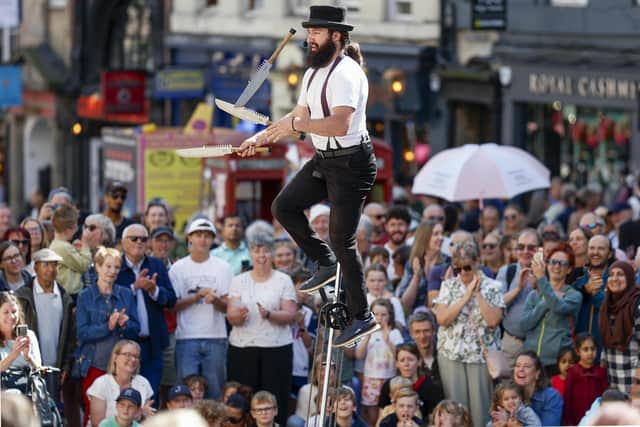
On pages 6, 7 and 8 of yesterday’s Scotsman you ran articles detailing the success of this year’s Festival Fringe, with ticket sales up by 8 per cent and a new record set for the largest number of attendances ever in a single day.
Yet in your editorial you repeat the assertion that the Fringe is in danger because of rising costs. The main complaint appears to be cost of hotel rooms, with Brian Cox complaining that he has had to scrape together £400 for a night’s accommodation.
You claim that the visitor levy is a reason for this. I would point out that the visitor levy on a £400 room would be £20. That hardly seems like a major factor but it is the only element that the city council has any control over. The rest is due to market forces and the same price hikes occur when there are major concerts in the city or events like the Highland Show. You are critical of Councillor Margaret Graham for pointing out this fact but she is absolutely correct. To paraphrase Mark Twain, rumours of the death of the Fringe are greatly exaggerated.

Robert Cairns, Ceres, Fife
Brian’s right
I don’t normally have a lot of time for Brian Cox, but fully support everything he says in yesterday’s Scotsman.
The Festival and Fringe are vitally important and bring a wealth of talent to Edinburgh for us to enjoy every year. Performers must not be priced out of this, and should, at the very least, be exempt from the tourist tax. Given that MSPs believe their second homes should escape that particular tax as they are here to work then so are Fringe performers! I also believe a cap on the number of shows, especially the comedy section, which is too big, would do no harm.
I appeal to those in power to get their act together and address this problem before it is too late.
Elizabeth Towns, Edinburgh
Back Glasgow
I voted for Michael Marra as leader of Labour in Scotland before I knew of his views on downgrading the priority that should be given to reviving the economy of greater Glasgow (your report, 29 August).
I would still vote him because he is the better candidate for the job. But I would hope to convince this fellow economist that, to put it in technical terms, you get more bang from your public investment buck by focusing policy on our neglected largest city.
Countries, especially small countries, depend on their cities to provide the critical population and financial mass that can support the arts, the international conferences and the large-scale sporting events that generate investment, employment and prestige. As John F. Kennedy put it: “Neglecting our cities we neglect the nation.”
Glasgow by virtue of size alone matters more than any other conurbation to the overall Scottish economy in terms of the employment investment and expenditure multipliers.
We need new public and private infrastructures to attract the inward investment necessary to combat the unemployment, poverty and downright shabbiness engendered by years of neglect.
A flourishing Glasgow is miles better for Scotland than the millstone Michael would make it out to be.
Michael Kelly, Giffnock, East Renfrewshire
State of decay
My August bank holiday saw an event that encapsulated the Hobbesian state of nature that now passes for our society.
Whilst taking a large desktop computer out of the boot of a taxi, a car horn was blown very loudly right next to me. I did not even flinch – this being Glasgow, where one swiftly desensitises to an endless cacophony of beeping at the slightest pretext from its temper-fraying one-way system.
However, when I turned round towards the road in order to take the computer to the repair shop across the street, I saw the driver of the car in question, only a few feet away, hastily putting down the mobile phone he’d been pointing in my direction in order to swiftly drive off.
In short, he'd attempted to make me drop what I was carrying (and hopefully physically break) to provide him with content for uploading to some monetised social media site. Having failed with me, in all likelihood others would be similarly targeted that day and in the days to come. The worst of it was not even being surprised, let alone appalled.
Mark Boyle, Johnstone, Renfrewshire
Nuclear baseload
In his letter on nuclear power (1 September), Paul Dorfman talks about Norway, but he doesn’t mention that Scotland doesn’t have Norway’s hydro potential: Norway produces 30 times more per year. Sweden is a better model: the cheapest power in the EU and a mix of wind, hydro and nuclear, like Scotland.
Dorfman offers a scattergun of anti-nuclear statistics, but he doesn’t mention that Torness Nuclear Power station is the most productive, cleanest, most reliable generator in Scotland, and that it cuts bills in Scotland.
The challenge is replacing Torness’s vital baseload. To do that, we should learn from Scotland’s own success on the original Torness project, the fastest and cheapest nuclear build in the UK when it was finished.
That is a better approach than making three overlapping bets on grids – which are already overbudget and delayed – batteries – the largest of which cannot yet replace Torness’s output for longer than a football match – and flexibility, which requires people to change their habits to suit the grid’s shortcomings.
Lincoln Hill, Director of Policy & External Affairs, Nuclear Industry Association, London
Biological reality
Tim Hopkins (Letters, 31 August) is right, in response to Susan Dalgety, that the Supreme Court in the For Women Scotland case did not establish a universal definition of “sex” governing every statute. It was interpreting the Equality Act 2010. But on the law before the Court, Ms Dalgety is correct: for Equality Act purposes, sex is biological.
If Mr Hopkins means that the judgment has no implications beyond that Act, he is wrong. The Court held that section 9(1) of the Gender Recognition Act can be displaced where the “terms, context and purpose” of another enactment show that applying acquired sex would create incompatibility or render its provisions incoherent or unworkable. It agreed that “sex” in the Victims and Witnesses (Scotland) Act 2014 must mean biological sex.
Within the Equality Act, the Court held that “sex”, “woman” and “man” mean biological sex because the alternative interpretation produced incoherence in provisions concerning pregnancy, sexual orientation, single-sex services and associations.
Mr Hopkins also places too much weight on Explanatory Notes. They are not determinative. The Court stressed their limited interpretative role, rejected an example in the GRA Notes after examining how the discrimination legislation actually operated, and elsewhere found those Notes to be “in error” where they did not reflect the statutory wording.
Nor does science establish what Mr Hopkins appears to imply. The existence of trans-identified people is plainly a fact. It does not follow that an innate “gender identity”, distinct from and capable of superseding sex, is itself an “incontrovertible scientific fact”. Human sex is an objective biological classification connected with reproductive organisation.
Respecting people and protecting them from discrimination should not require assent to every belief they hold about themselves, still less rewriting biological reality.
Brian Forsyth, Edinburgh
Swinney’s Buddy
If anyone needed an illustration of the pointlessness of Holyrood, I think that John Swinney has highlighted it. His party intends (supported by their Green chums) to enact another referendum bill (your report, 29 August). No attempt to do anything to develop Scotland’s industry and actually make things here. No. They just want to overspend, over-tax and bleat about independence, rather than doing what the Scottish people have voted for.
We all know that they have no right to hold another referendum after they soundly lost the “once in a lifetime” vote in 2014. Indeed, Andy Burnham, Labour’s answer to Buddy Holly, has indicated that there is zero chance that he will allow another attempt to break up the UK. “Oh, Boy!” he cried when he first received the predictable SNP request and “That’ll Be the Day”. Mr Burnham is said to have muttered “Everyday” in response to the repeated SNP request and I expect that he will have advised Mr Swinney not to “Rave On”. I would suggest that it would have been appropriate if he had commented that “It Doesn't Matter Anymore” after the thrashing received by Mr Swinney’s party in 2014.
I guess that explains why Andy Burnham wears Buddy’s style of specs. And John Swinney? Well, he will just have to admit that it's not “Maybe Baby”, but that he's living in a “Fool’s Paradise” and that it’s “Raining in My Heart”!
Andrew HN Gray, Edinburgh
Mum’s the word
I'm confused. On Friday morning I read that the SNP have published a draft referendum bill, along with a comment by John Swinney that “no-one will make better decisions about Scotland’s future than the people who live in Scotland”. Then an hour later I read of SNP members’ outrage that the annual party conference agenda contains no debates on independence strategy.
It makes sense if you’re John Swinney: he needs around 1.8 million votes to win a referendum; they got 930,000 in the Holyrood elections. Best to keep schtum...ish.
Allan Sutherland, Stonehaven, Aberdeenshire
Write to The Scotsman
We welcome your thoughts – NO letters submitted elsewhere, please. Write to [email protected] including name, address and phone number – we won’t print full details. Keep letters under 300 words, and in the body of the email – no attachments – and avoid ‘Letters to the Editor/Readers’ Letters’ or similar in your subject line. If referring to an article, include date, page number and heading. No poems.
Comments
Want to join the conversation? Please or to comment on this article.