
Readers' Letters: Water isn't the best way to fight historic building blazes
Reopening of Princes Street after fire spurs thoughts from reader
Now the trams in Princes Street in Edinburgh are running again after a costly and inconvenient aftermath of the recent fire, it’s an opportune moment to consider how this was dealt with.
Two points: Considering that there are a number of waterless firefighting techniques available nowadays, it has to be asked why huge amounts of water are still used to douse fires. Water takes a long time to act, and causes much incidental damage, such as collapsing floors under the sheer weight (eg the National Trust's Clandon Park in Surrey, which lost fine ceilings). How about using a smothering foam or one of the chemical fire retardants?
Secondly, there is surely an opportunity here for the Scottish government to bring in regulations requiring free-standing wifi smoke alarms and heat detectors to be used in all buildings under reconstruction (Debenhams and Jenners in Princes Street) or which store lithium batteries (Glasgow Queen Street), or indeed, any building unsupervised at night or anytime.
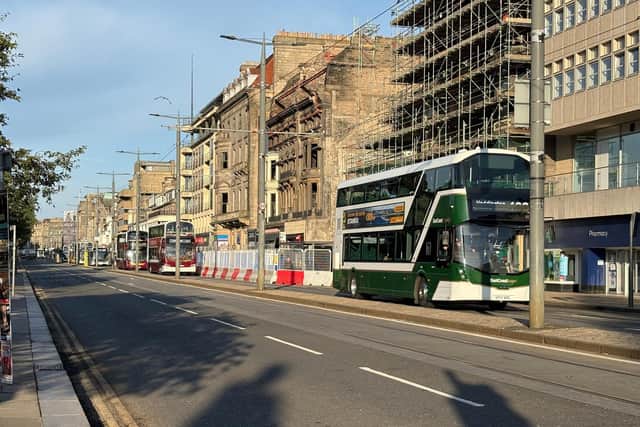

A further point is to highlight the huge difficulties that building owners face in dealing with insurers. The Elephant House in Edinburgh has managed to reopen after being closed for years, and the Glasgow School of Art is a national scandal. In a related matter, I wonder if Edinburgh's latest disgrace, the building on the corner of the Lawnmarket, covered for years now in scaffolding, will join the others in contributing to global warming.
Is this not a suitable concern to be dealt with at government level?
Paul Dimarco, Edinburgh
Out of ideas
Scottish MSPs return to Holyrood after a very long summer holiday. One might assume their priorities would include doing something about failing educational standards, helping an NHS on its knees or indeed, helping business create jobs and wealth.
However, after so many years of an incompetent SNP government I’m afraid my naivety takes centre stage as it seems their priority will be led by a draft Bill on Independence. Is this just throwing some red meat to the fanatics or is it that the SNP are completely out of ideas to fundamentally fix the issues facing Scotland? Regretfully it seems it is the latter.
Richard Allison, Edinburgh
Draft failure
Susan Dalgety is wrong to claim that last April the Supreme Court “settled, once and for all, that in law sex is biological” (Perspective, 29 August). In paragraph 2 of their judgment, the Court made clear that their ruling applied only to the Equality Act 2010, not to other law, and not to the meaning of “sex” in other contexts and policies.
The Court noted that the UK government's Explanatory Notes for that Act stated that its effect would be the opposite to the Court's interpretation. And government ministers confirmed that intention, in debates in Parliament. But the Court's job was to focus on the wording of the Act, and they concluded that it meant the opposite to what the government had said they intended. Not well drafted!
It is difficult for the large majority of us who are not trans to understand what it must be like to find that your gender identity is different from the sex registered for you at birth on the basis of your appearance. But the reality of trans people is incontrovertible scientific fact. The question is whether we treat trans people with respect, fairness and support, or refuse to accept that they really exist, and treat them with malice and ill-will.
Tim Hopkins, Edinburgh
A good move
I was delighted to see new Prime Minister Andy Burnham has blocked the early release of those found guilty of manslaughter, although the fact it took so long to come to that decision still says a lot about how lawyers and civil servants make the wheels of Westminster grind slowly. It does make a positive change from the strictly legal interpretations of former former prime minister Sir Keir Starmer and former Attorney General for England and Wales Lord Hermer, who never seemed to be on the side of law-abiding citizens in even the most basic of ways, despite it being a core responsibility.
Now that the early release decision has been made, perhaps Mr Burnham will decide not to cede the Chagos Islands and then pay £30 billion for the “privilege” of using them for what we already do. The ruling from the International Court of Justice was not one of its normally binding rulings and the needs and desires of the Chagosians were not taken into account. Mr Burnham has a chance to rectify this by revisiting the whole proposal.
So, a positive start from the new PM – let’s hope he doesn’t tax us further to death (and beyond). The October budget will be a test of whether Labour does what is needed to help grow the economy – actions rather than words – or continues to kill enterprise and jobs with high taxation and regulation. He might even allow us to use our own gas and oil from the North Sea!
Brian Barbour, Haddington, East Lothian
Pitch pooches
While serving with the RAF in Germany in 1957 I went to the Dusseldorf Fortuna v Bolton Wanderers football match. It ended with a pitch invasion and the German police released six German Shepherd dogs, growling and barking towards the invaders. The invasion ended in two minutes flat.
Alastair Paisley, Juniper Green, Edinburgh
Dry language
Please pass my thanks to Denise Richmond of Scottish Canals for adding a new word to my lexicon – “dewatering” (“Major repairs to historic Kelvin Aqueduct which sprung a leak will keep Forth & Clyde Canal closed for a year”, 30 August). That’s up there with someone being “unalive”. The English language can be very accommodating in its usage.
Charles Lowson, Fareham, Hants
Write to The Scotsman
We welcome your thoughts – NO letters submitted elsewhere, please. Write to [email protected] including name, address and phone number – we won't print full details. Keep letters under 300 words, and in the body of the email – no attachments – and avoid 'Letters to the Editor/Readers’ Letters' or similar in your subject line. If referring to an article, include date, page number and heading. No poems.
Comments
Want to join the conversation? Please or to comment on this article.