
Why Scotland's first-ever 'megafire' is even more alarming than it sounds
With warmer weather drying out peatland, wildfires are increasingly able to release vast amounts of greenhouse gases into the atmosphere

When I was a child, the advertising slogan “there’s nothing like coming home to a real fire” was one I very much related to. I grew up in homes with coal fires, anthracite (special coal) boilers and electric cookers. We had no gas and it always seemed different, strange, even alien. News reports about the occasional exploding house left me with a lasting suspicion of its sinister hiss.
My first encounter with a peat fire was as a student, living in a cottage just north of Aberdeen. It was a lot nicer to handle than coal, and seemed a gentler, more ‘natural’ experience altogether. In many ways, peat made the perfect fire, or so I thought at the time.
Fast forward nearly 40 years, and attitudes to home heating have changed. Coal and peat are out, gas boilers are ubiquitous and heat pumps appear to be the coming thing. However, for all our efforts to decarbonise, vast amounts of peat are still being burnt, although perhaps not so much by us any more. Instead, nature is taking over from where some of us have left off.
READ MORE: Fire crew battle wildfire near Edinburgh's Arthur's Seat as smoke visible for miles around

UK ‘experiencing extreme wildfire conditions’
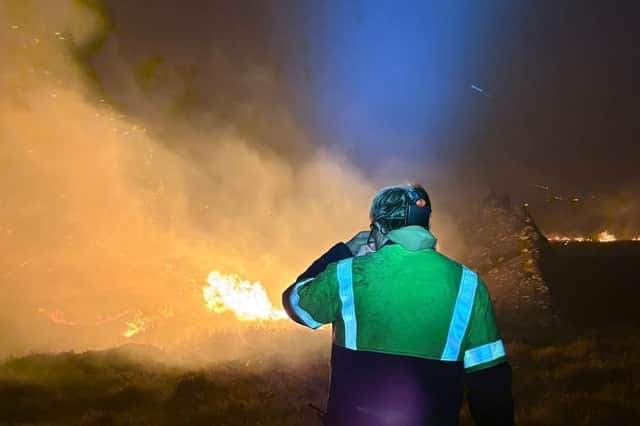
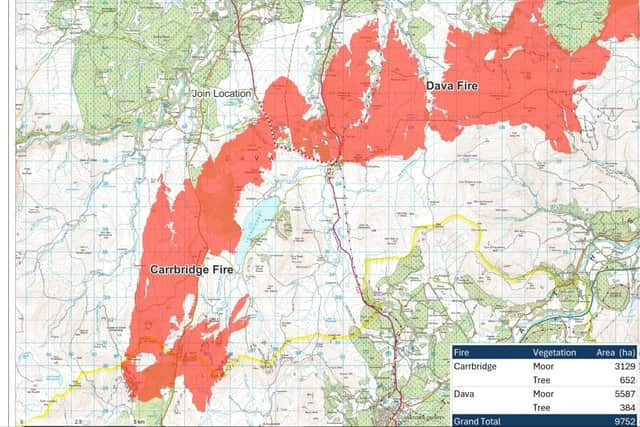
The Dava Moor fire, near Carrbridge in the Highlands, raged for four days in June and July last year. However, according to a new scientific study involving researchers from Stanford University in California – a state that’s no stranger to devastating wildfires – in that short time, it released an estimated 38,600 tonnes of carbon into the atmosphere. That’s equivalent to about 85 per cent of the UK’s total wildfire emissions in a normal year.
The size of the fire, which burned more than 10,000 hectares of land, prompted the researchers to declare it to be “the UK’s first megafire”, a term used in the US to describe the worst conflagrations. Just as Scotland’s climate and weather are changing, so too is our language. It’s a word we can expect to hear more often in the coming years.
“Fires are becoming larger and more severe in many ecosystems worldwide, resulting in increasing ecosystem impacts and carbon emissions. Changing wildfire regimes in peatlands, which have rarely burned historically, are especially concerning,” the scientists wrote in the journal Nature Geoscience.
“In the UK, a country where fires are usually small, often managed and not severe, the scale of this wildfire is unprecedented... We propose that these findings highlight that the UK is experiencing extreme wildfire conditions that make peatlands especially vulnerable and give insight into how temperate and northern peatlands may change with global warming.”
Burning peat worse than burning forests
Using data from Nasa monitoring satellites, a separate study found that “extreme wildfires have become more frequent, more intense, and larger” over the last two decades, with carbon emissions from forest fires increasing by 60 per cent worldwide between 2001 and 2023.
This is not quite as bad as it may sound, as forests usually grow back after they burn, soaking up a similar amount of carbon from the atmosphere. Too many fires, however, can result in the forest turning into scrub so that the carbon is not reabsorbed in this way.
Peatland, like the area burned by the Dava fire, is different. It is normally protected against fire because its boggy and wet. However, warmer temperatures and some types of land use have been drying it out. And while a blaze can rip through large areas of peat in a few days, sending vast plumes of carbon into the atmosphere, recovery can take centuries.
It gets worse. Peatlands only cover about 3 per cent of the Earth’s surface, but they contain almost a third of the world’s carbon – double the amount contained in all its forests. So burning peat is much more worrying for the fight against climate change than a forest going up in flames.
Not just a global warming problem
Last year, a major report compiled by 160 scientists from 23 countries included peat bogs in its list of potential climate tipping points, in which natural systems start to make global warming worse.
“The world has entered a new reality. Global warming will soon exceed 1.5 degrees Celsius. This puts humanity in the danger zone where multiple climate tipping points pose catastrophic risks to billions of people,” the Global Tipping Points Report warned, pointing out that crossing one tipping point would make it more likely that others would be triggered, potentially creating a cascading effect.
Of course, wildfires are not just a global warming problem. In June 2023, one burned the back garden of a home in Daviot, south of Inverness, while in July 2022, more than 60 houses were destroyed by wildfires in London and other parts of England.
In March, Calum Kippen of Bright Spark, a specialist firm offering muirburn and wildfire management training, warned MSPs: “There are villages within the Highlands that are in imminent danger from wildfires. The Carrbridge fire could easily have ended up in Grantown-on-Spey.”
Now Scottish Land and Estates, a landowner membership body, has said that the threat can “no longer be treated as an isolated issue” for firefighters alone, with the need for muirburn, vegetation cutting, and grazing by livestock to reduce the amount of flammable material as a fire prevention measure. I’m no expert, but those sound like eminently sensible responses to the growing dangers.
However, regardless of how much vegetation we cut back, there will always be something to burn and, for as long as global temperatures continue to increase, both the fire season and fire ranges will continue to expand. Reducing carbon emissions to net zero is the only real solution, and one that will get more difficult with every peatland wildfire.
So one day in the future, you could return home to discover that a “real fire” has destroyed your house – or, indeed, we all could.
Comments
Want to join the conversation? Please or to comment on this article.