
UK unprepared for wildfires almost a year on from Scotland's 'megafire'

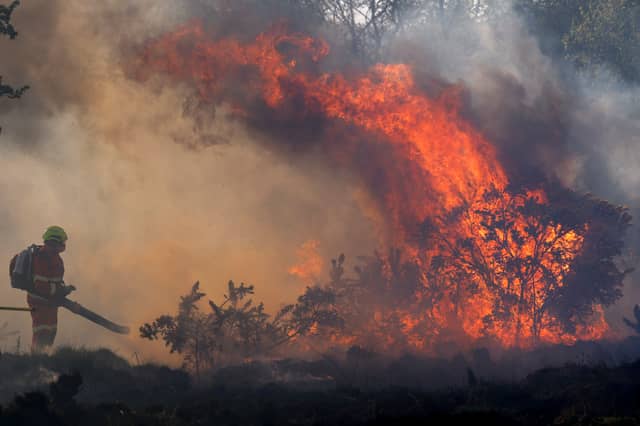

The warning comes as May is set to reach record temperatures.
The UK is unprepared for wildfires despite Scotland seeing what was believed to have been the biggest wildfire incident on record last year, rural experts have said.
Estate membership organisation Scottish Land and Estates (SL&E) warned Scotland needs a more Integrated Fire Management Strategy to prevent future devastating damage to wildlife.
Gamekeepers, who are often heavily relied upon to extinguish flames and prevent them spreading, have also warned rural villages and towns are in “imminent danger” from increasingly intense wildfires.
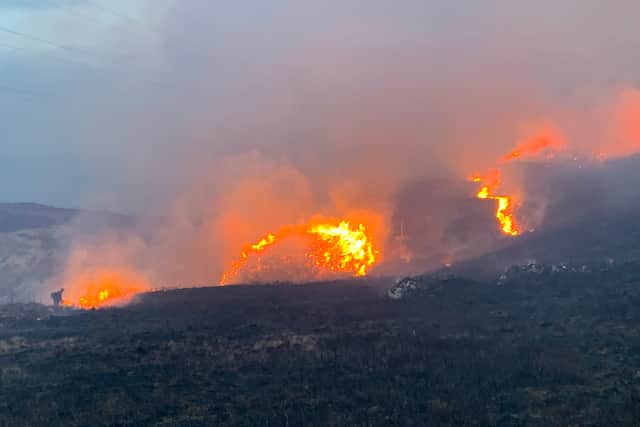
The warnings come many parts of the UK are expected to see temperatures reach a new record high for May, potentially adding to the wildfire risk.
Last year’s wildfires across Carrbridge and Dava in Strathspey devastated the same amount of land as is typically burnt across the UK in an entire year (an estimated 29,225 acres), SL&E said.
The organisation said an international team of researchers have classified the wildfire event as the UK’s first ‘megafire.’ The researchers said the blaze released carbon equivalent to 85 per cent of the average annual emissions from fires across the UK in the 20-year period from 2001 to 2021.
Ross Ewing, director of moorland and strategic projects for SL&E, said: “As our climate changes, wildfire can no longer be treated as an isolated issue which UK fire services can manage on their own. It is a land management, climate resilience, public safety and rural economy issue, that demands a stronger national response rooted in prevention as well as response.”

He said practical interventions including muirburn, vegetation cutting, grazing by livestock and coordination between neighbouring landholdings are essential to reduce the risk of a wildfire and to improve a collective response if and when a fire breaks out.
“One of the lessons from the Carrbridge and Dava wildfire was that where fuel loads are managed and land managers are organised at a landscape scale, containment can be faster and more effective,” he said.
SL&E has argued that wildfire policy should prioritise a reduction in ‘fuel load’, the term given to combustible vegetation in an area, as a central wildfire mitigation strategy and support a range of measures including muirburn, mechanical cutting and grazing.
SL&E warned earlier this year that tighter licensing of muirburn, due to come into force this autumn, may constrain effective fuel load management, which would weaken both wildfire prevention and operational suppression.
Others, however, argue that the practice, which involves the controlled burning of heather, should be regulated more. Campaigners have warned controlled burns can pose a risk to triggering wildfires. Environment blogger Nick Kempe analysed recent satellite-derived data from NatureScot to find that a main cause of wildfire in the Cairngorms National Park was most likely caused by ‘muirburn gone wrong’.
Meanwhile, research released by the James Hutton Institute (JHI) argues there is little overlap between muirburn and wildfires. The JHI said its Scottish Government-funded study of muirburn and wildfires looked at evidence of wildfires over 442 sq km of Scotland’s moorlands over a five-year period and found 96 per cent of them were outside of muirburn areas. Scottish Fire and Rescue Service’s wildfire chief Michael Humphreys said muirburn is an important tool for reducing wildfire risk.
Mr Ewing added: “Future policy must strike a workable balance between environmental objectives and the practical need to maintain resilient landscapes that are less vulnerable to severe wildfire events.”
Earlier this year the UK's Regional Moorland Groups formed a Wildfire Commission, to establish how effective, practical wildfire fuel load management should be undertaken across the country's upland landscapes, and how fuel load management can be delivered at scale. The first meeting of the Wildfire Commission was attended by UK academics, fire fighters and land managers.
SL&E, which worked with ministers and the Scottish Fire and Rescue Service to develop the UK’s first Strategic Action Plan on Wildfire, pointed to the Scottish Government’s Strategic Action Plan for Wildfires as a positive example of the kind of coordinated, multi-agency and cross-departmental approach that should now be implemented across the UK, bringing together prevention, preparedness, response and recovery. It said partnership working and locally responsive funding schemes are key to enabling an effective response to wildfires, particularly in remote areas and for small landholders.
Comments
Want to join the conversation? Please or to comment on this article.