


Have you ever looked at a map of Scotland (particularly the Scottish Highlands) and thought to yourself “what is going on with these place names?” The linguistic landscape of the country reflects a rich heritage of tongues such as Pictish, Old Norse and Gaelic which have led to famously mispronounced Scottish place names.
Gaelic’s influence on our maps is particularly strong, however, as it was at its height in Scotland around one thousand years ago meaning it imparted thousands of familiar place names with Celtic elements even in the Scottish Lowlands where Scots Leid became the preferred tongue.
With a heritage totally unique to English, it is understandable why non-Gaelic speakers are beguiled by Scottish place names which - regardless of being anglicised - feature unfamiliar letter combinations and pronunciation. However, even a basic understanding of Gaelic helps us to discover the full richness of the Scots landscape; especially as nature is at the heart of the language.
By doing so, we can unlock “so much about the past” as it tells us “about landscapes, social structures, land ownership, flora” and folklore, according to Dr Simon Taylor who is a reader in Scottish Name Studies at the University of Glasgow. Dr Taylor, who learnt Gaelic in adulthood, explains: "It’s a bit like detective work to get an idea where the name came from.
"As somebody who is very interested in language and landscape it fascinates me - they are a wonderful bridge between the two."
He remarked on how Munros (a Scottish word for ‘mountains’) feature many ‘evocative translations’ and that is where many people first encounter Gaelic and ‘spark a life-long interest’ in it. For example, Ben Nevis can be translated as the ‘venomous’ or ‘malicious’ mountain in Gaelic - fitting given recent events like the lightning strike that shattered a rock structure at its peak.
Of course, we can get by without such knowledge but doing so means forfeiting landscape literacy. Scotland’s lochs, rivers, glens and hills all feature lingual heritage terms that impart a hidden lore that remains forever inaccessible to those who are oblivious to it.
To better understand this ancient relationship between people and places, here is an essential guide for beginners to get you acquainted with Scotland’s most-used Gaelic vocabulary.
Note: Stay until the end for our “wee quiz” that tests your Scottish scholarliness and, if hungry for more, go to the Gaelic Place-Names of Scotland Database or Learn Gaelic for pronunciation help.
21. Adjectives
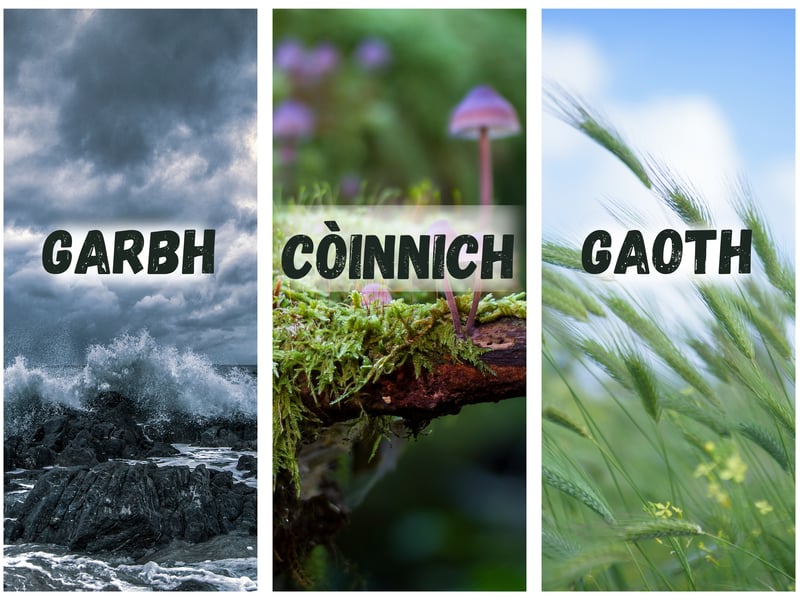
We know basics like Mòr (“more”) for big and Beag (“bek”) for little. Other handy words include Garbh (“garav”) for rough or coarse, Còinnich (“coh-nyeech”) for mossy and Gaoth (“goo”) for wind. In the Hebrides you may find Eilean Garbh (Rough Island), by Loch Lomond there is Conic Hill (Mossy Hill) and in the Highlands we have Sgòr Gaoith (Windy Peak). | via Canva Pro
22. Wee Quiz
Think you know your Bens from your Glens or your Auchs from your Lochs? Test your skills with the next four examples that mix and match terms from the Mountaineering, Wider Terrain, Water Features and Architecture sections. Simply scroll down to the point you see their names but don’t scroll as far as the text that holds the answer until you’re sure. Note: Gaelic anglicisation is often inconsistent, look out for vocabulary resemblance e.g., house (Taigh) appears as Tigh, Tay or even Tea. | via Canva Pro
23. Ardbeg and Kilmore
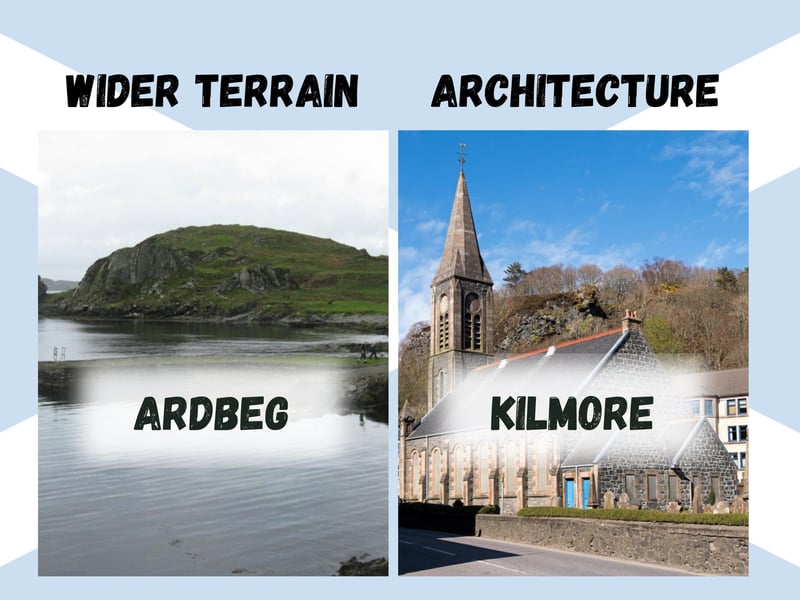
Ardbeg - yes, the whisky - combines Àrd (High Place or Height) and Beag (Small) for the “little height”. Kilmore combines Cill (Church) and Mòr (Big) for “the big church”. | via Canva Pro
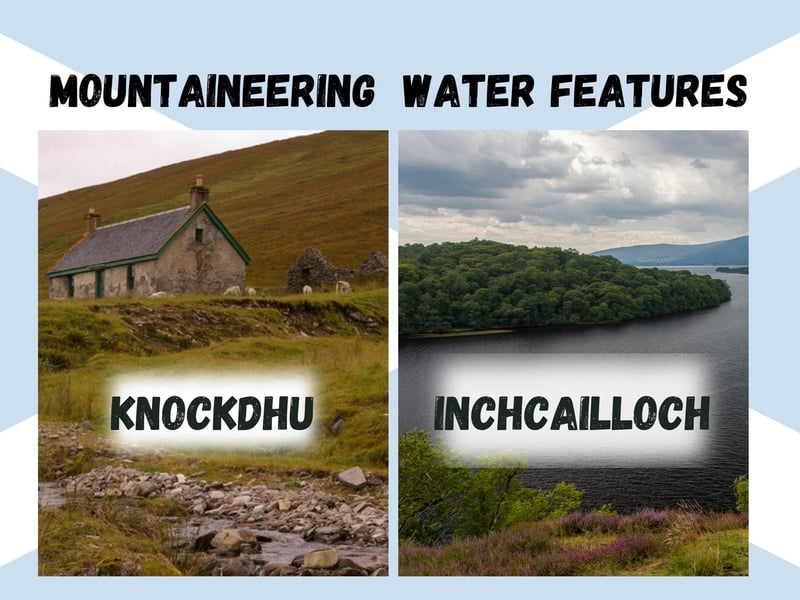
24. Knockdhu and Inchcailloch
Knockdhu combines Cnoc (Hill or Hillock) and Dubh (Black) for the “black hill”. Inchcailloch combines Innis (Island) and Cailleach (Old Woman) for “Island of the Old Woman”. How did you do? We hope this guide brings you closer both to Scotland’s beautiful terrain and to the Scots who roamed it long before us; appreciating the insights they imparted in Gaelic. | via Canva Pro