
How philosophy is helping pupils bridge the gap between primary and secondary

Philosophy might not be the obvious choice for raising attendance but a project in Dundee is helping pupils tackle life’s big questions - and making them keen to come to school
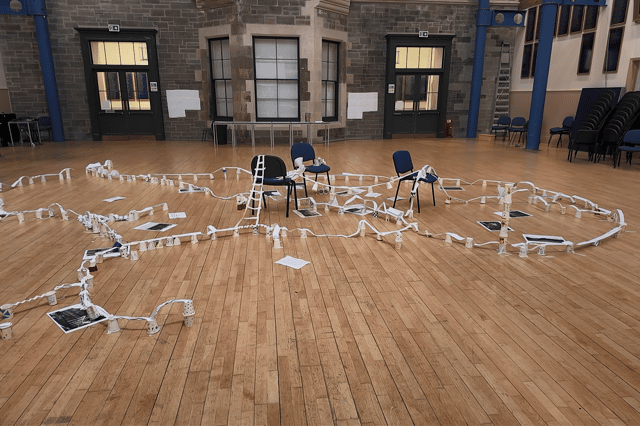
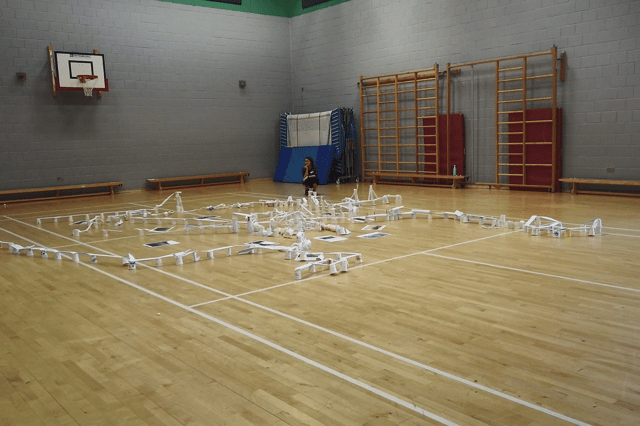
In the centre of the grand hall is an interlocking series of paper bridges, connecting anchor points that tell local stories.
Winding across the floor, they share photographs and tales from generations of Dundonians.
But as well as being visually arresting, the art work is a way of both helping children navigate their lives’ biggest questions - and boost school attendance.
These stories are the work of pupils from Morgan Academy’s cluster schools who are taking part in an innovative project with Dundee University’s philosophy team.
The project has a lifespan that started in 2018 when inspiration struck during a conversation between Dr Dominic Smith, a philosopher, and Dr Anna Robb, of the education department.
Dr Robb and Dr Smith discovered a shared interest in thinking about how children consider life’s big questions.
Covid came in the way of starting the project immediately but it was up and running properly in 2022.
There are three elements to the project: helping pupils transition from primary to secondary; academics work with teachers to help inform their practice; and new graduates have the chance of employment working in schools.
Dr Smith said: “The reason we work with P7s going in to S1 is because we think they are living through philosophy, and they are encountering big questions like why is the world changing, how do I make connections with new people, and what should adults hear in children's voices?”
The sessions in both P7 and S1 try to “chart three worlds” and, Dr Smith says, “the kids change massively over the course of that period.”

“They are palpably grasping philosophical questions and exploring big questions together, learning change, connection, listening.”
The academics use art to lead the exploration of these subjects, from a printing press experiment to using the Tay Bridge disaster as a focus of an art project.
A mentimeter, a type of word cloud, as another example, demonstrates epistemic certainty and issues of trust.
Morgan Academy began its partnership with the University of Dundee in 2022.
The school wanted to focus on the transition of P7s from local primaries coming up to the high school for S1.
While many schools will have two transition days in June, for more vulnerable pupils or those with additional support needs (ASN) they need a much more comprehensive transition period - as much as a full year.
One of head teacher Gregor McBain’s main goals was to add a third transition day in June to help prepare new pupils - and Localising Philosophy seemed like the perfect choice.
“What it offered us was something very different from the traditional sampling of classes or trying sports, so we thought it sounded great,” Mr McBain said.
What the school didn’t want, however, was someone “parachuting in”, giving a presentation and then leaving again.
“We’d agreed that probably wasn’t going to be effective so we worked with Dominic to ensure he was working across our four cluster primary schools and that the work was carried out over a few months,” the head added.
The way Mr McBain describes it, the primary sevens learn about how the brain makes associations and builds bridges onto the next stage of their lives.
“What we talk about is bridging; the philosophy of bridging between primary and secondary, but also bridging into a different community,” Mr McBain said.
As part of the project, pupils work in small groups to create the interlocking bridges that take up the whole floor space, connecting their feelings and thoughts.
“We find it,” Mr McBain said, “Really powerful, the realisation that they already have connections here.”
Attendance rates at the school for S1 have increased since the philosophy project was added to the transition programme.
The head teacher added: “Pupil feedback, that sense of belonging and safety in the pupil survey that we do comes across quite strongly as well.”
While philosophy is an unusual topic for a primary school pupil, Mr McBain says they get in at the “right time” to persuade pupils the subject is accessible.
He said: “We do have some who think, ‘Maybe this isn’t for me,” but we manage to get them out of their comfort zone.”
Dr Smith specialises in the philosophy of technology, a vast topic for young people navigating a rapidly changing world.
“Technology is a huge problem that children are facing in terms of how it shapes the world,” he said.
“It's a competitor for the school and the university and the parliament, it changes our institutions.”
Dr Smith and Dr Robb would like to expand the programme, which has worked with 2000 pupils over the past five years, by adapting it to local events.
Dr Smith said: “We want to take the big questions and make them very, very concrete for groups that we owe a duty to.
“Children will live with the the ecological legacy, the political legacy, with the information economy legacy of AI.”
Dr Smith says he learns as much from the teachers and the pupils as they learn from him - particularly changing new internet vernacular.
Everything new is old, however.
Fun fact: the first person to use the phrase "brain rot" was the American writer and philosopher Henry David Thoreau in the 1850s.
He said: “What I hope pupils get out of it is the capacity to realise that something like philosophy isn't abstract, and that it need not be a career either, it can be a supplement.”
Mr McBain is slightly more circumspect.
“I want to create a sense of belonging in school to help our kids raise attainment and attendance,” he said.
“I’d love to say we’d nailed attendance but no school has.
“But the more opportunities you can create to have that sense of belonging then you are creating societal improvement and that’s when good things happen.
“By no means have we got it right for all of our kids but that’s what you’re working towards.”
Comments
Want to join the conversation? Please or to comment on this article.