
Exclusive:'No regrets': The man who could be managing Denmark against Scotland if cards had fallen differently
Former Celtic and Dundee man put health before career

Anyone who has watched the grainy eight-minute video on YouTube charting Morten Wieghorst’s fightback from Guillain-Barré syndrome will know the Dane’s bravery cannot ever be called into question.
An emotional tour de force, the short film outlines the extraordinary effort involved. It’s therefore startling to hear Wieghorst now describe having to inform the Danish Football Association that he could not fulfil his first assignments as interim head coach due to stress symptoms as perhaps the toughest moment of his life.
One year ago this week, his heart was meant to be swelling with pride at Parken stadium in Copenhagen before a Nations League clash with Switzerland. As manager, albeit interim, of his country, it should have been the realisation of a dream - he had even already installed former Liverpool defender Daniel Agger as his assistant. But instead of standing with his arm around Agger as the national anthem struck up, he watched this game, and the one after it against Serbia, on television. The Danes won both matches 2-0.
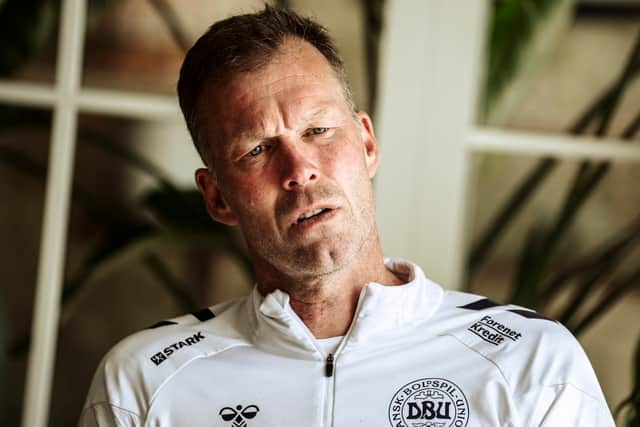

“When I had to call off, I had a couple of weeks to try and get better,” Wieghorst recalls. “I rested a lot. By the time the first game came around, I was better. I did watch the game. Fortunately, the squad I had been part of putting together did very well.”
Now back serving in the role of assistant manager ahead of Friday’s opening World Cup qualifier against Scotland, one Danish newspaper has described him as “the national coach Denmark never had”. He recognises the likely cost of that phone call to his bosses last August. It doesn’t alter his conviction that it was the right and indeed only thing he could do.
In an exclusive interview with The Scotsman, the first thing to establish during a 40-minutes long conversation with the popular former Dundee and Celtic midfielder is that he’s back fighting fit. Mercifully, it seems that he is.
Our appointment has been slightly delayed due to a problem with the steering wheel in his car – “it was like driving a vintage car,” he says – which meant he had to get a train home to pick up a replacement. The urgency was because he’d been “silly enough” to put his name down for a legends’ game later the same day to celebrate the 125th anniversary of amateur team Norre Alslev BK, based 100 kms south of Copenhagen. Teammates included former Liverpool and Ajax midfielder Christian Poulsen.
Wieghorst’s involvement alone – he scored in an 11-0 win for the old boys – is heartening evidence that all is well. “I missed the September international games last year, due to circumstances,” he begins to explain. “And then I came back. I had to be careful for a couple of months but I am back to normal now. That’s the main thing. And I am still enjoying it.”
‘Health is the most important thing’
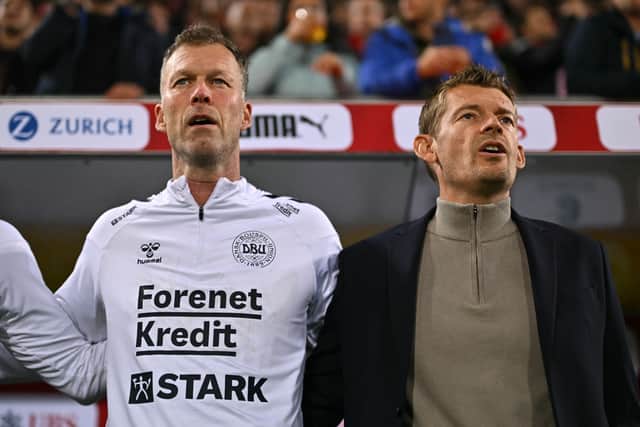
He has been a long-time assistant manager of the national team after being appointed by Kasper Hjulmand in 2019. After Hjulmand stepped down following last summer’s Euros, where Denmark were beaten by Germany at the last 16 stage, Wieghorst, who has also managed the Danish Under-21 side, seemed the natural choice to take over. The Danish FA agreed, installing him as interim manager for all six Nations League matches with a view to taking the role on a full-time basis. Shortly before the first games, Wieghorst had the sense to listen to what his body was saying and went on sick leave. Despite a seemingly enviable life-work balance, a study by the Danish government earlier this year concluded that one in five Danish working people struggle with stress. He is far from alone, in Denmark and elsewhere.
“It was a combination of work-related things and private things,” Wieghorst explains. “It was not an easy decision to make, of course. It was a big thing to be the head of the national team. But at the end I had to take this step unfortunately. Because health is the most important thing that we have. And it was tough in many ways. Basically, I don’t regret it. I have always been that kind of person. Things happen for a reason. You make decisions for various reasons. What I keep coming back is that I am healthy now and I am enjoying what I am doing and that is the main thing. I cannot look too much to the past. I never have done. But obviously, it was tough at the time.”
When Wieghorst says health is the most important thing, he is speaking as someone who knows. It’s 25 years ago this month since he noted being exceptionally tired after a reserve game for Celtic at former club Dundee’s Dens Park. He was on the comeback trail after a serious knee injury, so was not duly unconcerned. He was aware he had been pushing himself physically. He was included in the travelling party for a Uefa Cup trip to play HJK Helsinki later that week. There was no expectation that he would play but new Celtic manager Martin O’Neill wanted to make him feel part of the new era.
As well as dog-tired, Wieghorst felt his balance had gone awry on stepping off the plane in Finland. These were the first symptoms of the rare neurological condition Guillain-Barré syndrome. Shortly afterwards, he was on a ventilator in intensive care. Thoughts of a Celtic comeback seemed fanciful as he fought for life and yet remarkably, just over a year later, he returned to the side for the first time competitively in an 8-0 League Cup thrashing of Stirling Albion.
Last year’s health crisis was not associated with this illness. “But I tried to learn from the past,” he says. “At that time, With the Guillain-Barré syndrome, there is no doubt that I really pushed myself in some respects a step too far. That was on my mind as well with this thing as well. Even though you might want to push yourself and move forward, you have to make decisions to try and protect yourself. I tried to use the past in my favour.”
He accepts the price might have been giving up the chance to ever manage the Danish national team, having won 30 caps as a player. Brian Riemer, Thomas Frank’s former assistant at Brentford, was appointed in October. One wonders if the Danish FA might have held the position open a little longer. But with World Cup qualifying on the horizon, as well as League A Nations League commitments, Wieghorst understands they could ill-afford to sit still.
“I was not close to the process,” he explains. “They wished me well. I had all the support I could ask for. They must have been in a difficult situation because they didn’t know how long I as going to take and this is all about timing, isn’t it?
“If the right person or the right coach is there and available then you have to act which is what they did. But the new managers and new management wanted to keep me, which was nice. Now it seems like quite a bit of time ago, but it is only a year. I think it was a consideration (to keep the position open) but they did not know how long this would be.”
‘Managers are only human’
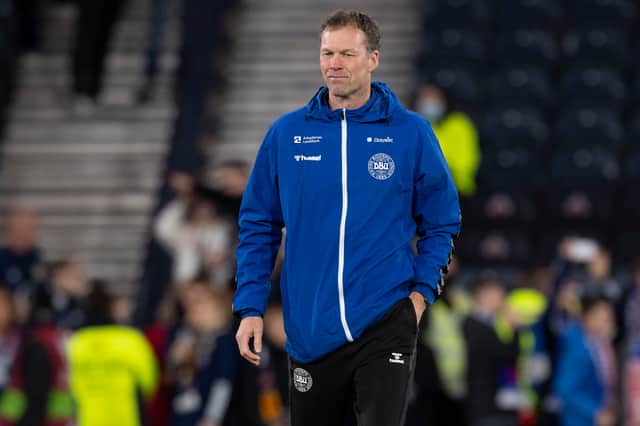
Wieghorst is back as an assistant along with Lars Knudsen, who stepped in for him last year. As favourites in a group containing Greece and Belarus along with Scotland, the pressure is on Denmark. Wieghorst admits he felt the strain last summer, when Denmark drew all three group games and then fell foul of dubious VAR decisions to exit at the hands of the hosts. Having reached the last four at Euro 2020, where they lost in extra time to England, expectations are high in Wieghorst’s homeland, as too is scrutiny. Goalkeeper Kasper Schmeichel was described by one Danish newspaper as playing “like a polio-stricken child” in the 5-2 Nations League semi-final defeat to Portugal earlier this year. It can be an unforgiving landscape. “It’s just the way it is these days,” says Wieghorst.
Not everyone has his sense of fair play. He once received an award from the International Olympic Committee for intentionally missing a penalty for Denmark in a friendly against Iran, one of whose players picked up the ball after mistaking a whistle in the crowd for the referee’s. On the subject of the unrelenting demands of the professional game, Wieghorst is realistic. Criticism is part of the deal.
“It is (difficult),” he says. “It’s the beauty of the whole thing. Professional football is all about passion and the fan base and so on. At the same time, when teams and players and managers don’t live up to expectations, it can be tough. But, of course, there’s a limit to how much a manager can accept, if it’s violent or totally foul abuse. Other people have to stand up to protect the managers as well, because it’s not the way it should be. I accept fans can have expectations when it comes to big clubs and nations but you have to try and protect the managers a bit. They’re only human as well.”
Now 54, Wieghorst still harbours ambitions to be his own man again. He has been regularly linked with the Dundee manager’s position on the many occasions it has been available although he has not ever held any serious discussions with the owners.
As well as the Danish Under-21 side, he has enjoyed spells in charge of FC Nordsjaelland, Aarhus GF and Aalborg BK in his homeland. It remains a desire to manage again but he’s happy to let life unfold for now.
“Things have not changed in that respect,” he says. “I can see myself doing that, I am not saying I will. This is all about timing as well and if the right opportunity comes up. I may just continue what I am doing as an assistant coach, which I am enjoying. I do not know. It’s not as if I am saying: ‘No, management is not for me’. Because we thrive under pressure as well. Pressure is not always a bad thing. It is the exciting edge as well.”

Memories of Scotland
He will feel it on Friday, against the country to whom, he says, he owes so much. A move to Dundee from Lyngby opened doors and saw him win his first international cap, while playing in the Scottish second tier. Such progress prepared the way for a later move to Celtic.
When he visits Hampden in November for the return match against Scotland, with qualification potentially on the line for both teams, it will be 30 years to the month since he graced the turf of the stadium for the first time in Dundee’s 1995 Coca Cola Cup final defeat against Aberdeen.
He made a pivotal contribution to the quarter-final win over Hearts, scoring the winning penalty after a 4-4 draw and scoring Dundee’s fourth with a corkscrewing shot that flashed past Henry Smith in the goalkeeper’s final appearance for the Tynecastle club. Wieghorst ranks it in his top ten goals. “It’s one of the goals I do remember vividly,” he says. “I do not think I scored a goal similar to that from that kind of distance.”
All these memories, he says, bring him joy but do not lessen his desire to see Denmark profit at the expense of Scotland and others in the coming weeks.
With children Sofie, who was born in Glasgow but now studies in New York, and Sebastian now grown up, he and wife Anna have moved from Aarhus back into downtown Copenhagen, where he last lived for a short spell before joining Dundee in 1992. He says he is enjoying the hustle and bustle. But like when he elegantly patrolled midfields as a player, he is conscious of the need to tap into an old ability to find space and time in crowded areas to maintain a sense of well-being.
Comments
Want to join the conversation? Please or to comment on this article.