
John Swinney's plan to slash NHS boards faces fierce union backlash

Unite accused the First Minister of setting out a ‘slash and burn programme’
John Swinney is facing a fierce backlash from trade union leaders after announcing plans to drastically reduce the number of NHS boards in Scotland from 14 to two.
Unite accused the First Minister of setting out a "slash and burn programme" that will inevitably result in "swingeing cuts and thousands of job losses".
It said the move would not reduce workload or staffing pressures and warned it would not stand by and allow its workers to be “attacked”, paving the way for potentially disruptive industrial action.
It came as Mr Swinney set out his legislative agenda for the coming years, with plans to merge quangos and radically reform local government.
His programme for government will also extend the rollout of a £2 cap on single bus fares to parts of the west of Scotland from this coming Monday.
Meanwhile, a consultation on plans for a price cap on essential foods has been published despite strong opposition from retailers.
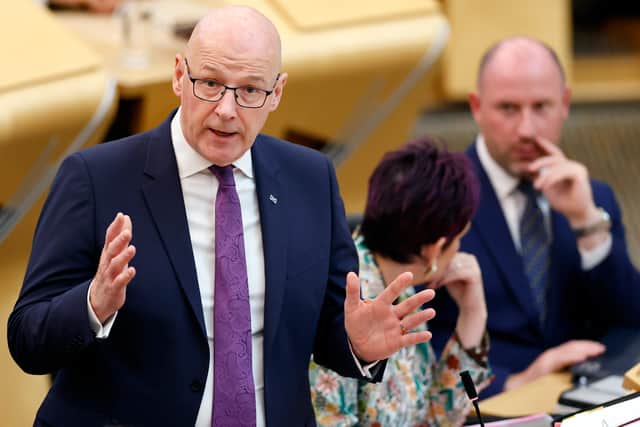

Addressing MSPs, Mr Swinney pledged to oversee the “the most radical reshaping of public services” in Holyrood’s history.
He confirmed the government will seek to replace the current 14 territorial health boards with two strategic health boards.
“This will be the most significant structural reform of the NHS in the era of devolution,” he said.
He said the move would help ensure “no one waits more than 26 weeks for the treatment they need” by the end of 2031.
Sharon Graham, the general secretary of Unite, which represents thousands of NHS and social care workers, slammed the plans.
“The Scottish government has set out a slash and burn programme for the NHS,” she said.
“The proposals will inevitably result in swingeing cuts and thousands of job losses across the public sector. Our members will not be the collateral damage for the Scottish government’s failings.”
James O’Connell, the union’s regional coordinator, added: “Reducing health boards does not reduce workload or staffing pressures. Unite will not stand by and allow workers and services to be attacked.
“We will be consulting our members on the damaging implications of this announcement, and all options will be on the table to prevent this unacceptable programme of cuts.”
Roz Foyer, general secretary of the STUC, accused Mr Swinney of recklessness.
“Crushing down Scotland’s health boards into two may seem bold on paper but further centralising power when local communities are crying out for health and social care services tailored to their needs seems more reckless than revolutionary,” she said.
“This is not the way to do public sector reform. Before the axe is swung on any public service - whether health, council or social care - Scottish government ministers would do well to engage meaningfully and purposefully with the workers who deliver on the ground. This cannot be done in the timescales outlined.”
Dr Iain Kennedy, chair of BMA Scotland, the doctors’ union, expressed his disappointment that it had been given “very little detail” about the reforms, and said it will await further information.
But he warned structural reform “must not come at the expense of the immediate need to address the challenges the NHS faces”.
Colin Poolman, executive director of the Royal College of Nursing Scotland, also voiced concerns.
“We agree that there is a need to reform and deliver health and care services in a different way, and we will not oppose change in a kneejerk way,” he said.
“But we have concerns that, despite the best intentions, reform ends up being driven by considerations around savings, rather than improving how services are delivered.
“We have been frustrated by the lack of transparency around the sub national planning approach that has prepared the way for today’s announcement on the reduction in the number of health boards.
“This must improve going forward and staff must have a voice in change. Proposals must clearly set out how service delivery will be improved and establish clear measures to monitor whether this is achieved.”
Elsewhere, Mr Swinney fired the starting gun on a radical reorganisation of local government.
He said said some of Scotland’s councils are “too small to be strategic” or “too big to be local”, and announced “a three-month period of intense engagement” about “a new structure for local government in Scotland”.
This will include reforming social care.
The First Minister also said he will “substantially reduce the number of public bodies over the course of this parliament”.
This will include scrapping Transport Scotland as a separate entity and merging Scotland’s environmental agencies, while a single ferries body will be created for routes covering the Clyde and Western Isles.
“As a result of these actions, at the end of these five years, people in Scotland will notice clear improvements in their lives and in their experience of public services delivered by the Scottish government and our partners,” Mr Swinney said.
Scottish Labour acting leader Jackie Baillie warned warm words are no substitute for action.
“We need real action to improve our NHS, make life more affordable and help our communities and our economy flourish,” she added.
Reform UK’s Scottish leader Malcolm Offord said the First Minister was offering the “same old empty promises, just rebranded”.
Lord Offord insisted the government’s plans were “a medley of sticking plasters and gimmicks instead of practical, long-term solutions for the benefit of the Scottish people”, going on to accuse Mr Swinney of “rearranging the deck chairs on the Titanic”.
Scottish Conservative leader Russell Findlay said the programme for government was “big on rhetoric, but painfully thin on detail”.
He said: “My party is delighted that the First Minister finally agrees with us that Scotland’s public sector is bloated and inefficient under the SNP, and that we need to see cuts within it.
“But I have very little faith in his and his ministers’ ability to deliver the reforms that are desperately needed. Their track record is dire.
“Just look at the mess they have made of Police Scotland which lurches from one crisis to another, or the millions they squandered on their abandoned National Care Service.
“The public will rightly be suspicious because they have heard it all before from the nationalists.”
Meanwhile, Scottish Liberal Democrat leader Alex Cole-Hamilton vowed to provide “fierce opposition” to the SNP’s “centralising” plans to slash the number of health boards.
"Right now, ambulances crews are queuing up outside A&E, patients are being treated in corridors and NHS staff are worked to the point of burnout,” he said.
“Reform is necessary but it needs to have their interests at its heart. Big upheaval lasting years could deliver distraction instead of change. If you are a pregnant woman in Caithness or a cancer patient in the Borders, will this actually improve your care?
"We were strong critics of the centralisation of the police, and in the early years we were shown to be right and sadly people lost their lives.
"We are in favour of communities being in charge and are instinctively nervous about the proposed merger of health boards."
Scottish Green health spokesperson Kayleigh Kinross-O’Neill said the NHS announcement would cause “significant concern amongst staff, patients and communities about the future of local health care in Scotland”.
She added: “All parties understand the need for public sector reform but this appears to be the full centralisation of services and a radical change from how front line health care is delivered.
“The Scottish government needs to urgently share more information about their plans, to reassure NHS staff that there will be no roll back on the Scottish Government policy of no compulsory redundancies, hard fought for by health care trade unions.
“They also need to explain how these changes won't result in downgrading of local health services, and people having to travel further to access essential health care.”
Shona Morrison, president of Cosla, the council umbrella body, said it would take time to consider the detail.
“There are important implications for local government and council services, particularly the proposed NHS reforms and what they will mean for the future delivery of social care,” she said.
“Over the coming days, Cosla will engage closely with our member councils and with Scottish ministers to ensure these proposals are focused on what is best for communities across Scotland and respect the democratic legitimacy of local government.
“Public services work best when decisions are taken as close to communities as possible. We look forward to meaningful engagement with the Scottish government and believe that the dialogue on the future of local governance must be carried forward with councils and Cosla as the collective voice of local government.”
Comments
Want to join the conversation? Please or to comment on this article.