
Scotsman Obituaries: Alan Jackson, Scottish poet 'inspired by the angels'
Alan Jackson, poet. Born: 6 September 1938 in Liverpool. Died: 15 September 2026 in Edinburgh, aged 88.
Born to working class parents in Liverpool, Alan Jackson became a native of Edinburgh in early childhood. The biographical facts of his life are sketchy, probably unnecessary and certainly not illuminating. It is his artistic and spiritual life – as well as his profound thinking – that paint a true picture of the man. For these there is nowhere to look but in his poetry and prose writings and to his conversations with the shrinking cohort of those that knew him.
Jackson was a poet and writer – and virtually nothing else – all his life. In character he was mercurial, quick witted, impulsive, profoundly intelligent and often very funny. He could also be caustic, sarcastic, combative and unkind. He was a no-compromise man who could often appear abrasive because he was no friend of the niceties of social convention – particularly if they were in conflict with what he saw as the Truth. As a teenager he had been – like so many – unhappy and miserable at the prospect of the drab bourgeois life that appeared to stretch before him in the grey Edinburgh of the Fifties. He spoke of a moment he overheard a conversation between two guardian angels in which one was asking “Is there anything we can do to help this poor suffering lump of humanity?” – to which the reply was “We'll give him poetry”. And this they did.
The Sixties had arrived and Jackson dived into the boiling cauldron of artistic and political activity that characterised the time – the anarchistic creative tidal wave that was crashing in on the post-war drabness. Here was a place for his voice to be heard alongside the poets and artists of his ilk: Roger McGough, Brian Patten, Adrian Henri and many others who were storming around the village halls, clubs and cellars up and down the country, upending the sedate academic intellectual art that went before, irreverent, fearless, hilarious and dangerous, questioning absolutely everything.
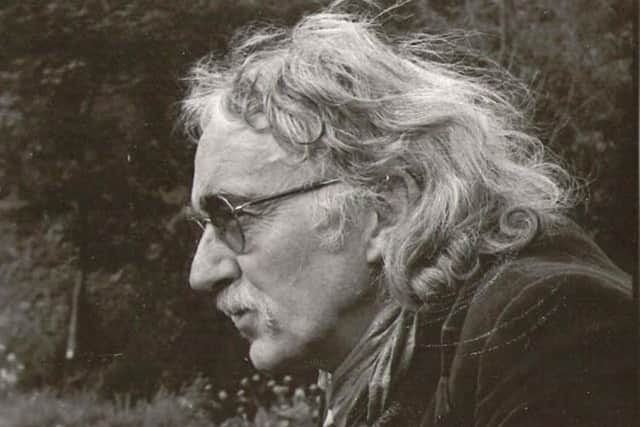

Jackson’s poetry was written to be spoken and to be performed – and unlike many poets he was the one who spoke it best. Yes - his poetry reads beautifully on the page but you really had to be there to be captured and ensnared by his rhythms and his images. It was at one such reading – very late in his career – that he succeeded in bewitching this particular writer. He would say he didn't actually “compose” his poetry, but that he listened for it – and it came – and his job was to write it down. As the angel had promised.
He used many forms – rhyme occasionally, rhythm and pulse always. In his earlier work there is a great deal of myth and parable. In his prose work he tells stories – sometimes bizarre, sometimes outlandish, some homely and personal. He was ever a good storyteller. He would at times use the Scottish idiom – sometimes there is an Anglo-Saxon mythic character to the stories and poems. There's street talk – rough speech and refined speech. There are fairy stories. There are dialogues between imagined archetypal characters. In short, everything was at the service of what he had to say. His poems are often angry – always uncompromising, never genteel, nothing for the sweet tooth. Full blooded, you might say.
The theme of Jackson’s early poetry is intense horror and disgust with what we as humans as a race and as a culture have become. That is, dishonest, morally empty and cruel. There is much talk of blood, of the elements, destruction and death.
Much later on in 1989, in the preface to his selected poems, Jackson would write “Since I was 18 or so I have only had one purpose. I don't think it's mine alone but that it is laid into the foundation of the world and in particular into the shape of this time. We are in combat for our spirit lives every second, night and day”
His poetic language is vivid – even lurid – but at other times funny and quirky. Not a cliché in sight. Towards the end of the Sixties Jackson became increasingly aware that the darkness about which he constantly wrote was, as well as being out there in the world, “in here” within his own soul. He speaks of this time in a lengthy prose piece called “Reasons for the Work” which formed the first section of Heart of the Sun, published in 1986 by Open Township. It's a piece that would probably do a better job as his obituary than the present piece. It's the account of the complete transformation of his life: “The time had come when it was no longer my place merely to convey ‘my’ poems to others – take the credit – make a lifestyle out of it or an image. The word that came through was this: ‘What you have to do now is obey the poetry’.”
And so he did. Turning his back on the heady but increasingly decadent world the Seventies had become he walked away from the artistic milieu of the city and entered into an almost monastic life of solitude and self-examination, using his own work as his map. From this time on his work became gentler, softer. There was more talk of love – there was compassion. Something of the warrior who has done battle with the Dragon and, to a degree, prevailed.
Jackson's voice was – is – unique, original, deeply felt and urgent. The man wasn't playing with poetry. He had something of transcendental importance to say. His humour is not designed to distract but to draw you in. His intensity is the measure of his surrender to a higher truth. It's a good thing that one of his shorter poems is carved into the stone of the Scottish Parliament building. There's a lot of meaning in the few – apparently flippant – words. I'll not quote it here – you should go and see it for yourself. He himself suggested a possible epitaph: “Never knowingly understood”.
Jackson's work was included in Penguin Modern Poets 12 in 1968. Much later, in 1990, Polygon published Salutations – Collected Poems (1960-1989). Many collections of his poetry were published by some of the small independent publishers in the Sixties and Seventies. The collections Walking through Apocalypse and A Great Beauty were self published under the Lulu imprint in 2007. His play The Attic – a one-man show – was performed at the Edinburgh Fringe in 2010, and his most recent book, Sparkle Assassin – a critique of the work of Ted Hughes – was published in 2014. A large part of his oeuvre can be read at the Scottish Poetry Library.
Obituaries
If you would like to submit an obituary (800-1000 words preferred, with non-copyright image), contact [email protected]