
How Ancient Greeks' practice of silencing women is alive and well in Scotland today – Susan Dalgety
Women may have won the right to vote, own property and become Prime Minister, but the fight for free speech continues
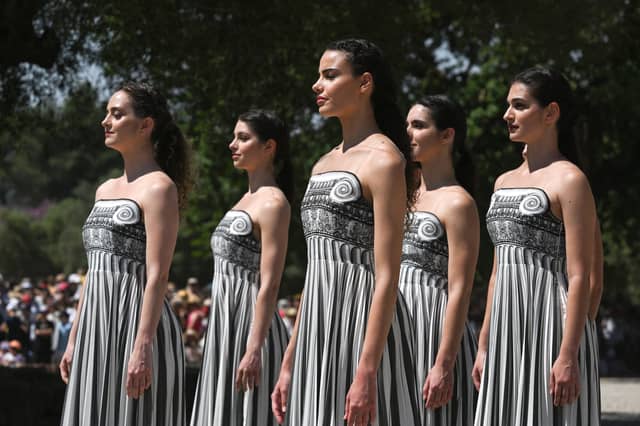

Scrambling up the Acropolis in Athens in the morning heat earlier this week offered me plenty of time for reflection. My immediate goal was the Parthenon, the deceptively simple structure that hovers over the crowded city below and stands as a symbol of Western civilisation. It was my gift to myself on a landmark birthday. To spend time in the birthplace of democracy, where philosophers such as Plato, Socrates and Aristotle asked searching questions about humanity and society.
As I paused for breath, my mind started to wander past the great men of classical Athens and onto the women and girls who lived there 2,000 years ago. Not divine women such as Athena, the Greek goddess of wisdom, but women like me. Mothers. Grandmothers. Sisters. Wives. Half the ancient city’s population, yet the little we know about them, whether the wives of rich merchants or slaves, was told to us by the men in their lives.
There were a few female poets in Ancient Greece, Sappho being the most famous, but in ‘democratic’ Athens, women had no voice. There were no female politicians. No women writers. They were not allowed to vote. They were rarely educated.
Women’s struggle to be heard
The only area of public life where women played an active role was in religious ceremonies. According to Sue Blundell’s Women in Classical Athens, while the great thinker Plato argued that the only difference between men and women was their reproductive system and that women should be allowed to participate in the governance of the city, to do so they must first surrender their mothering role.
Sitting at last on a piece of marble, made impossibly shiny by centuries of use, I started musing on the last few years of my life, as one does when faced with the reality of mortality. By accident rather than design, I have found myself immersed in a battle for women’s voices to be heard – not the long-dead women of classical Athens, but my contemporaries.
Women like Labour politicians Alison Ann-Dowling and Norma Austin Hart, who in a few weeks’ time will challenge their trade union, Community, in the Court of Session over the legality of its gender equality strategy. Ann-Dowling and Austin Hart will also argue that their union, whose high-profile members include the Scottish Secretary Douglas Alexander and Scottish Labour leadership hopeful Michael Marra, victimised them when they challenged the policy.
In the same week, Fife nurse Sandie Peggie, who was plunged into the spotlight after her objection to being forced to share a changing room with a biologically male doctor who ‘identifies’ as a woman, will take the stand again – this time against her former trade union, the Royal College of Nursing. Ms Peggie is suing the RCN on the basis of discrimination due to her beliefs.
Politics not about ‘keeping your head down’
A few days ago, Glasgow councillor Fiona Higgins won the first round in her legal battle against the Standards Commission for Scotland. Councillor Higgins had been reported to the commission for “public misconduct” following comments she made about proposals to cut hundreds of teaching posts, but the watchdog had refused to allow her to submit important evidence in her defence.
Last week, the Court of Session ruled that the Standards Commission acted “outwith its lawful powers”. Councillor Higgins, a former teacher, said on social media that she did not go into politics “expecting to spend her time in the Court of Session”. She went on: “Public service can never be reduced to keeping your head down. It should mean remembering who sent you there, and having the courage to speak for them.”
Fiona Higgins, Sandie Peggie, Alison Ann-Dowling and Norma Austin Hart are just four of the thousands of women who have had to find the courage to speak out for women in recent years.
Women in 21st-century Britain may have far more freedoms than their counterparts in Ancient Athens. On paper, we have exactly the same rights as men. We can even lead our country, as three Tory women have shown since 1979.
Scotland’s gullible leaders
But a decade ago, when women started to rail against the threat to the basis of all our hard-won rights – our sex – we were told, in no uncertain terms, to shut up. And it wasn’t just men who tried to silence women. Scotland’s longest-serving First Minister, Nicola Sturgeon, who claims to be a feminist, famously told women their views were not valid. The male members of the Athens Assembly, the Ecclesia, would surely have cheered a woman leader who appeared to agree with their fundamental view that political participation be restricted to free adult men over the age of 18.
There have been notable victories in the last decade. The most significant was last April, when the Supreme Court ruling in For Women Scotland’s case settled, once and for all, that in law sex is biological, not a feeling or a costume. But the battle drags on.
I wonder what Plato would have made of the incurious, gullible public leaders who have created a culture where the demands of men who want to be considered female trump the needs of women and girls, and where bureaucrats believe they have the right to silence a woman elected to speak up for her community.
As I started my descent from the Parthenon on Tuesday, I realised I was walking into the final phase of my life. It may last 30 years, though it probably won’t, but however long I remain active I intend to stand up for the rights of all women to speak out.
We may have won the right to vote, to own property, to join men in our parliaments and on the battlefields, but the ancient fight to have our voices heard is far from over. Aἱ γυναῖκες οὐ σιγήσουσιν, or as we say in 2026, women won’t wheesht.
Comments
Want to join the conversation? Please or to comment on this article.