
Readers' Letters: New airport boss offers hope for better experience
A reader says Edinburgh Airport’s new chief excutive seems to understand that the transport hub must provide an improved service
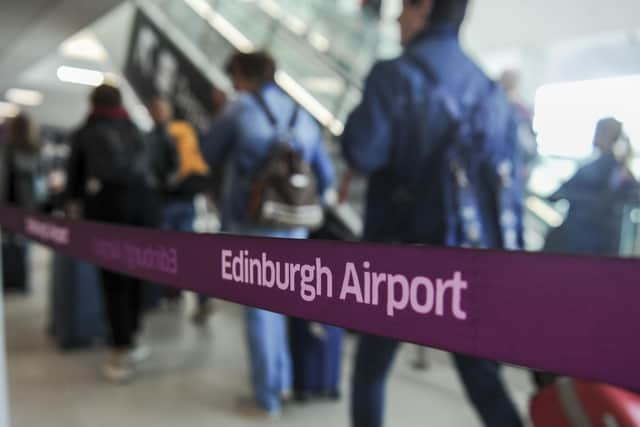
Thank goodness new Edinburgh Airport chief executive Mark Johnston, in a move that distances him from his predecessor, is reported to agree that the passenger experience in Edinburgh, particularly around arrivals, must improve. For too long, the airport operator has had a hands-off approach to the appallingly poor delivery of baggage in Edinburgh, and the terrible arrival halls and corridor with a “nothing to do with us, guv” mentality, blaming the airlines and the baggage handlers.
The leadership at Edinburgh Airport has never quite understood that it is a gateway to Scotland and the passenger experience matters. Contrast that with other airports such as Dubai where the baggage is usually waiting for you when you get through passport control, and the airport is a delight. My own experience of arrivals at Heathrow T5 recently was brilliant and passport control took only a few minutes.
I wish him well in tackling the issues at Edinburgh through a combination of investment in the arrivals area, and in having productive discussions with the airlines and baggage handlers in working to deliver a fast, seamless experience to passengers who ultimately pick up the bill.

Brian Barbour, Haddington, East Lothian
Short-sighted stunt
The Home Office’s latest policy overhaul to Indefinite Leave to Remain (ILR), shifting the default settlement timeline from five years to a gruelling ten, is a short-sighted political stunt that threatens to inflict severe, long-term damage on Scotland and the wider UK.
Britain cannot ask overseas workers to build their lives here, pay their taxes and keep essential services running, then treat their hopes of a secure future as a political bargaining chip.
The Home Office’s settlement announcement deserves scrutiny. Its own estimate is that more than 500,000 people will wait longer than five years for indefinite leave to remain. That means years more uncertainty for families who have followed the rules.
Scotland faces distinct demographic challenges, alongside acute sector-wide labour shortages. Our care homes struggle for staffing, our health service is under persistent pressure, and tech and hospitality businesses regularly cite workforce deficits as their primary barrier to expansion. Disincentivising global talent from settling permanently will only worsen these shortages, weaken our public services, and hamper national wealth creation.
For Scotland’s hospitals, care providers, hotels and technology businesses, prolonged uncertainty risks making recruitment and retention harder.
Replacing experienced staff costs money, disrupts services and takes time. Training more domestic workers is essential; unsettling existing workers is no substitute.
Of course we must tackle immigration fraud, unlawful employment and exploitative sponsors. Enforcement should target wrongdoing, not make compliant workers, international students and their families feel permanently unwelcome.
We need an immigration strategy rooted in economic reality, compassion, and fairness, one that respects international talent and supports the public services relying on them.
Dhruva Kumar, Glasgow
Pious platitudes
The Prime Minister has said that “no one who has served our country should ever be left to sleep rough on our streets ... People who stepped forward prepared to put their lives on the line for the rest of us should never lack a roof over their head.”
Except that long before Ralph McTell ripped off Pachebel’s Canon for Streets Of London, long before Kipling railed in The Last Of The Light Brigade how its survivors were given only the choice of the street or workhouse, the lot of the common soldier has forever been a nation’s neglect.
The pious platitudes of empty empathy are proclaimed every year from the first note of the last post on the eleventh hour of the eleventh day of the eleventh month until packed away with the other false empathies on Twelfth Night. Pray tell us, Prime Minister, what makes yours any different?
Mark Boyle, Johnstone, Renfrewshire
Penny drops
Finally, the penny has dropped for John Swinney (“SNP U-turn on new oil and gas drilling is confirmed”, Scotsman, 6 November).
Why didn’t Mr Swinney just say this when confronted multiple times for an answer to this very question at First Minister’s questions? The disarray is obvious.
Naturally, the Scottish Greens are incensed but do they matter any more? It looks as if the Liberal Democrats are about to replace the Greens as Mr Swinney’s partners but is this simply rearranging the Titanic’s deckchairs? Politics is being turned on its head by the SNP and this smacks of desperation and a desire to suddenly “go with the flow” after reneging upon years of determined opposition to oil and gas extraction.
The picture now painted is not a pretty one. Has Mr Swinney suddenly realised that his policies are leading Scotland nowhere whilst our essential services are all close to breakdown?
Holyrood has failed us probably in large part due to SNP incompetence aided by Green silliness. Do the Liberal Democrats really want to associate themselves with the SNP as the damage of the last 20 years is well nigh irreparable.
Mr Swinney is very exposed to a challenge after this monumental U-turn. Are Scottish politics about to experience a profound meltdown?
Gerald Edwards, Glasgow
Correction
A letter in Saturday’s Scotsman calculated the total cost of firework displays in Scotland to be half a billion pounds. The actual figure, based on the statistics in the letter, should be £585,000. We apologise for the error.
Write to The Scotsman
We welcome your thoughts – NO letters submitted elsewhere, please. Write to [email protected] including name, address and phone number – we won’t print full details. Keep letters under 300 words, and in the body of the email – no attachments – and avoid ‘Letters to the Editor/Readers’ Letters’ or similar in your subject line. If referring to an article, include date, page number and heading. No poems.
Comments
Want to join the conversation? Please or to comment on this article.