
Why Tony Blair is completely wrong about net zero and economic growth – Ian Johnston
The path to net zero is paved with economic opportunities that the UK must seize


In 2024, the average British person’s carbon emissions were an estimated 4.5 tonnes a year – about the same weight as a large hippopotamus or a medium-sized Asian elephant. That sounds like quite a lot to me, but the last time this figure was so low was in the 1850s and it represents quite a drop from the 1971 peak of three hippos (11.8 tonnes) each.
In a new report from the Climate Change Committee, Professor Julia King, Baroness Brown, wrote that the last 20 years had been a “huge success” in terms of cuts to our carbon emissions, with a reduction of 42 per cent. For the majority of those 20 years, the UK had a Conservative government and it’s a tragedy the Tories now appear to have disowned this genuine achievement and adopted a Reform-like stance on net zero.
They are not alone. According to former Labour Prime Minister Tony Blair, the UK should scrap its green energy targets as “Britain’s emissions are around 1 per cent of global emissions” and “we can’t solve climate change”.
Both statements are true. However, as arguments against decarbonising our economy, they fall apart on closer scrutiny. The UK’s emissions may be just under 1 per cent of the world’s but so is our population. As emitters, we’re about average.
Facing reality
If the world divides itself up into small enough units, they can all tell themselves they only contribute a small amount to the problem and “can’t solve climate change”. Taking this attitude will guarantee humanity will fail to tackle this planetary problem or, after eventually waking up to the need to act, have a much harder time trying to do so.
So while the UK can’t fix this alone, it must be part of the solution – unless, of course, you think scientists the world over are part of a giant conspiracy, in which case you’re living on a very different planet (an imaginary one where everything will be just fine because it just will...). Facing up to the reality of our situation may be difficult, but we have no other option.
Some environmental campaigners must also face economic reality. Dismissing the need for growth and countenancing wilfully causing a recession will only end in disaster. To ‘Just Stop Oil’ would be deeply counter-productive. Instead, the approach adopted by “the world’s greenest petrostate” Norway – of rapidly decarbonising their economy while also selling oil and gas, increasingly to other countries – provides a real-world model of how to actually get things done.
Norway is not just decarbonising, it is modernising. If the UK fails to adopt a similar approach, it risks being left behind with an outdated fossil fuel-based economy. Oil and gas are significant parts of our present, but their importance will continue to diminish into the future, and not just because the North Sea’s reserves are running out.
‘The Growth Story of the 21st Century’
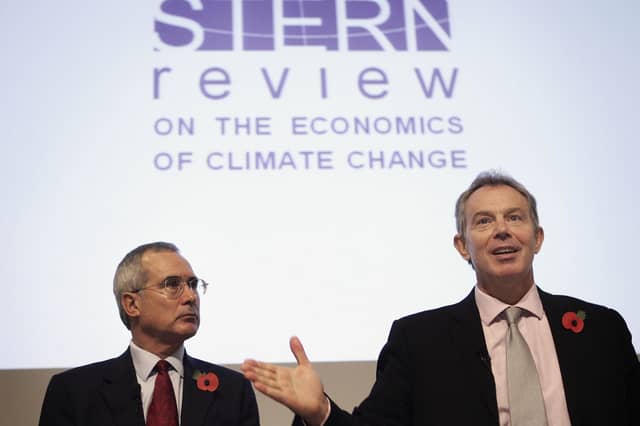
In 2006, the leading economist Professor Nicholas Stern published a major report, commissioned by the Blair government, on the economics of climate change. The Stern Review’s findings caused a worldwide reaction with many large businesses changing their approach.
Stern calculated then that the costs of reducing greenhouse gas emissions would be about 1 per cent of global GDP a year, but the cost of dealing with the consequences of climate change – extreme storms, rising sea levels, searing heat etc – could rise to between 5 and 20 per cent.
In a book published last year, entitled The Growth Story of the 21st Century, Stern stressed not just the costs of failing to act, but the economic benefits of reducing emissions.
“The challenges that arise from the climate science dictate both the urgency of and scale at which action must occur – to avoid the immense risks of a changing climate,” he wrote. “The argument for acting in this way is greatly strengthened when we recognise that climate action will bring the multiple benefits of driving economic growth, protecting and creating resources, and fostering a healthier environment. Climate action must be at the heart of and a priority in each nation’s sustainable development story – both to avoid catastrophic outcomes and reap the opportunities that come from moving to a more sustainable, resilient, and equitable world.”
In other words, taking the path towards net zero will lead to new ways to increase our GDP – something that hard-left, anti-growth Greens and net-zero naysayers like Blair, Reform etc fail to realise. And we really are going to need all the economic help we can get because, unfortunately, the costs that Stern warned us about are starting to ramp up.
READ MORE: ‘Net stupid zero’ vs economic madness: How the climate change debate is losing touch with reality
Thatcher: ‘no one can opt out’
That Climate Change Committee report, its “Fourth Independent Assessment of UK Climate Risk”, warned “the UK was built for a climate that no longer exists today and will be increasingly distant in years to come”.
“By the middle of the century, the UK’s climate will be much more extreme than today. Hotter heatwaves could see 92 per cent of existing homes overheat, creating dangerous conditions for vulnerable people. Peak river flows will be up to 45 per cent higher, last longer, and be seen more frequently, driving increased flooding. Drier summers will mean shortfalls in water supply could reach over five billion litres per day, making drought more widespread,” it added, saying that the world is not on track to restrict global warming to 2 degrees Celsius and 4 degrees by 2100 “cannot yet be ruled out”.
Global warming must not be ignored. As Margaret Thatcher once said, “every country will be affected and no one can opt out”. It will remain the elephant (or hippo) in the room until we get to net zero and finally put an end to our reckless experiment in how far we can push the Earth’s climate before it really starts running amok.
Comments
Want to join the conversation? Please or to comment on this article.