
Scotland needs to learn from Norway, the world's 'greenest' petrostate, about how to fight climate change
Norway is wealthy thanks largely to its oil and gas exports and it is decarbonising its economy faster than any other developed country

What is the most important political cause of our times? Stopping the boats? Ending global poverty? Persuading authoritarian leaders not to invade other countries?
We must all make our own choices but, for me, it is unquestionably the fight against climate change. As a former science correspondent, I’m fairly sure most scientists would say the same.
Those who object to efforts to tackle global warming like to portray environmentalists as hard-left “extremists” who would crash the economy. However, the people who convinced me that climate change is a real problem were not idealistic hippies, but scientists at world-leading universities and institutions like Nasa.
The arguments deployed by those who have sought to deny there’s a problem – or one that requires us to participate in any kind of solution – have also struck me as paper-thin.

This is no hoax
Despite climate scientists essentially winning the argument – there is no credible alternative theory to the mainstream science (Donald Trump warbling on about hoaxes doesn’t count) – in recent years the UK and much of the world have started to come up against obstacles on the road to net zero that appear to be persuading some politicians to give up the fight on the grounds that it’s too expensive and disruptive.
However, there is one country in the world that perhaps offers hope and which could be used as a model – Norway. A decade on from the landmark Paris Agreement on climate change, no country in the world has been fulfilling its requirements, according to the authoritative Climate Action Tracker.
The actions of just a handful of states are deemed “almost sufficient”, with Norway the only European country in that category. Others in this select band include Nepal, Costa Rica and Ethiopia.
The UK’s policies are classed as “insufficient”, as are Germany’s, Japan’s and Brazil’s, while China, India and Canada are in the “highly insufficient” category. Russia, Saudi Arabia, Iran and the USA are among the members of the final “critically insufficient” group.
READ MORE: ‘Net stupid zero’ vs economic madness: How the climate change debate is losing touch with reality
If only the world was like Norway
Norway’s high ranking may strike some people as odd, given it is the world’s fifth largest exporter of crude oil. Emissions from its fossil fuels exports are “estimated to be over ten times higher than Norway’s domestic emissions”. And the Climate Action Tracker notes that it is “sometimes described as the world’s ‘greenest’ petrostate”.
However, it concludes that Norway’s policies and actions could be consistent with limiting global warming to 1.5C with only “moderate improvements” and states: “If all countries were to follow Norway’s approach, warming could be held at, but not well below [the Paris target], 2C.”
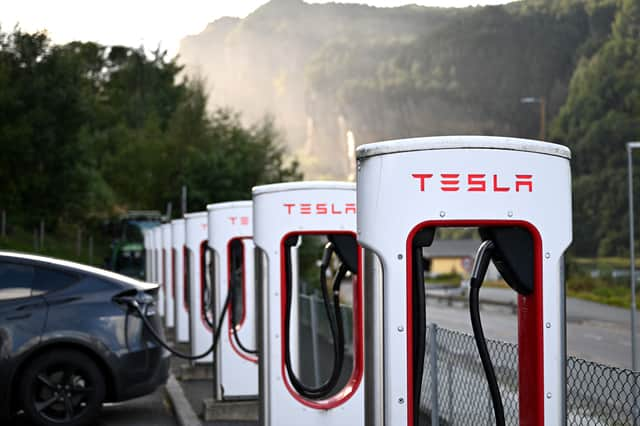
So Norway, where 98 per cent of all new cars sold in November were fully electric, is putting its own house in order, while making lots of money by selling large amounts of oil and gas to other countries.
This approach may not be perfect or particularly inspirational, but it is pragmatic and it is actually working. Norway has correctly identified what the economy of the future looks like and is moving towards it at a faster rate than the developed world.
In doing so, it may help drag others into that future as the economic advantages become increasingly clear and regular extreme weather events underscore the need to act.
‘A complete waste of time’
In contrast, the UK risks joining Trump’s march into the past, given the ‘net stupid zero’ rhetoric of Reform UK and some leading Conservatives, who may end up forming a coalition government if Labour’s fortunes continue on their current trajectory.
Meanwhile, too many environmental campaigners seem caught up in the debate about oil and gas licences. In 2024, Chris Stark, the then chief executive of the Climate Change Committee who is now the Labour government’s ‘head of mission control for clean power 2030’, expressed frustration with this argument, saying it had “mostly been a complete waste of time”.
“We need gas, right through to 2050 so domestic production of it makes sense, because otherwise it will be importing it,” he said. Without new licences, he said it was expected there would be a 97 per cent reduction in gas production, and with them, a 95 per cent reduction.
Instead of focussing on reducing the supply of oil and gas, we should first be tackling the demand for it – just like Norway. In this task, the Norwegians have been helped by their vast fossil fuel wealth that contributes substantially to one of the highest GDPs per capita in the world. If they had ‘just stopped oil’, their ability to decarbonise the economy would have been significantly reduced.
A terrifying warning
In order to truly address climate change, we need to find a practical, affordable path to net zero that the public will support. The dangers of attempting to take an impractical, unaffordable one in the face of mass protests should be obvious.
However, there are still those who shrug their shoulders and think everything will somehow be fine or that this is a problem for future generations to solve.
A study published last year by an international team of climate scientists led by former Nasa scientist James Hansen, who issued a historic wake-up call to the world about global warming as long ago as 1988, provides a salutary warning.
The researchers concluded that a shutdown of the Atlantic Meridional Overturning Circulation, a vast ocean current, is “likely within the next 20 to 30 years, unless actions are taken to reduce global warming”.
This could cause widespread, major disruptions to weather patterns in much of the world and dramatically reduce temperatures in the UK, turning the climate into something more like Canada’s.
Their findings were controversial, and their timeframe may be wrong. But the longer we continue on our current path, the more dangerous the risks become. The world has many pressing concerns, but we cannot ignore the greatest of them all.
Comments
Want to join the conversation? Please or to comment on this article.