
The mainstream media exposés that show why we need a strong free Press – John McLellan
From Russell Brand and David Walliams to MPs’ expenses and an infamous ‘twerking’ incident in Edinburgh Castle, investigative journalists have repeatedly proved their worth

Last week I was researching some background about a controversial landowner and a dispute over a windfarm project in the Grampians, and above a story in The Times was a warning that the article was still subject to a legal complaint.
Although I’d like to go into details, for the purposes of this article, I’ve been advised not to. Suffice to say that as the wealthy gentleman was apparently being considered for a peerage and still hasn’t received one, the coverage resulting from a previous Sunday Times investigation was rather unwelcome.
Legal gags on journalists’ investigations do work, as shown by the continued ban on The Sun identifying the celebrity alleged to be involved in three-in-a-bed sex, even though the name is all over social media and the international press.
READ MORE: How the European Court of Human Rights is defending free speech in Scotland – John McLellan

Brand’s ten years for rape
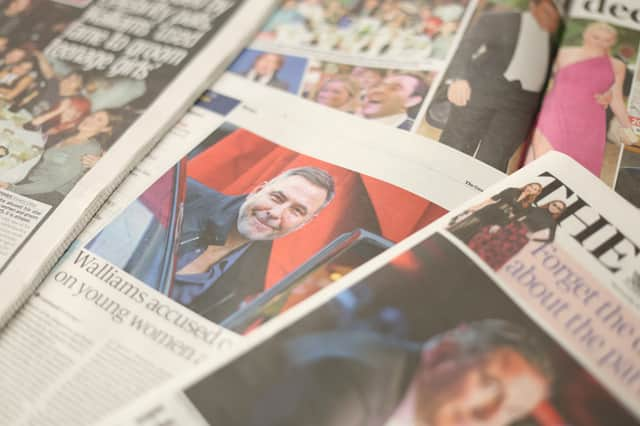
But brave journalism is vital, and comedian and author David Walliams obviously didn’t welcome the investigation by ITV News and The Guardian into allegations of sexual misconduct against him, revealed after legal attempts to prevent disclosure failed. And thanks to work by The Times, Sunday Times and Channel 4, Russell Brand is now doing ten years for rape.
Huw Edwards? That was The Sun. Martin Bashir’s duplicity in manipulating the late Princess Diana? The Mail on Sunday. Across the pond, who revealed Nvidia CEO Jensen Huang’s affair with a suspected Chinese spy? The New York Times.
Closer to home, the Daily Telegraph, which famously exposed the MPs expenses scandal in 2009, revealed in 2023 how the now ex-SNP minister Michael Matheson claimed £11,000 for data roaming charges incurred by his sons watching a football match on holiday.
And it was Scotsman reporter Catriona Stewart who revealed the now infamous “twerking” incident at an Edinburgh Castle event, which has been at the centre of ongoing upheaval at Historic Environment Scotland.
An unpleasant experience
I could go on, but every day somewhere there is a journalist looking into matters of public concern, not just the affairs of the rich and famous, but issues affecting people’s everyday lives, with the common denominator that somebody, somewhere doesn’t want you to know.
I got a taste of it myself when an unsympathetic newspaper gleefully published a spurious allegation of bullying behaviour against me when I was a councillor, for which I was cleared. It was a thoroughly unpleasant experience, but it comes with the territory of public roles.
Politicians understand the importance of Press scrutiny, but in power the recognition is often by its avoidance, with the growing practice of dodging questions at speech events, limiting numbers at Press briefings, and seeking to ”control the narrative” through official social media channels. It’s not just politicians but public bodies themselves, with organisations like Police Scotland operating as digital publishers.
Yet there is still recognition that journalism is not a nice-to-have, but part of the national infrastructure of a healthy country and democracy. Not my words, but those of Prime Minister Andy Burnham from an article published for last week’s Journalism Matters campaign run by my colleagues at the News Media Association.
“It holds power to account, strengthens our resilience and connects people to the places they call home,” said Mr Burnham, and he’s not wrong, but vigilance is needed to ensure it stays that way.
SNP plan to tighten the law
The use of the courts to prevent publication with so-called SLAPPs − Strategic Litigation Against Public Participation – is an ever-present threat and, to its credit, the SNP pledged to tighten the law in this year’s election manifesto. Now the Scottish government has included SLAPPs in its Open Government Action Plan for 2026-30, which although positive means reform is some years away.
Meanwhile in Westminster, a SLAPPs bill drafted by the Ministry of Justice, but to be tabled by usually doughty defender of Press freedom, Conservative MP John Whittingdale, might have the unintended consequence of making it easier for powerful people to use the courts to cover their tracks.
And at the same time, the Hacked Off Campaign, primarily aimed at shackling Sun publisher News UK and the Daily Mail, and its associates in the publicly funded Press Recognition Panel, are pressing the UK government to usher in the beginning of state Press control by the back door of the new Green Paper consultation on online news prominence.
Ironically, the Green Paper’s basic aim is to address the decline of public service broadcasters from the onslaught of live streaming, a laudable aim in principle, but risks another unintended consequence of making non-broadcast local news less prominent than at present. And when so many recent high-profile scandals have involved broadcasters exposed by investigative journalists, the danger should be obvious.
The road to hell may be paved with good intentions, and while some eyebrows have been raised about some of the grants made to local news providers across England and Wales from the UK government’s £12 million Local News Fund, at least there is money where Mr Burnham’s mouth is.
Does McAllan value independent journalism?
In Scotland, there is no such fund and former Culture Secretary Angus Robertson decided not to put cash into a proposed Scottish Public Interest Journalism Initiative, a recommendation from a working group (of which I was a member) established by the Scottish government in the wake of the pandemic.
After a post-election reorganisation of ministerial responsibilities, media has now been lumped in with new Scottish Education Secretary Mairi McAllan’s brief, so it’s hardly surprising that falling school standards and the university funding crisis are higher up her list of priorities.
There must, of course, remain a clear distance between government and a truly free Press, but last year the Scottish government spent £3.5 million on marketing with US-based tech giants and £54,000 with Scottish publications. Priorities are certainly something Ms McAllan should address if her administration truly values independent journalism.
Comments
Want to join the conversation? Please or to comment on this article.