
How Scotland's Christians face attacks on free speech and attempts to drive them out of politics
During the Assisted Dying Bill debate, Murdo Fraser was struck by the number of times he heard arguments that people opposed to the Bill because of their faith should not be allowed a voice

Amongst the many hustings events I’m doing during the Scottish Parliament election campaign, I took part in one last week hosted by Christian think tank Logos Scotland. Ably chaired by Logos chief executive Shona Haslam, this brought together representatives from all major political parties to answer questions on the intersection between faith and politics.
One subject of keen interest to those attending was the reaction that Christian politicians receive for expressing their views in the public sphere. In responding to that, I made reference to the treatment of SNP Deputy First Minister Kate Forbes, when she stood for the SNP leadership in 2023.
Forbes’ views on social issues horrified many in her party, particularly when she expressed her opposition to same-sex marriage. This reaction was all the more surprising given it was no secret that Forbes was a member of the Free Church of Scotland, and it was entirely reasonable to expect that her views would be in line with her church’s teaching.
READ MORE: Why Reform is a threat to religious freedom

Concern for Christian politicians
There was a huge backlash against Forbes’ candidacy, with even some who had initially backed her withdrawing their support and rallying behind her leadership rival, Humza Yousaf. So concerned were the party establishment by the prospect that Forbes might win the leadership that John Swinney, now First Minister himself, was deployed to argue that Forbes’ views meant she was unsuitable to be elected to the position of First Minister, even though he himself professed Christian faith.
The negative view amongst the party leadership did not seem to be, in the end, broadly reflected amongst the SNP’s membership, 48 per cent of whom voted for Forbes to be leader, meaning she missed out on becoming First Minister by a whisker. Even more interestingly, public opinion surveys at the time suggested that Forbes was by far the most popular candidate amongst the wider Scottish public, indicating that people more generally were forgiving of a Christian politician expressing views in line with their personal beliefs.
Forbes has now decided to step back from frontline politics, and will be a significant loss to Scottish public life. It was perhaps her experience that drove attitudes in the recent Logos survey of Christians in Scotland, which found that more than 80 per cent of participants said they were worried about the negative reaction or criticism that Christian politicians have received.
Putting vulnerable people at risk
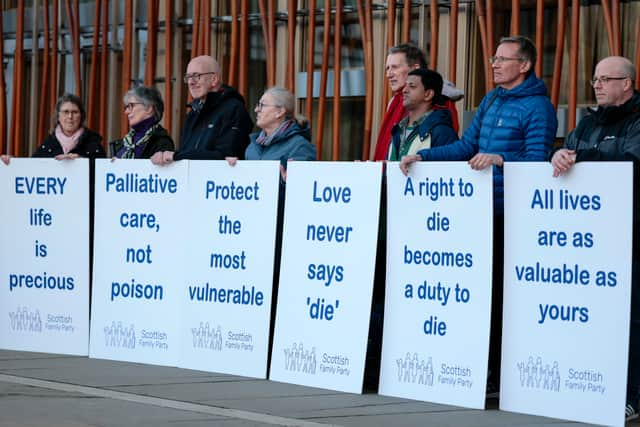
We saw some of this around the recent Assisted Dying Bill debate. I was struck by the number of times I heard from people that those who came to the debate with a faith position should not be allowed a voice. After the Bill was defeated, one supporter was quoted as saying their side should have made much more of the faith background of some campaign groups which opposed it.
It was undoubtedly the case that some of those opposing assisted dying came at the issue from a faith perspective, but many more did so because of the belief that the weak, vulnerable and disabled would be put at risk should the law be changed in this way. And there never seemed to be an argument that those who approached the debate as atheists, and with no belief in the intrinsic value of human life, should somehow be excluded in the same way as those on the opposite side of the debate.
If Christians, or people of any faith, are being put off from standing for election because of these concerns, that should worry us, whether we have a faith or not. Holyrood is there to represent Scotland in all its diversity, and faith continues to play an important part in the lives of, at least, a very significant minority of the population.
READ MORE: Cross-party campaign and religious lobbying: How Scotland's assisted dying legislation fell
Conversion therapy ban raises real concerns
There will be significant challenges to be addressed by the new parliament. In the very final First Minister’s Questions last week, Swinney indicated that should the SNP form the next government then a priority would be to bring forward a Bill to ban “conversion therapy”, which LGBTQ campaigners have long been pressing for.
It’s clearly wrong that individuals are tortured or coerced in an attempt to change their sexuality or gender identities, but such behaviour is almost certainly already illegal. What is proposed by campaigners seeking a ban on conversion therapy goes much further.
As prominent legal figures have argued, the Bill some are pushing for would make criminals of a priest, minister or imam setting out to a group of young people their faith’s traditional teaching on human sexuality. Similarly, parents of a young person with gender confusion who do not immediately affirm them in the gender of their choice and aid their transition could find themselves facing a jail sentence.
There are huge concerns around the freedom-of-speech and freedom-of-religion implications of a conversion therapy ban, and, as with the debate around assisted dying, faith groups will be involved in setting out the arguments. This is something that we should welcome and encourage, for it is only through open debate with all voices being heard that we can expect good sense to prevail when making legislation.
I write this in Holy Week, when Christians around the world gather together to celebrate Easter, the most significant day in the church calendar. In too many other countries, not least in the Middle East, Christians do so under cover and in fear of persecution.
In our own country, we are fortunate that with many centuries of Christian tradition we still have our liberties to join, pray and worship together. But Christianity should not simply be a private matter, it also needs to exist in the public square. And that is why I hope we will hear more Christian voices, from all parties, at Holyrood after the election in May.
Murdo Fraser is a Scottish Conservative MSP for Mid-Scotland and Fife
Comments
Want to join the conversation? Please or to comment on this article.