
Scotland's historic buildings must not be 'left to rot' as tough choices loom
Historic Environment Scotland embarks on ‘difficult and emotional’ decisions over the future of its 300 properties.
Scotland’s national heritage body has been told it must continue to protect lesser-visited historic properties and not leave them “to rot” amid concerns over a bold new plan which could lead to a loss of investment in some sites and others left to naturally decay in the landscape.
Historic Environment Scotland has launched a strategy into the future management of its 300 properties it manages on behalf of Scottish ministers as the organisation faces growing pressures over rising visitor numbers, accelerated deterioration of monuments caused by climate change, increased costs and a lack of traditional skills to maintain its assets.
Dr David Mitchell, director of cultural assets at HES, said that “emotional and difficult decisions” had to be taken over the properties, with the strategy stating that “not all sites are equally important” and that “it may not be possible or necessary for us to be the custodians of a place forever”.
An major exercise is now under way to measure the “significance” of HES sites, which will no longer be valued solely on their historic and cultural value but also their worth in economic, social and environmental terms. Management plans will then be drawn up for each property.
The “big hitter” sites such as Edinburgh Castle, Urquhart Castle and Stirling Castle are unlikely to be affected given the revenues they raise, which then support the rest of the HES portfolio, but the future of lesser-visited sites is more precarious as the organisation takes tough decisions over where its money is spent.
Jocelyn Cunliffe, chair of the The Architectural Heritage Society for Scotland, which campaigns to protect and champion historic buildings, said: “For a site, it is better to have a lot of visitors, otherwise it is at the bottom of the priority list and this has been our concern all along.
“The main concern is that HES don't focus only on the ones that are generating revenue.
"There is a value that goes beyond the monetary value.
"Yes, they say they are going to use that revenue to underpin the others. But the worry is the others, where there are very important properties in cultural terms which don't have a huge footfall.
"I wouldn't like to see HES walking away from these or Scottish ministers walking away from these because they are not revenue generating."
Some properties could be given new purpose and turned into rented accommodation or community space under the plan, the first of its kind since the concept of state care of historic sites was introduced in the late 19th Century.
Meanwhile, some buildings could fall into “managed decline” and left to deteriorate safely and naturally given the costs of their ongoing conservation and meeting health and safety requirements.
Ms Cunliffe added: “I find it very worrying because HES has these properties in its care by the state and the state and AHHS thinks that everyone should be encouraged to care for their properties.
“There are privately owned castles and other buildings that are decaying and that are on the buildings at risk register.
"Some of them will have passed the point of no return, but whether HES should be letting its properties go down that plughole, well I am not entirely sure that they should.”

Tory MSP Murdo Fraser, the shadow cabinet secretary for business, economy, tourism and culture, added: “The preservation of Scotland’s cultural heritage is not just the responsibility of Historic Environment Scotland, but the sole reason for the organisation.
“It exists to champion and protect the buildings and sites in its care, and it is a damning indictment of the SNP government that HES should be proposing to leave them to rot because of a lack of funding.”
Dr Mitchell said the organisation had to “navigate the line” between public benefit and revenue generation at its properties. He added that managed decline did not equate to “not caring” for a property.
He said: “They are not museums in the landscape and I think there has been a perception and a view that we look at these places and manage them as if they are museum objects.
“There is a desire for us to shift our approach as to what we see is significant. Now that is challenging for some people but we have to look at drivers and challenges that we have got now in terms of climate and investment.
A public consultation on the strategy, which has been under discussion for 10 years, has now opened.
Dr Mitchell added: “What we choose to do will have long lasting consequences so it’s important that all views are taken into account.
“We know how much these places mean to local communities, to the people of Scotland and those who visit us from overseas. They are truly sustainable assets for subsequent generations if we get our approach right – balancing benefits without placing the assets themselves at risk.”
He added: “The consultation is about encouraging all these conversations. It is difficult and it is emotional but there is a reality that we have to have these discussions. “

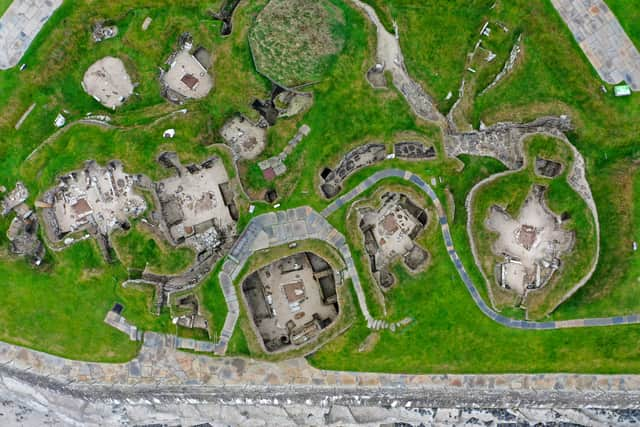
Dr Mitchell pointed to two sites under discussion - Fort George, the18th Century military fortress built after Culloden at Ardersier and Skara Brae, the Neolithic village in Orkney.
Fort George recently suffered a collapse into the sea, which was “directly in line with what had been forcecast” in a recent climate risk assessment.
Dr Mitchell said: “Now, if that happens at scale, there is a reality there. Are we as a society prepared to spend £30m to £40m on coastal protection at Fort George?”
Meanwhile, he said the loss of coastline at Skara Brae in the last 20 years had been “quite remarkable”.
He added: “I suspect that we should invest at Skara Brae. It is internationally significant. The costs of doing that and doing that long term may be unviable but I think for example, for the next 50 to 100 years, and this is where the strategy comes in, that we need to be able to say ‘Skara Brae, long term, yes we are going to invest there’.
“Are we going to invest £40m at Fort George ? Maybe not, but yes we are going to do it at Skara Brae because the cultural significance and economic impact is disproportionately strong in Orkney rather than if it were somewhere else.”
A spokesman for The Scottish Government said: “A long-term strategy is required that considers how we manage, present and make accessible the properties and associated collections in state care in a sustainable, safe and innovative way to maximise their contribution now and for generations to come.”
Comments
Want to join the conversation? Please or to comment on this article.