
How 'one of Scotland’s great icons' is helping communities a century after historic Paris Olympics win
“Eric Liddell’s story reminds us that we have more in common with others than sets us apart.”
John MacMillan is chief executive of The Eric Liddell Community, a care/specialist dementia charity and community hub founded in 1980 in memory of the eponymous Scot who 100 years ago this month won gold in the 400 metres at the Paris Olympics, a feat later immortalised in the Oscar-winning film Chariots of Fire.
Also known as The Flying Scotsman, he was famous for his compassion as well as his sporting achievements, according to The Eric Liddell Community (formerly known as The Eric Liddell Centre, and based in the former North Morningside Church at Edinburgh’s Holy Corner).
The organisation says it aims to unite people in their local communities to enhance health and wellbeing, including tackling loneliness and isolation. Its offering includes its flagship Dementia Day Care service, and Community Hub programme, encompassing its community café and providing office space for social enterprises and other local charities.
Can you explain more about the significance of the centenary of Eric Liddell’s historic success at the Olympic Games, and about your Eric Liddell 100 programme?
With the 2024 Olympic Games also being held in Paris [starting this Friday], we have a great opportunity to engage people in Eric Liddell’s story, the values he led his life by, and the inspiration that they bring.
To do this, The Eric Liddell Community joined with local, national, and international partners to develop the Eric Liddell 100, a programme of events and activities spanning three workstreams (education, cultural, and sports/physical activity) to recognise and celebrate the life, sporting, and community service achievements of one of Scotland’s great icons. We are delighted that HRH The Princess Royal is patron of the Eric Liddell 100, and that she has been able to support and participate in our endeavours at our events.
You have corporate partners including asset-management firm BlackRock and Edinburgh-based IT company Microsys, while you’ve said you’d introduced a number of business activities at The Community, and had yourself implemented a business-like approach to serving as its CEO. Can you give details on how business and The Community collaborate?
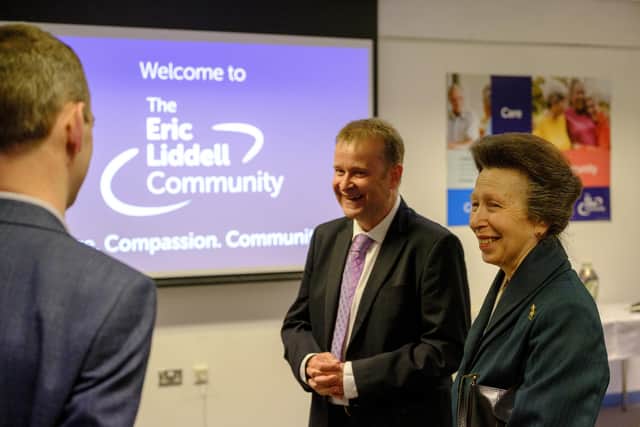

Business plays a crucially important role with the work we do to care and support some of Edinburgh’s most vulnerable people and also via the Eric Liddell 100. We have partnerships in place with businesses at a local, regional, national, and international level, and without their support, we would not be able to make the meaningful impact that we do.
When you think of our main specialism – supporting those with dementia, we know every family has been touched by the disease, or will be. Businesses are a key part of society, so we are not surprised that they have recognised the key role they can play in supporting local people.
I’m also delighted that key businesses have joined our growing list of partners to help us celebrate and secure the legacy of Eric Liddell via the Eric Liddell 100 – for example this has enabled us to submit Eric Liddell 100 squads to participate in this year’s Melrose Sevens Tournament, and we now have business partners to sponsor The Centenary Eric Liddell Lecture and the first Eric Liddell Awards later this year. Our recent pop-up exhibition in Hong Kong was supported by businesses with Scottish and UK connections.
Could you summarise your career before joining The Community – and how this provided you with skills useful in your current role?

After graduating in community development, I worked for ten years as a professional musician, playing in rock bands and working in the arts sector as a community musician. I went on to work in local government and had senior management roles in community learning, economic development, and cultural and sports services, where I was also responsible for European funding and support to the third sector.
Being able to communicate and engage with people has been a key area for me – people in need, community representatives, business contacts, decision-makers, funders, and politicians from all parties. This led me towards working in the charity sector, and I’ve been so lucky to have worked for The Eric Liddell Community for the last eight years.
Could you cite any particularly memorable moments leading The Community? What is your biggest challenge?
I’ve had a few memorable moments, and the national launch of the Eric Liddell 100 Educational Resource for schools, which took place in Edinburgh’s Castlebrae High School earlier this year, was certainly a highlight.
Any CEO working for a charity will probably say the biggest challenge is fundraising, and this has certainly become harder when we consider the recent challenges of Covid-19 and the impact this had on all levels of society and the more recent cost-of-living challenges.
We have launched our Eric Liddell 100 Olympic Appeal, which we hope will enable us to further develop the next batch of resources for schools, establish a permanent exhibition at The Eric Liddell Community, and extend the range of our sports events and activities to inspire young people.
To what extent are the life and achievements of Eric Liddell pertinent today, for example to younger generations?
We worked hard with our partners, including members of Eric’s family, to develop the values – passion, compassion, and integrity, which we feel he lived his own life by – for the Eric Liddell 100.
He spent the last two years of his life in a Japanese internment camp, but was described as its “brightest star”, and encouraged others to treat everyone with compassion.
His story reminds us that we have more in common with others than sets us apart. And all we can do is try our best, just as he did – I know I fail every day, but I’m not going to give up just yet. We believe Eric Liddell is a Scottish icon who deserves to be remembered
Comments
Want to join the conversation? Please or to comment on this article.