
Readers' Letters: National Care Service idea is not one that would work for Scots
Scottish Government should listen to councils and bin National Care Service idea, says reader
The majority of councils, via Cosla, have told the SNP government that they do not wish to proceed with the National Care Service, a flawed concept that will centralise power and decision-making but lay blame locally when it goes wrong.
Local authorities and care providers can best provide the care that is required in their area. They know the demographics, the care needs and the staff. This concept of a National Care Service is all about pulling control into government hands, adding a level of bureaucracy that is not required. As with everything the SNP government touches, estimated costs have already almost doubled, with them having been given as between £644 million and £1.26 billion over five years. Those figures are now looking more like £2bn and it will only get more and more expensive.
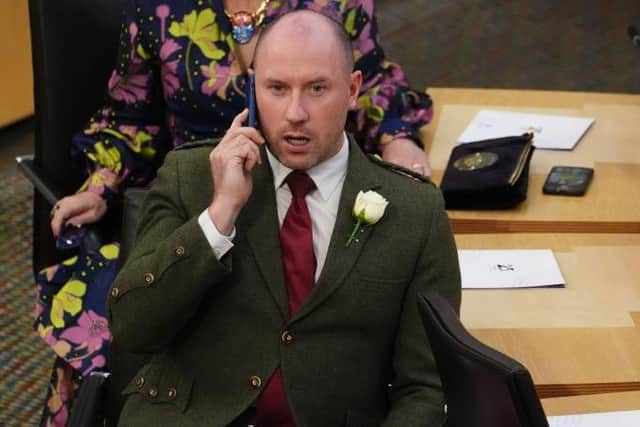
At what cost will Neil Gray, the SNP Health Secretary, try to push this through? What will it take for him to listen to those who know what is required?

Jane Lax, Aberlour, Speyside
Outside remit
So Nicola Sturgeon, clearly so proud of herself that she's not only put in one of her rare appearances at Holyrood but actually spoken, posts her speech on Facebook.
But was she talking about ever-lengthening NHS waiting times, the educational attainment gap she promised yet failed to close, her party's failure to dual the A9 as promised or its inability to meet its own climate change targets – or even the nationalists risible ferry procurement processes? No, none of these key devolved areas of responsibility. She was discussing foreign affairs – in this instance, the Ukraine conflict – which is a matter entirely reserved to Westminster.
Few of us fail to be moved by the shocking events in Ukraine, or indeed, Israel and Gaza – but our taxes fund Holyrood to focus on a raft of crucially important domestic matters, not international affairs. But perhaps Sturgeon thinks this is all too humdrum and simply beneath her?
Martin Redfern, Melrose, Roxburghshire
Like a Cassandra
The King made the point in his speech to Holyrood that devolution in 1997 was a turning point for Scotland. He was, of course, quite right, but maybe not in the way he intended. Prior to 1997 Scotland was governed by politicians of stature like Malcom Rifkind and the late Alistair Darling. They were replaced by a series of Scottish Executives, none of whose members should ever have made Lanarkshire District Council. In 1997 we had an education system which was the envy of the world, a health service which was the best in UK and one of the finest police forces in Europe. Now all that has been trashed.
I voted against devolution on three counts: first, that we could not find enough politicians of stature to run another parliament; secondly, that any future Scottish Executive would always ask for more powers, in spite of being incompetent to operate the ones they already had; and, finally, because I believed that any future Scottish Executive would continually increase the centralisation of powers to the Central Belt.
I wish I had been wrong.
Mark Tennant, Elgin, Moray
Gift of an idea?
If we could for a moment set aside our demonisation of everything Iranian, we might learn of a practice which has for centuries checked the greed of ministers, politicians and civil servants and is currently practised in India, Pakistan and Bangladesh, namely the Toshakhana, or Treasure House. First introduced in Iran as a depositary for gifts from Princes and Deputations, it was adopted by the Mughals in the sub-continent and then by the East India Company and the successor Raj which required officials to surrender any gifts, which were often reused as gifts to foreign rulers. In its current form in India, all gifts must be declared and valued by the Toshakhana officials and if over a modest sum (my memory is about £50) is only returned if the full valuation, less the initial allowance, is paid by the depositor.
If a system like this were applied in the UK in a form covering contributions in kind and money, from domestic or foreign donors, given to an individual rather than an institution it would be an assurance to us all that we were not being governed by influence-peddlers and the avaricious.
James Scott, Edinburgh
Award inquiry
At the recent annual Scottish Muslim Awards, former First Minister Humza Yousaf got the gong for “public service”. Good for him. John Swinney commented that the award was “well deserved”.
I wonder if the citation specified in exactly what ways Mr Yousaf earned that distinction. After all, his constituents are worse off than when he took office, and his party is going backwards and Scotland as whole is more bitterly divided than probably it has ever been.
If he had got the award for his efforts and services to other countries and regions over the past year or so, it would have been far more understandable.
Alexander McKay, Edinburgh
Tram ways
As Neil Anderson comments (Letters, 30 September), reaching Edinburgh Airport is quicker (and cheaper) by bus than by the tram. In fact, when looking at the cost of a taxi (around £40!), the bus or a combination of bus and tram, my wife and I decided to stick with the bus on a recent holiday. It could hardly have been quicker, or better. Almost door-to-door, we were there inside an hour.
However, had Edinburgh City Council a little more imagination they could have avoided all the vast cost and economic damage caused by building the tram in the first place by using the existing rail network and putting in the changes that would be required for a system carrying passengers around the city in a loop. The line north to the Forth Bridge could have had a loop of its own for passengers to reach an airport railway station, thence to the airport terminal by bus. Passengers from outside town could travel by train from Waverley to Morningside simply by changing trains. Existing platforms which remain in southside stations could have been used and improved by whichever company had won a bid to run the trains.
As it is, we have a council which has spent the same amount in numbers, if not value, to travel from the airport to Leith as Nasa spent sending a man to the moon!
When we have a council which prioritises such a clunky means of transport, it's no wonder that we have a large plaque placed by them in St Andrew Square telling untruths about our history as well.
Andrew HN Gray, Edinburgh
Pointless crusade
UK politicians and those of the green persuasion love to flaunt their green credentials and monotonously demand that we must save the planet by buying electric vehicles and heat pumps, eating less meat, walking or cycling, taking the bus or train and not flying or taking foreign holidays.
All this for the UK's minuscule 1 per cent of global emissions. They dare not mention the elephant in the room. There are 39 wars and conflicts in the world, each churning out multi-million tons of greenhouse gases, but this is never mentioned by those on the climate gravy train.
Ukraine is at war with Russia and Israel is at war against Hamas and now Hezbollah. Add on Syria, Iraq, Yemen and Iran. China has its eyes on Taiwan and North Korea on South Korea.
Manufacturing weapons creates multi-millions of tons of greenhouse gases and using them creates even more.
Add on the greenhouse gases created in rebuilding and surely even those with green-tinted glasses can see the futility of the UK's climate diktats. The UK's climate crusade is pointless and costly.
Clark Cross, Linlithgow, West Lothian
Save civilians
Israeli Prime Minister Benjamin Netanyahu has “settled the score” by succeeding in killing Hezbollah leader Hassan Nasrallah.
One might expect the Israeli government to stop the killing of innocent civilians now but that’s unlikely given the humiliation experienced in Iran and Ayatollah Khamenei’s vow to avenge the death of Nasrallah. Escalation is therefore inevitable and the killing of another Hamas leader does not help.
We have been here before, with former Israeli PM Ariel Sharon dubbed the “Butcher of Beirut” for massacring Arabs and creating Israeli settlements in Gaza and the West Bank.
Like Sharon, Netanyahu has an uncompromising approach by letting no innocent civilian, whether Arab or Christian, stand in his way when he sees things he considers acts of aggression by terrorists against the Israeli people. Netanyahu has been backed militarily and politically by the West to prosecute a policy of aggression with no regard for innocent human lives. Neither the UK nor US are prepared to back down on arming Israel.
Jews around the world are appalled by the escalation of war resulting in an acceleration of civilian deaths. Major Harrison Mann’s resignation from the US Defence Intelligence Agency in protest at the “needless slaughter of Palestinian civilians” speaks for many Jews when he compares the suppression of the Palestinian people with that of the Jews during the Second World War. In August Maj Mann wrote “it’s a wonder that the conflict has not already escalated into a ruinous full-scale war against Hezbollah dragging in the US and Iran”.
Given Nasrallah saw Israel’s attack into Lebanon as a “historic opportunity” who is to say it will not?
Neil Anderson, Edinburgh
Write to The Scotsman
We welcome your thoughts – NO letters submitted elsewhere, please. Write to [email protected] including name, address and phone number – we won't print full details. Keep letters under 300 words, with no attachments, and avoid 'Letters to the Editor/Readers’ Letters' or similar in your subject line – be specific. If referring to an article, include date, page number and heading.
Comments
Want to join the conversation? Please or to comment on this article.