
I was there in Saint-Etienne and Sapporo: Why England v Argentina remains ultimate World Cup rivalry
England and Argentina have delivered riveting affairs – and plenty of antipathy

While pondering the approaching World Cup semi-final between England and Argentina and wondering what angle among many to take for a preview of the game, something hit me: I realised I was present the last two times the teams met at the World Cup.
Talk about intense, riveting affairs: one in the clammy heat of Saint-Etienne in 1998 and the other four years later in the then novel environment of an air-conditioned stadium in Hokkaido, Japan’s most northerly main island.
These were the last two times the teams met full stop, competitively at least. There have been two friendlies in the last 30 years, one in Geneva and one at Wembley, although 'friendly' seems a misnomer in the annals of England v Argentina, which is now among the great - perhaps greatest? - rivalries in international football.


There’s even a Wikipedia page devoted to the subject of their antipathy. These last two World Cup meetings get plenty of coverage alongside the first time they played each other in the tournament in 1966 and the clash that springs to mind most readily: the Hand of God game of just over 40 years ago.
These ‘recent’ meetings, including That game in the Azteca in 1986, were set in the context of the Falkland Islands. The Maradona clash was four years after the conclusion of the 74-day war, with the legend stressing that he was primed to win the game for Argentina as “revenge” for his country’s inability to remove what he described as the occupying force.
“If it had been up to the Argentines, each of us, the players would have gone out there with a machine gun and killed Shilton, Stevens, Butcher, Fenwick, Sansom, Steven, Hodge, Reid, Hoddle, Beardsley, and Lineker,” is the striking way one chapter in his 2016 published autobiography, Touched by God, opens. A few paragraphs later he concedes that for him at least, it was more a matter of honouring the dead, “to give the families of those boys some relief, and to wipe England off the world map – the world soccer map, that is.” He adds: “Eliminating them from the World Cup in the quarter-finals was like forcing them to surrender. It was a battle, oh yes, but on my battlefield.”
The David Beckham redemption arc
Even as recently as last week, the Argentina FA seemed happy to release a video on social media following the dramatic last 16 win over Egypt where players can be heard singing a song in the dressing room referencing what remains a political hot potato (just ask Gary Lineker). “I am Argentine from cradle to grave, for the Malvinas (the Falkland Islands), for Diego (Maradona), for Leo’s (Lionel Messi) final chapter!” they chorused.
I can remember this backdrop from 2002, when I was beyond fortunate to be sent to cover the World Cup in South Korea and Japan. The game of games, the one even The Scotsman ended up putting on its front page the following day, was England v Argentina in the Group of Death (Nigeria and Sweden, the eventual group winners, were the others involved).
As well as a fierce, short war on an archipelago in the South Atlantic Ocean 20 years earlier, the clash had an additional frame of reference: David Beckham. He was cast as the fall guy when Argentina beat England on penalties in the previous World Cup in a pulsating last 16 clash in the Rhone-Alpes region of France. It wasn’t even as if he had missed one of the penalties.
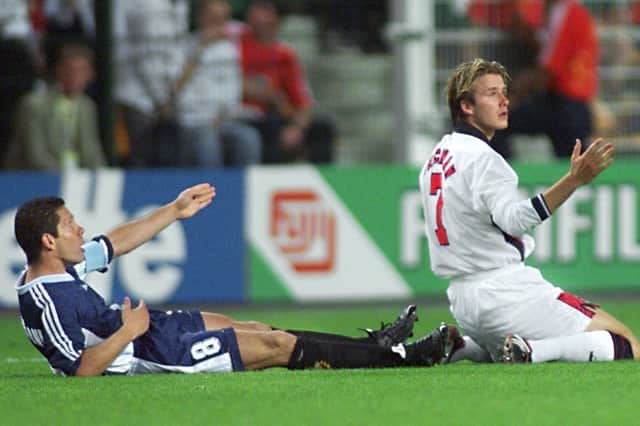
The problem was he could not take one having already been sent off for a petulant flick of his leg in the direction of Diego Simeone, now better known as the black-clad manager of Atletico Madrid. The circle of life was underlined at the recent Argentina v Cape Verde match in Miami when the pair were photographed together, both smiling broadly. “Bumped into an old friend in Miami,” Beckham wrote on Instagram.
He might not have been so eager to relive the moment had things worked out differently. A significant part of Beckham’s redemption arc was scoring the decisive penalty in Sapporo, the capital of Hokkaido and, I remember learning, Japan’s fifth largest city. I’ve just checked and it remains so (just the 1.96 million people).
I learned something else on that trip: don’t leave booking hotels to a well-intentioned editorial assistant, whose eye was attracted to premises with names like “Dream Palace”. ‘Soaplands’ or ‘love hotels’ as they are referred to in Japan. Basically, thinly disguised brothels.
Accommodation issues framed my attendance at England v Argentina in 1998 as well. Mercifully, the kindly landlord of Le Glasgow, a pub in Saint-Etienne, pointed me in the right direction on the eve of the game, Scotland fans having left him enriched a week earlier when in town for the disastrous group clash v Morocco. For whatever reason, England fans did not so obviously flood into the city. Possibly the inflated cost was a turn-off – a story circulated that tickets for the eagerly awaited encounter had soared to £500 on the black market, somewhere below the sum of several thousand pounds it will likely take to gain entry to the latest clash in Atlanta. Those who stayed away missed one of the games of that or any World Cup and a special goal from teenage wunderkind Michael Owen. England were ultimately burnt in the Cauldron, as the Geoffroy-Guichard stadium was known before its refit.
The Lionel Messi anomaly
Sadly, chances to relish the almost guaranteed drama this fixture produces have been limited in modern times. As with Scotland v England, despite the trend for football to max out commercial opportunities there has been a curious lack of willingness to arrange matches. Argentina seem to prefer to play probably more lucrative friendlies in North America and the Middle East.
The last time the countries played was in 2005, one of those aforementioned friendlies. Even Scotland have met Argentina more recently – in 2009, in what was Maradona’s first game of a somewhat unlikely and ill-fated spell as manager.
Given the heavy programme in international football these days, with so many players almost routinely edging towards and exceeding 100 caps, it seems incredible that Messi, after 205 appearances, has never played against England before. He himself noted this anomaly in the aftermath of Argentina’s quarter-final victory over Switzerland.

It might be tempting to conclude that this, therefore, is his moment, the one he has been waiting all his career for. But he’s already won a World Cup, which many presumed he would view as the perfect time to announce his retirement, from international football at least – as he had done six years earlier before changing his mind.
This, therefore, is a bonus World Cup, one in which he has nothing left to prove, although that hasn’t stopped him excelling. The 39-year-old might play a sophisticated form of walking football these days but it’s taken Argentina deep into another tournament, with one observer, World Cup specialist Simon Kuper, diagnosing a case of ‘Messidepencia’.
The author and Financial Times columnist identified this eight years and two World Cups ago in actual fact. Perhaps worryingly for Argentina, the condition remains as acute today, perhaps more so. Without Messi, much of Argentina’s seeming lustre, perhaps nearly all of it, would fade. He is their lynchpin, their main hope.
As for England, it’s true they are ‘suffering’ from their own attack of overreliance: Kane-Bellinghamdepencia. Of the 13 goals scored by Thomas Tuchel’s side so far, 12 of them have come from these two players. Help has also come from on high – a Spidercam to be accurate. This device overhanging the pitch provided an unusual and likely illegal assist for Jude Bellingham’s equaliser in Miami against Norway. It reminded me of an incident in England’s Euro 2020 semi-final against Denmark at Wembley, when Raheem Sterling won what proved the decisive penalty despite two balls being on the pitch at the time. The referee played on.
NEXT READ: How a 64-team World Cup would work and impact on Scotland as Fifa consider expansion for 2030
Of course, fortune favours the brave. England have proved their mettle in difficult circumstances against both Mexico and Norway. The Hand of God is a distant memory, as is England’s payback win in 2002 in the Sapporo Dome.
Like then, the roof of the Atlanta Stadium, venue for Wednesday’s semi-final, will be pulled tightly shut. Hidden from heaven, the players may have to manage without divine intervention on this occasion.
Comments
Want to join the conversation? Please or to comment on this article.