
How a 64-team World Cup would work and impact on Scotland as Fifa consider expansion for 2030

Fifa to discuss prospect of increasing World Cup to 64 teams for 2030
The 2026 World Cup reached 100 matches over the weekend when Argentina defeated Switzerland to reach the semi-finals. By the time the tournament ends with the final in New Jersey next Sunday it will have hit 104.
With 48 teams, 12 groups and the introduction of an extra knockout round of 32, the current edition of the World Cup is already the biggest in history. Now, football's governing body is considering taking that expansion even further.
FIFA president Gianni Infantino has revealed that the prospect of increasing the number of teams participating at the World Cup finals to 64 for the next tournament in 2030 is on the table.
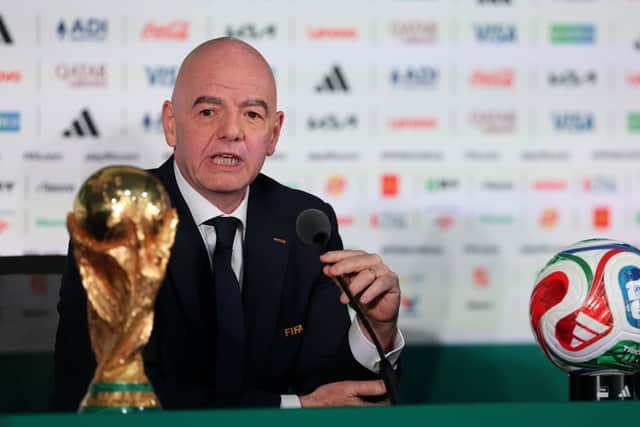

"These are all issues that we will be examining after the World Cup," Infantino said. "When organising a World Cup, it's important to organise it for the whole world - not just Europe and South America, but effectively the entire world. Every nation should be allowed to dream of participating in the World Cup.
"You can see that the quality of the teams is extremely high, and it's getting higher and higher, all over the world. If you don't give smaller countries a chance to participate in the World Cup, they'll lack the incentive to keep improving."
Whether adding a further 16 teams to the mix is good or bad for the tournament will be debated.
The 2026 World Cup has certainly been an enjoyable one with underdogs such as Cape Verde and DR Congo bringing much to the party. It has, however, been noticeably long.
It seems ages ago that co-hosts Mexico opened the tournament with a 2-0 win over South Africa. 32 days to be precise. The 2022 World Cup in Qatar would have already finished three days ago but the 2026 finals will run to 39 days from start to finish.
Scotland qualified for the first time in 28 years as a result of winning their qualification group to gain one of the 16 European slots up for grabs. Under the old 32-team World Cup format, only 13 UEFA countries made it.
A 64-team tournament could see almost half of Europe's 55 nations make the cut, which would only further increase Scotland's chances of qualifying while also adding more slots for Africa, Asia, the Americas and Oceania. Indeed, a 64-team World Cup would see almost a third of the 211 Fifa-affiliated countries qualify.
How a 64-team World Cup would work
The concept, first proposed by South American association CONMEBOL, would result in the World Cup finals being expanded to 16 groups of four teams, leading directly into a 32-team knockout phase.
Only the top two teams in each group would advance to the next round meaning there would be no progression for any best third-place teams. That could arguably make it more difficult for Scotland to reach the knockout stages for the first time. A third-place finish with three points was not enough this summer as Steve Clarke’s side exited the tournament on goal difference. It will now be up to his successor, whoever that may be, to go one better.
To win the trophy, a team would have to play eight matches (three group games plus five knockout games), which is one more than the historical 32-team era required, but no different from the 2026 tournament. The overall number of matches, however, would increase to 128.
The 2030 World Cup is scheduled to span three continents and six countries with Spain, Portugal, and Morocco as primary co-hosts and single ceremonial matches played in Uruguay, Argentina, and Paraguay to mark the tournament’s centenary. Saudi Arabia, however, have been chosen as single hosts in 2034 and delivering a tournament of this size independently would present unprecedented logistical, financial and infrastructural challenges.
While expansion could open the door to smaller, developing football nations, the revenue generated from a 64-team World Cup would also grow with more lucrative television and commercial deals plus increased ticket sales. In theory, this would mean more revenue to be distributed to the member associations. It is estimated that The Scottish Football Association secured $10 million (approximately £7 million to £7.8 million) in base prize money from FIFA for their participation in the 2026 World Cup.
Infantino certainly seems to be in favour of further expansion. He described the first 48-team World Cup as "a huge success", citing the progression of nine out of 10 African teams to the knockout stages.
"At the last World Cup, there were only five teams from Africa," he said. "That just goes to show how important it is to include all teams - to give them this opportunity to participate.”
Comments
Want to join the conversation? Please or to comment on this article.