
Return of the King - is cash on the way back?

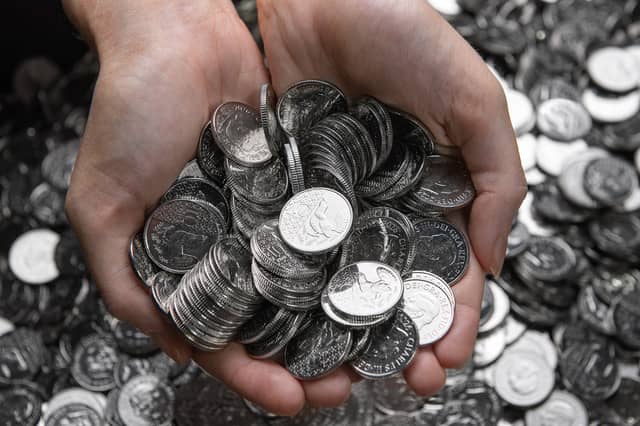

Despite the rise of contactless payments there are signs that the use of cash is increasing again.
In the world of money, cash is king.
In recent years the rise of contactless card payments and online services, alongside the continued shuttering of bank branches across the UK, has seemed like an inevitable slide towards a cashless society.
Despite all the blows however cash has remained an important part of life for Scots - and recent reports suggest it is on the rise again.
Its continued importance was underlined in a small way this week as more than seven million 10p coins bearing the King’s portrait entered circulation for the first time.
They will soon start appearing in people’s pockets and wallets, proving that for now cash is still an important part of the economy.
The cost of living crisis has been credited with moving more people back towards increased use of physical money, as it is considered - rightly or wrongly - an easier way to track your spending and manage your budget.
The World Cup and Commonwealth Games has also helped increase cash use, according to the Post Office - which thanks to the closure of many high street bank branches is now one of the biggest handlers of cash in the UK.
The Post Office said that in July 2026, Scottish branches saw 1.07 million cash transactions (deposits and withdrawals) across both business and personal customers. That is a 1.4% rise month on month, and a 3.9% rise year-on-year.
The second quarter of this year (April – June) saw 3.11 million cash transactions across Scotland’s 1230 post offices - a 6.4% rise quarter on quarter, and a 2.5% rise year on year.
And a recent study carried out by the Post Office and WPI Economics on access to cash and banking found that 85% of people in Scotland use at least monthly, compared to 77% in the UK.
“Not everybody has a bank account. Not every child has a card. At Christmas we get kids in with pocket money buying presents for their family, and I’m not willing to be the shop that turns them away.”
Hithendra Cheetirala, postmaster of Stirling Post Office, has run branches since 2015.
“We have definitely seen an increase in cash withdrawals and deposits by businesses and personal customers in the past year and there’s certainly been an increase over the summer,” he said.
“People like to budget over the summer when weekly spends become more expensive with holidays and children off school, days out. People like to use cash for small items like ice creams and are pleased when businesses give the choice of paying in cash as it helps them budget their spending.
“With the closure of so many banks, more and more businesses use post offices to deposit their takings – we get a lot of businesses depositing their takings at our branches.”
Handling cash does come with a cost for businesses of course, with electronic transfers doing all the work of counting, sorting, and depositing payments. It's little wonder then that over the last year around 14% of UK high street businesses said they had gone cashless.
In Scotland however, where cash appears to be used more frequently and more regularly than in other parts of the UK, many stores are resisting the move, despite the benefits it can bring them.
The Fat Buddha Store, an independent multi-brand retailer trading on Queen Street in Glasgow since 2005, is one business determined to keep using cash
Alongside clothing and footwear, it is one of Scotland’s main suppliers of spray paint to artists, muralists and decorators. And it has found cash use concentrates sharply on particular groups of customers, such as self-employed working artists, and people without bank accounts or cards, who would be cut off entirely if the shop went card-only.
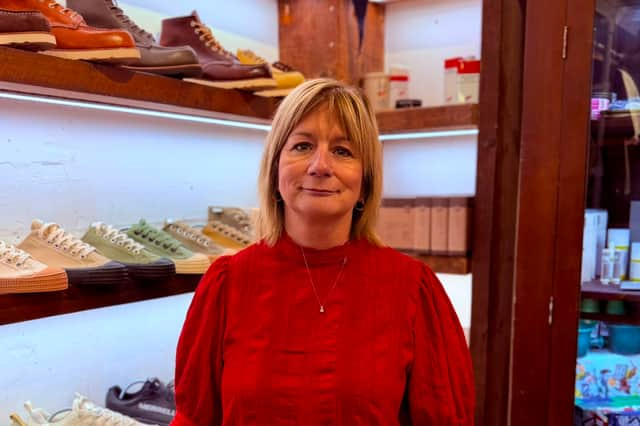
Gillian Frew, managing director and co-owner of Fat Buddha Store and an elected member of the FSB Scotland Volunteer Members Council, as well as Co-Chair of Make Glasgow Region A Living Wage City, said she had seen first-hand the drop in cash use over the last twenty years
“I used to work in the St Enoch Centre and back then cash was 95% of the business,” she said. “Banking it was a big part of the job and you had to go to the local branch with lots of cash.
“Now it’s far less, but the decline has stopped. We are seeing the same amount of cash now as we did four or five years ago.”
Over the last year the business found around 15% of transactions were in cash - and almost half of them were purchases of art supplies.
“Across the shop, about one sale in seven is cash,” Gillian said. “For spray paint it’s one in four. Our paint customers are twice as likely to pay cash as anyone else who walks through the door — and paint accounts for nearly half of every cash sale we take.
“These are self-employed artists. Commissioned murals, community projects, decorating. They get paid in cash for a job and spend it on materials the same week.
“Going card-only wouldn’t lose us a few customers here and there. It would lose that whole trade.
“Not everybody has a bank account. Not every child has a card. At Christmas we get kids in with pocket money buying presents for their family, and I’m not willing to be the shop that turns them away.”
Like many small business owners Gillian has also found that continuing to accept cash payments is vital when internet services are out - but admitted there was a growing cost to maintaining cash sales.
“Two days ago our broadband went down and we couldn’t take a card payment,” she said. “Cash is the reason we stayed open. You don’t think about that until the day it happens.
“The conversation about cash is usually about whether people can get hold of it. For a shop, the harder question is what it costs to put it back in the bank. That’s the bit that has quietly got worse.
“Counting the till and doing the float costs us over £2,000 a year in staff time. We’re a Living Wage Employer, one of very few retailers in Glasgow, so we pay properly for those hours. “We carry that cost on purpose — but let’s not pretend accepting cash is free.”
The need for banks to be more supportive of businesses using cash was also underlined by Guy Hinks, Scotland Chair of the Federation of Small Businesses.
“For thousands of small businesses, cash remains a vital method of payment,” he said. “More than half of small businesses in Scotland continue to accept cash payments despite the challenges that often presents for them.
“It’s essential that small firms continue to have the freedom to choose the system that works best for their customers, whether that’s cash-only, card-only, digital or fintech solutions, or a combination of any or all of them.
“For that to remain a viable option for small firms and consumers, including many vulnerable groups, the right infrastructure needs to be in place.
“We’ve seen a huge decline in the bank branch network in Scotland in recent years. That has meant an increase in the logistics and costs of handling cash for many small businesses, to the point where some have found it unmanageable.
“In areas where bank branches have closed, banking hubs are starting to provide consistent and secure facilities for cash withdrawals and deposits for businesses, as well as financial advice.
“We want to see the roll-out of these hubs delivered as quickly as possible including actively considering calls from communities which are asking for one but have not yet been identified as a hub location.
“Cash is also an important competitor to cards and other kinds of payments, acting as a brake on rising fees, as well as acting as a reliable backup when digital systems are unavailable. That’s particularly important in places with poor digital connectivity.”
Comments
Want to join the conversation? Please or to comment on this article.