
Drill and blast: How Shetland's £1.5bn inter-island tunnel network will be built

Excavated rock could create reclaimed land to extend the islands
Explosives would be used to blast through rock to create the planned £1.5 billion network of inter-island tunnels in Shetland, according to consultants working on the project.
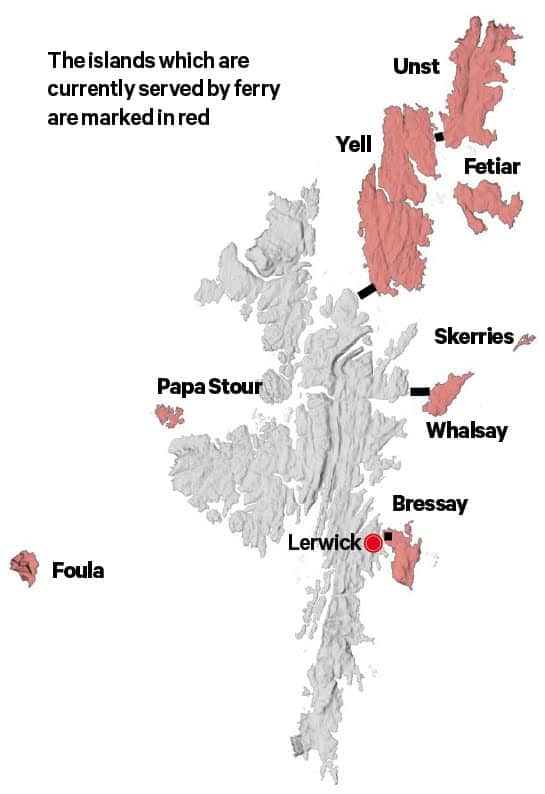
Details of how the sub-sea links would be constructed came after the local authority took the latest step towards replacing ferries to four of its islands, with the first possible within eight years.

Tunnels are seen as cheaper in the long run than repeatedly replacing the islands’ ageing ferry fleet, providing quicker and more reliable transit and being likely to attract more residents.
Shetland Islands Council last week approved a new draft transport strategy that includes tunnels between Mainland and Yell, Bressay and Whalsay, and another between Yell and Unst.
Other islands without bridges to Mainland - Fetlar, Skerries, Papa Stour and Foula - would continue to be served by ferries.
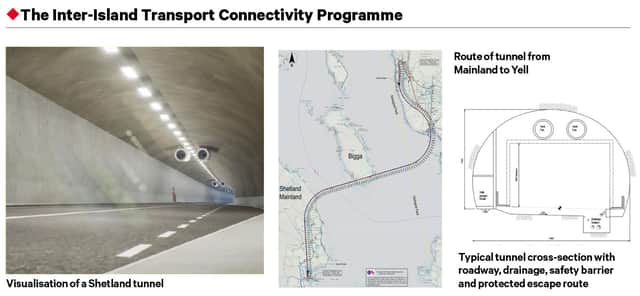
The first, four-mile tunnel to Yell, which has a population of 960, is estimated to cost £402 million.
A Yell-Unst tunnel could cost £345m, with a further £255m for a Bressay tunnel and £486.5m for one to Whalsay.
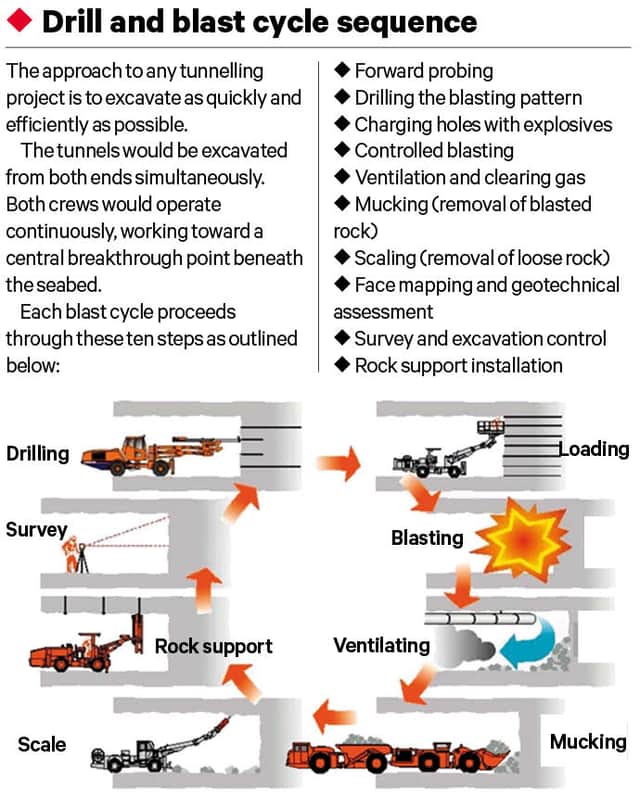
Andy Sloan, executive vice president of engineering firm Cowi, which is advising the council, said the tried-and-tested hard rock “drill and blast” method would be used.
This involves drilling a pattern of holes into the rock at the tunnel face and packing them with explosives, which are detonated to break up the rock.
Blasting would start at both ends of the tunnels simultaneously with continuous working until a central breakthrough point was reached beneath the seabed.
A report by Cowi to the council said: “This dual‑heading approach significantly reduces the overall construction duration and enables more efficient use of plant, labour and tunnelling equipment.”
The broken rock will be removed and the tunnel then lined to provide support as construction advances.
Rock could be used to reclaim land to extend the islands.
The exclusion zone during blasting would stretch only as far as the site compound at the tunnel mouths.
Mr Sloan said the technique had been successfully used in the Faroe Islands and Norway, and for advance work tunnels at the Coire Glas pumped hydro scheme north east of Fort William.
The report said: “Sufficient experience of the design and construction of such tunnels exists within Scotland, although further investigation of site-specific conditions, supply-chain capacity and construction risks would be required.
“Hard rock drill and blast techniques give the flexibility to deal with the anticipated variations in rock mass conditions along the route and the optimisation of the tunnel profile for rock support and end usage, albeit with associated risks relating to geology, groundwater and construction environment which would require detailed investigation.”
Mr Sloan said: “Tunnelling in Scotland’s islands is relatively straightforward from an engineering and construction perspective.
“Because Scotland sits predominantly on rock, we can use the drill and blast technique, successful all over the world in the creation of subways, canals, roads and hydro electric schemes.
“The lengths we are talking about are relatively short in tunnelling terms and the process is fairly simple.
He said the tunnels themselves are likely to be relatively simple, with a smaller diameter and single carriageway compared with, for instance, the eight-lane Fraser River Tunnel, which is being built in British Columbia.
Funding has yet to be secured but a combination of private finance and council borrowing is being considered.
Tolls would be charged to pay for tunnel maintenance at the same level as ferry fares, currently £16.50 return for drivers on all four routes.
The tunnels would be restricted to motor vehicles, with pedestrians, cyclists and horse-drawn vehicles not permitted because of the length of the tunnels and safety risks.
A council report said buses that could carry bikes were likely to be provided for foot passengers and cyclists “to provide a broadly equivalent level of service to the current ferries”.
Loads such as fuel and whisky could be transported through the tunnels but would be accompanied.
Comments
Want to join the conversation? Please or to comment on this article.