
Obituary: Dave Hewitt, giant of the hill-walking world
Dave Hewitt. Born: July 10, 1961 in Derby. Died: November 24, 2025 in Cambuskenneth, aged 64
Not for nothing was Dave Hewitt, who died suddenly at his home in Cambuskenneth on November 24, aged 64, known as a giant of the outdoor publishing world. His bottomless well of hill knowledge and insatiable curiosity for everything else made him a boon companion, provided you could stomach the oily sardines which generally formed the basis of his on-hill rations. But his 6ft 8in frame made every one of his giant strides worth two of most ordinary mortals. Small wonder he racked up thousands of ascents of Munros, Corbetts, Marilyns and other eminences. His favourite hill was Ben Cleuch in the Ochils near his home where he logged his 1,783rd ascent just six days before he died.
Hewitt was born on July 10, 1961 in Derby and grew up in Swanwick, on the south-eastern edge of the Peak District. His father was a railwayman and a cricket lover, which accounts for at least two of Hewitt’s abiding enthusiasms. As a schoolboy, he became the scorer for the local cricket team, embracing the task so whole-heartedly he became known as ‘Frindall’ after the BBC’s Test Match Special expert.
He arrived in Scotland in 1979 to study statistics at the University of Aberdeen. He never completed his degree but he never left Scotland either (aside from visits to his family with whom he remained close). Instead, he joined a long line of English writers celebrating the Scottish hills from Walter (W.A.) Poucher (Licolnshire), Irvine Butterfield (Yorkshire) and Alfred Wainwright (Lancashire, about whom Hewitt wrote a fine book-length appreciation – A Bit of Grit on Haystacks), to more recent writers such as Martin Moran (Tyneside) and Ralph Storer (also Lincolnshire).

It is not difficult to reconcile Hewitt’s interest in statistics with his interest in lists of hills. The Clerk of the Lists at the Scottish Mountaineering Council considered Hewitt the ultimate authority on who completed what, when and where.
In 1986, by his own description ‘footloose and fancy free’ – which meant unattached and with limited career prospects as a youth and community worker in Glasgow – he decided first to identify and then to walk the line which divides Scotland between rivers flowing west and east. Nobody had done either before. The following spring, he set off from Hobbs Flow, a boggy corner of Scotland’s southern border. Following his carefully researched route all the way, he reached Cape Wrath exactly 80 days later.
It was to be another seven years before Walking the Watershed, his account of this pioneering epic, appeared in book form. In the meantime, he and Perkin Warbeck, the alias of Doug Small whom he had met thorough volunteer community work, had launched The Angry Corrie. This self-described ‘hillzine’ was, as they wrote in its first edition in 1991, a riposte to “the entire opus of Scottish hill writing [which] over the past couple of decades has been as stiflingly stuffy as a midge-filled tent on a damp August morning”.
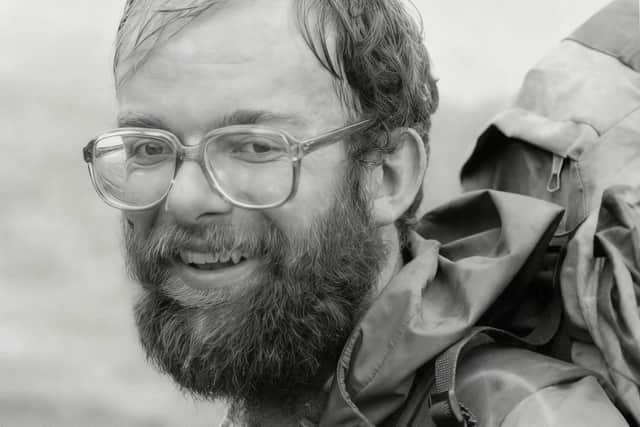
In the early days, most of TAC was written by Hewitt and Small, though a disparate coterie of argumentative, witty and well-informed writers quickly coalesced around it. The illustrations, by Chris Tyler and Craig Smillie, were another attraction. Hewitt’s distinctive bearded, bespectacled appearance was such a gift that he was sometimes recognized in Highland car parks from the cartoons alone. Part of the fun was its many madcap quests, all pursued with deep seriousness, such as the hunt for the empty Ordnance Survey grid square. But it was also fair-minded. The letters page was always open to alternative viewpoints. Estate factors, historically the enemy of walkers, such as Simon Blackett at Invercauld on Deeside, became regular correspondents.
Apart from its inherent qualities, TAC captured the zeitgeist at a time when the woolly bunnet and plus-fours of Tom Weir’s generation had given way to Goretex and fleece. Soon after its launch, it was featured on a similarly irreverent BBC television series, The Munro Show, presented by Muriel Gray. Hewitt went on to become the question setter on Gray’s follow up comedy quiz show, The Golden Cagoule and a regular columnist in The Great Outdoors.
This growing reputation enabled him to launch his own publishing imprint, TACit Press (the sly joke being that tacet in Latin means ‘be silent’, the opposite of a publishing house’s objective). Its first publication was Walking the Watershed but several other volumes followed including some related to the Relative Hills of Britain, the brain child of Alan Dawson, another early TAC contributor. Whole new categories of hills emerged, not least the Hewitts – Hills in England and Wales In excess of Two Thousand feet.
It was no surprise, therefore, when The Scotsman launched its own Outdoors section in 1999, that Hewitt was invited to join the team. He contributed a column entitled ‘Hill Informed’, as well as a lot of the background editorial heavy lifting. The section did not survive the digital revolution but Hewitt was later taken up by the short-lived Caledonian Mercury and went on to work for The Times and the hill magazine Grough.
He was no fearless mountaineer. It took three attempts and a member of the local mountain rescue team to get him up the Inaccessible Pinnacle on Skye before he could finish his own Munro round in 2007 on the Saddle in Glenshiel. But he was not afraid of confronting grand reputations. He took on the BBC in the pages of The Times in 2007, pointing out that comedian Griff Rhys-Jones had not reached the summit of Ben Nevis as he had claimed in the BBC series, Mountain.
When he moved to the Stirling area in the late 1990s, to be with his thereafter life-long partner Tessa, he became a stalwart of the local chess club, captaining teams to victory in several leagues. “Cricket, Chess, Cleuch, Cats” was one crisp summary among the outpouring of affection on many hill forums which greeted his passing. Hewitt, no mean prose stylist himself, would have appreciated the economy, rhythm and modesty of the epitaph.
Obituaries
If you would like to submit an obituary (800-1000 words preferred, with jpeg image), contact [email protected]
Comments
Want to join the conversation? Please or to comment on this article.