
Readers' Letters: Swinney's food promise is an admission of failure
SNP promise to cut food prices fails to convince reader
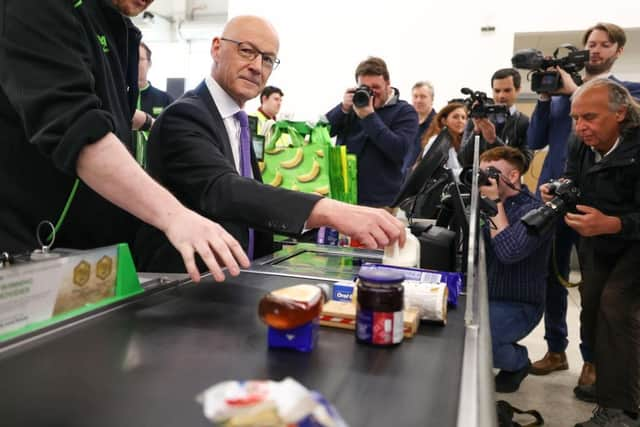
The SNP's proposal for national food pricing is more than a PR stunt; it is a confession of economic and fiduciary failure. By proposing price controls the SNP effectively concedes that its policies have created structural deficits in the economy so severe that they impact the population.
History is a graveyard of attempted government price controls. From Diocletian’s Rome in 301AD to Revolutionary France, failure was uniform. Modern history is no different. From Argentina to Zambia and including the world’s largest democracy India, to communist USSR and Cuba, to the dictatorships of Venezuela, Zimbabwe, and Chile, all have proven that mandating “fair” prices destroys supply and they fail. Even our own domestic history offers a warning. The disastrous “Prices and Incomes” policies of Harold Wilson and Edward Heath in the 1970s led to the three-day week and runaway inflation.
When any government proclaims it will dictate the price of essentials it is decreeing with aplomb its fiscal incompetence. For the SNP, this “fair food” law is an acknowledgment of the consequences of their own mismanagement. On the positive side many of these proclamations of price control came in the dying embers of these governments. One can only hope.

Martin Sweeney, Archerfield, North Berwick
No answers
John Swinney has never had a job outside of politics. To all intents and purposes he lives in a political world of his own.
Knowing full well there is no mechanism he can use to set up his own independence referendum, he has nevertheless promised to prioritise independence immediately following re-election.
If he thinks the UK government will allow him to even attempt to transfer referendum powers from Westminster under a Section 30 Order he’s labouring under a king-size misapprehension.
When all’s said and done, in 2022 the Supreme Court ruled that the Scottish Parliament does not have the power to legislate for a referendum for Scottish Independence.
Like it or lump it, Mr Swinney is a British Scot, subject to British law. I asked him several times how Scotland would survive outwith the Union and he didn’t give me the courtesy of a reply.
His argument that other small nations pay their way is a non sequitur. As I wrote recently, their income exceeds expenditure, unlike Scotland which relies heavily upon the Barnett formula, without which Scotland would not survive.
Then there are little things like currency after independence. Scotland may wish to continue using sterling but that would depend upon the UK government of the day agreeing. And there would be a cost.
Whether Scotland’s borrowing costs would be higher or lower than in a currency union would depend on the Scottish government reducing its ever-present debt burden, currently running at £26.5 billion – or 12 per cent of GDP.
It could only increase government income by seriously increasing income tax.
First Minister Swinney is in cloud cuckoo land if he thinks that his prioritising independence could actually make the slightest difference.
Doug Morrison, Tenterden, Kent
Tide is rising
Hugh Pennington (Letters, 29 April) is either suffering from selective amnesia or is disingenuous in attempting to make out that the Better Together campaign did not claim change would result from a No vote in the 2014 independence referendum.
Admittedly it was almost a generation ago, but many have not forgotten the promise that a No vote would lead to “equal partner” status within the UK and the granting of “extensive new powers” to the Scottish Parliament.
Setting aside the fact that instead of having guaranteed membership of the European Union Scotland has been taken out of the EU against the will of the Scottish electorate, EVEL (English Votes for English Laws), introduced by David Cameron immediately after the 2014 referendum without any prior notice, the Tory’s UK Internal Market Act and Labour’s UK Growth Fund, have all served to diminish the influence of Scottish politicians and Scotland’s parliament at Holyrood. Instead of the “Home Rule” promised by Gordon Brown the Scottish government has had to confront further impediments to building a wellbeing society, from the imposition of Westminster austerity to the bedroom tax and the two-child cap (including the notorious rape clause). Recent claims from voices which backed Brexit that Scotland should lead the UK echo more duplicitous, if not discredited, Better Together voices from the past.
To infer that scientific co-operation would cease should Scotland become independent sounds like the desperate claim of someone who has finally realised that even as ex-Chair of Aberdeen Better Together he cannot hold back the tide of popular opinion for real change and for Scots to make a long-overdue fresh start through determining their own future.
Stan Grodynski, Longniddry, East Lothian
Stop the boats?
Malcolm Offord, Reform UK’s leader in Scotland, stated at a Holyrood election debate that he owns six houses, six boats and five cars.
It is interesting to note that Reform UK’s solution to “stop the boats” is to buy them.
Alex Orr, Edinburgh
Calling Sir Tom
How dare Malcolm Offord have several houses, cars and boats? How dare he mention it? Actually, it’s already published in his Wikipedia entry. Rich people have possessions and are often, like Mr Offord, philanthropists.
One of our richest and most philanthropic citizens is Sir Tom Hunter. Like Malcolm Offord he hails from the west of Scotland and was brought up in modest circumstances. Both of these men are undoubtedly talented and have worked hard and imaginatively to build up successful businesses.
The problem is that, in 21st-century Scotland business is neither well-regarded nor well-supported. Yet from where else does the money come to support public services and all the multifarious freebies in government’s gift? Sir Tom Hunter has lamented this, and more: “Our education standards are falling, our health service is struggling and we have a lacklustre economy... Scotland has not been a business-friendly for the last ten years... [and] we pay more for worse outcomes from our services.” He adds: “If you're saying to the voters, ‘we’ve got a £5 billion deficit, we’re going to have to cut things’, they’re not going to vote for you. If you say, ‘we’re going to give you free dental care, child care, social care...’, aye, I’ll vote for that. But it’s dangerous... it’s dangerous stuff."
Voters will support whoever offers them the highest bid, not what is best for the country, and that auction is bad for democracy. It characterises SNP rule and campaigning.
If only Sir Tom Hunter had been the one to enter politics. We could do with someone like him at the helm now.
Jill Stephenson, Edinburgh
Hypocrisy
What should we make of those on the left who are condemning Malcolm Offord for admitting that he owns six houses, five cars and six boats? He also stated that he has paid £45 million in tax and has employed hundreds of thousands of staff.
John Swinney has revealed that he owns one home, one car and no boats, as if that makes him more righteous than someone who has worked hard, taken risks and made the most of opportunities that he created for himself from very poor beginnings. Mr Swinney has been a career politician for more years than I care to remember, not creating privately funded jobs or paying as much tax as Mr Offord to put back into the public purse.
What Mr Swinney does do, however,is reach out to luvvies like Brian Cox and Martin Compston to try to encourage voters to rip the UK apart. Mr Cox is reported to have a net worth of £12m and has homes in USA and London. Mr Compston is believed to have a net worth of about £3.5m.
What makes these millionaires acceptable to Mr Swinney yet makes him condemn Mr Offord for what he has? The hypocrisy reeks.
We need more entrepreneurs in Scotland who want to create jobs, make successful businesses, create wealth, and pay taxes to support our public services.
I am no fan of Reform but I’d much rather have one Malcolm Offord than ten John Swinneys or any others who want on the political gravy train.
Jane Lax, Aberlour, Moray
Happy days
The photographs of activity around Edinburgh’s Waverley Station (Heritage, 29 April) took me back to the early 1960s when I was a postman before joining the Armed Forces.
Night shift in the GPO meant down to the station to meet the London Mail Train and unload a mountain of postbags which were then quickly moved to the sorting office so the night staff could get it sorted for first delivery. Yes London to Edinburgh in a day. A very busy time.
An earlier memory was of Waverley Market and the exhibitions held there – the Ideal Home Exhibition had one stand every year where a man would guess your weight for a shilling!
Another was of life in the USA, and for some reason it seemed as if all the information was on blue paper, or at least my memory of it, it was a long time ago.
Charles Lowson, Fareham, Hants
Write to The Scotsman
We welcome your thoughts – NO letters submitted elsewhere, please. Write to [email protected] including name, address and phone number – we won't print full details. Keep letters under 300 words, and in the body of the email – no attachments – and avoid 'Letters to the Editor/Readers’ Letters' or similar in your subject line. If referring to an article, include date, page number and heading. No poems.
Comments
Want to join the conversation? Please or to comment on this article.