
Readers' Letters: Edinburgh citizens are on the road to ruin
The state of Edinburgh’s roads is a national disgrace, reckons reader
I journey from the Second City of the Empire to the capital quite frequently. Slow journey times on the M8 due to congestion, road works and HGVs overtaking on the long drag up to Harthill (my pet hate) have been as nothing, however, compared to my drive across Edinburgh last Sunday from Bruntsfield to Leith.
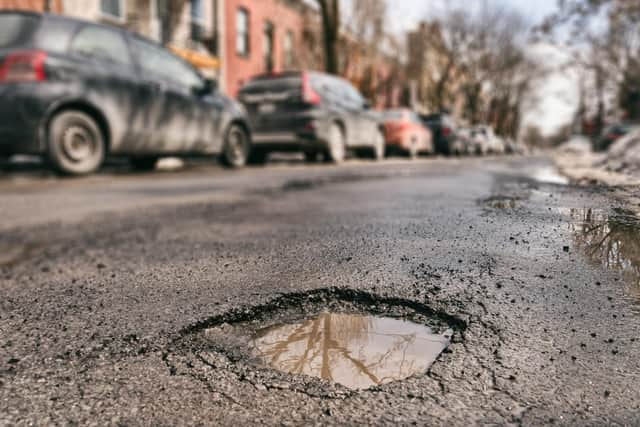
I’m familiar with Edinburgh roads and had my route planned in advance – no satnav required. It took forever. Roads I remembered as open now sealed off with bollards. Multiple “sleepers” (far too many) of varying height and depth on residential roads that jarred the neck and spine, even when taken at funereal speed. Worst, more unrepaired ruts than I’ve ever encountered in my driving life! Tyre pressure warnings lit up the dashboard. Indeed, I felt fortunate the car suspension remained intact.
Both driver and passenger were relieved when this highly uncomfortable, bone-shaking driving experience came to its end without the need for a visit to the chiropractor! My passenger, however, opted for a return journey back to Morningside by tram and bus. In truth, I’d have joined them if I hadn’t had the car.

I’m sure Edinburgh City Council will be delighted to know its policy of driving the motorist to extinction in the capital is working so well. I for one will be reducing my intra-city car travel when in Edinburgh. And as such journeys are typically to paying venues and restaurants etc, where public transport options are either unavailable, inconvenient or inappropriate, the city’s economy will be seeing much less of my disposable income.
With above average household income and residential property values, but below average council tax rates and rate increases, I guess the good citizens of Edinburgh are getting the roads they deserve. Or maybe they are not shouting loud enough for a more balanced approach to road transport policy.
Ewen Peters, Newton Mearns, Renfrewshire
Unsafe Swinney
Is it really credible that many still appear to think the biggest party after the election in Scotland will be the SNP after nearly 20 years of mistakes, failed policies and a near total absence of anyone taking responsibility? John Swinney is still trying to be confident of success (“SNP minister signals a cut to income tax”, 28 April) but is this just a front? This tax cut would be a surprise given that the SNP potential spend outstrips its potential income so it must be an electoral sop, but there is another bigger sign of panic in the SNP ranks.
Mr Swinney has altered the “terms” of his independence referendum bid. His fabled absolute majority is now watered down to “the biggest party”. Not only that, but he intends to arrange a constitutional convention but exclude Reform UK. This is blatantly decrying democracy. Mr Swinney has read the writing on the wall. His majority is highly unlikely and even his job is no longer safe. Pride comes before a fall.
Gerald Edwards, Glasgow
Sneaky moves?
Don't be fooled by SNP MSP Mairi McAllan's Bambi persona. She knows very well saying that Scotland has “too few migrants” will drive horrified Scottish nationalists to “loan” Reform their vote in the regional “top-up” to give her party a “fright” – and in doing so ensure Scottish Labour's demise. It’s a classic “Briar Patch” gambit.
The SNP's “both votes SNP” strategy has always been patently absurd. The more constituency seats won, the less regional “top ups” are possible as votes are divided down by the number of seats each party holds plus one. A clean sweep of constituencies makes regional seats mathematically impossible.
Hence the Scottish Greens’ parasitical Holyrood existence from cynically targeting list seats only – and loaned votes from less arithmetically challenged nationalists.
The SNP regards Reform as all flash and cash. Labour, on the other hand, is the vampire that won't stay staked. Finishing a clear third to Reform come May, however, would seal more than Anas Sarwar's doom – and Reform are best placed to deliver it.
Well played, Ms McAllan.
Mark Boyle, Johnstone, Renfrewshire
Details please
I have always understood that when I vote in an election, I am choosing the person I want to represent me. Their personal values and integrity are more important to me than the party they represent, although that party’s manifesto is a relevant consideration.
For the Scottish Parliamentary elections I can assess the candidates standing in my constituency through local media, campaign materials and hustings. However, it is far harder to find meaningful information about those standing on the regional lists.
I have examined the top three candidates for the six main parties in the Highlands and Islands region. Of the 18, five are former MSPs whose records can be judged. A further ten are candidates in other constituencies in the region, often in areas far removed from my own. I can find very little information about them. For the remaining three, beyond a name and photo on a party website there is virtually nothing. This makes informed scrutiny by voters difficult and weakens the direct accountability we should expect of elected representatives.
Consequently, once elected, some list MSPs may consider themselves more accountable to party structures than to the electorate. There is frequent comment on the poor quality of debate at Holyrood and I think there may be a link. MSPs relying heavily on speeches and questions prepared by political advisers may, in doing so, demonstrate greater loyalty to their party than to those who elected them.
A system based entirely on a larger number of constituencies, using the Single Transferable Vote, could retain broad proportionality while ensuring every MSP has a direct electoral mandate from identifiable voters. That would strengthen both accountability and engagement in our parliamentary democracy.
George Rennie, Inverness
Change record
As Chair of Aberdeen Better Together I found it hard to understand Peter Ovenstone's statement that we made promises of change if we won (Letters, 28 April). Our fundamental principle was to fight against the repeal of the 1707 Act of Union, and keep the status quo. We didn't need to publish a 649-page White Paper like the one signed off by Alex Salmond. It would have been impossible for us to come up with an agreed manifesto for change in any case, because the group had Tory, Labour and Lib Dem members, united because of support for No, but otherwise sticking to very different party policies.
A driving force for me was to preserve the UK scientific system, which has been enormously successful and has ignored the Border. After all, Alexander Fleming discovered penicillin in London, Joseph Lister came from England to Glasgow, where he revolutionised surgery, and James Clerk Maxwell held professorships in both Scotland and England.
Hugh Pennington, Aberdeen
Vote mince!
In this, the Great British Beef Week, I was heartened to see mention of mince in your pages (“We need an ‘NHS for food’ (inspired by the US military)”, 28 April). In an age of culinary fads and fashions there’s something wonderfully honest about beef mince. It’s economical, forgiving, and, when treated with a bit of respect, delicious.
Unlike much of the modern world, beef mince asks very little of us. An onion, a carrot, a stock cube, a simmer, and maybe a handful of peas, are more than enough to produce a meal capable of restoring faith in civilisation. Add potatoes – mashed or boiled – and you have not just dinner, but reassurance on a plate.
It’s no surprise that beef mince continues to feature in so many homes. It stretches, it freezes, it feeds families, and it forms the backbone of half the dishes we pretend are foreign when, at heart, they are mince: bolognese, chilli, lasagne.
There are many things over which we may disagree in the run-up to the elections. But surely we can still rally round a pan of mince‘n’tatties. I should add, for the avoidance of doubt, that I have no pecuniary interest in beef mince.
Brian Forsyth, Edinburgh
Heights of romance
The Scotsman Magazine’s interesting piece on Sophie Raworth mentions her visit to Barra and climbing Heaval, which reminded me of our visit there in June 1998, when I climbed it from Castlebay’s shore without turning round until first admiring the north-eastern view from the summit towards the Minch between the Uists, Benbecula and Skye.
Only then did I look back to the south. Spread out before me under a perfect blue sky was a glistening sea, dotted by numerous islands from Vatersay to Mingulay and Barra Head, with the low-lying Coll and Tiree beyond.
To the east was the spectacular Cuillin, plus Canna, Rum, Eigg and Muck; and to the south-east Ardnamurchan and the magnificent Ben More dominating Mull.
I turned 180 degrees and clearly visible on the north-western horizon were the towering sea-cliffs of St Kilda – a total trans-ocean spread from Ben More of some 135 miles, from a height of only 1,257ft. Utterly magical!
We were there with my parents to celebrate their 60th anniversary since honeymooning on Barra in June 1938, when a reporter also staying in their guest house wrote in his newspaper article, “among our fellow guests was a young couple who tried very hard but could not quite disguise the fact that they were on their honeymoon”.
And as Dad said 60 years later, “so far I haven’t regretted it”.
John Birkett, St Andrews, Fife
Write to The Scotsman
We welcome your thoughts – NO letters submitted elsewhere, please. Write to [email protected] including name, address and phone number – we won't print full details. Keep letters under 300 words, and in the body of the email – no attachments – and avoid 'Letters to the Editor/Readers’ Letters' or similar in your subject line. If referring to an article, include date, page number and heading. No poems.
Comments
Want to join the conversation? Please or to comment on this article.