
Readers' Letters: Single sex space ruling could cost us all dearly
The gender row continues to raise hackles among readers
In her article on this year’s Supreme Court judgment Jenny Lindsay mentions the 1975 Sex Discrimination Act, as well as its follow-up, the 2010 Equalities Act (“A happy new year to those who understand court’s gender ruling”, Perspective, 29 December).
Although designed to eliminate discrimination against women, both acts nevertheless allow for exemptions. For instance, it is legitimate for an employer to reject a female application for a cleaner’s job if it involves cleaning a space used solely by men.
Implicit in that exemption is a ban on biological females accessing male-only spaces. Yet if you go into any hospital, supermarket or office block during the day you will encounter female cleaners taking over men’s toilet facilities and preventing access. Previously, cleaning took place outwith opening hours but that is no longer the case.

In my last office the female cleaners would arrive at the start of the lunch hour and simply close the toilets on our floor and tell us to use those on another floor. This led to queues of men waiting to gain access. In other buildings there is often no such choice.
With the Supreme Court judgment it seems this will now have to stop and cleaning companies will have to employ male cleaners in order to satisfy the single sex space requirement. It will be the same for maintenance companies. They will have to recruit adequate numbers of female electricians etc in order to fulfil their contractual obligations regarding female-only spaces.
It will be interesting, therefore, to see if any forthcoming guidance from Westminster confirms this. If so, it will have a significant negative impact on the operation of many businesses at a time when they categorically do not need this.
Robert Menzies, Falkirk
Insult to women
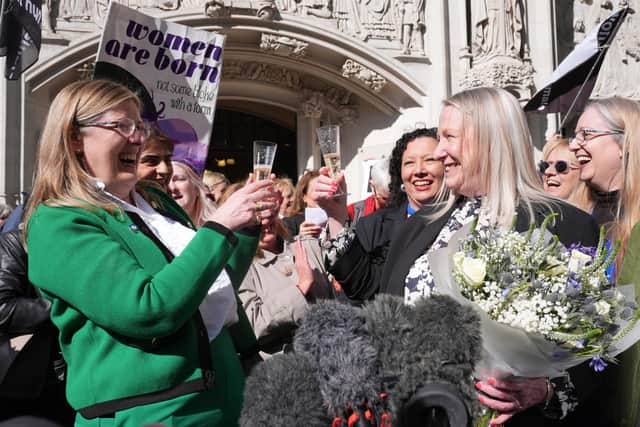
Jenny Lindsay notes that the Scottish Government has yet to pay For Women Scotland’s costs following the Supreme Court confirming that “sex” in the Equality Act refers to biological sex, that “women” means women, and that single-sex provision can be lawful.
Having reportedly spent at least £374,000 of taxpayers’ money unsuccessfully advancing the proposition that a man can be a woman for the purposes of the Act, one might have expected Ministers to settle For Women Scotland’s expenses promptly – and to reflect on continued funding for bodies that promote positions at odds with the Act as clarified by the Court.
Ms Lindsay cites the Scottish Government-funded group Engender, which described the Supreme Court ruling as “regressive”. A check of Engender’s website makes clear that it rejects the view that “woman” should be limited to the female body; it received £617,193 in Scottish Government funding in 2024-25.
The Equality Network, which received £51,166 in 2024-25, similarly promotes contested claims about gender identity. Its chair was recently among the signatories to a letter criticising the National Library of Scotland for reinstating The Women Who Wouldn’t Wheesht, a book about women campaigners who take odds with such claims.
The Scottish Human Rights Commission, funded by the Scottish Parliament to the tune of around £1.5 million annually, previously backed the SNP’s failed self-ID legislation and has been permitted to intervene in For Women Scotland’s judicial review of prison rules that allow some trans-identifying men to be held in the female estate.
That Scottish taxpayers continue to subsidise organisations that are advancing contested gender-identity claims – including in ways that risk weakening women’s speech, association and boundaries – should concern all fair-minded people.
It adds insult to injury that sums remain withheld from For Women Scotland at the same time.
Brian Forsyth, Edinburgh
Isotope idea
Labour MP Gregor Poynton has called on the Scottish Government to drop its opposition to Small Modular Reactors (lead report, 29 December). The intractable problem remains, however: the waste produced.
Depending on the isotopes, this needs guarding for many centuries, so on the “polluter pays” principle, storage costs should be factored into the bills of those consuming nuclear electricity. That would cost them a pretty penny, and give non-nuclear suppliers a level playing field at long last.
George Morton, Rosyth, Fife
OTT safeguards
The excellent Scotsman Editorial gives a prime example of the misuse of political power with respect to nuclear generation (29 December). It is people like SNP MSP Graham Leadbitter who insist on completely OTT safety requirements and then use the additional cost as reason for not investing in this power source. One example is the safeguarding of fish at Hinkley Point C – this has been calculated to cost about £280,000 per salmon!
There has been precious little publicity about the real cost of renewables – the largest (300 MW) of the SMR reactor designs is the equivalent of about 150 of the largest wind turbines, plus storage, plus a hugely enlarged grid distribution system and has an estimated lifespan of twice that of the turbines, so is really equivalent to 300 of these (20,000 tons of non-renewable waste in the blades alone ).
A McCormick, Terregles, Dumfries
Snap happy
That was a great picture you published by Lisa Ferguson of the Boxing Day dippers on Ayr beach reflected in the sea (29 December). I had to search for a strong magnifying glass to read the credit line.
Please, Scotsman, make it a New Year resolution to give photographers proper recognition and print their names at a decent size that everyone can read.
Gordon Wright, Edinburgh
Write to The Scotsman
We welcome your thoughts – NO letters submitted elsewhere, please. Write to [email protected] including name, address and phone number – we won't print full details. Keep letters under 300 words, with no attachments, and avoid 'Letters to the Editor/Readers’ Letters' or similar in your subject line – be specific. If referring to an article, include date, page number and heading.
Comments
Want to join the conversation? Please or to comment on this article.