
Readers' Letters: Rupert Lowe should answer for shameful Dunblane comments
Politician’s ‘unbelievable comments’ on Dunblane massacre upset reader
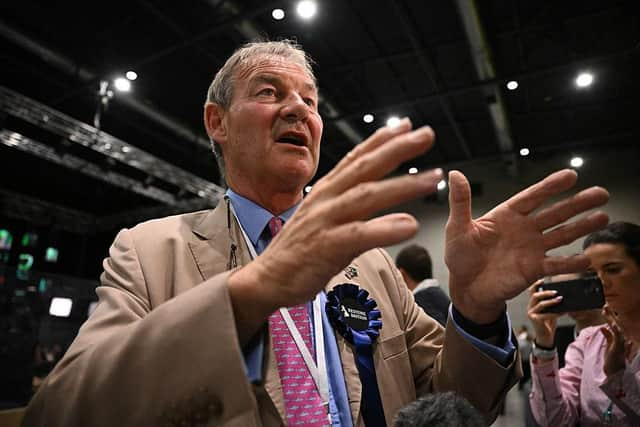
For once, I can actually agree with a statement by an SNP MSP. Keith Brown called Rupert Lowe's unbelievable comments on the Joe Rogan podcast, “beyond despicable”.
Spot on. Having been as horrified as everyone, worldwide, when 16 children and a teacher were massacred in Dunblane in 1996, it is hard to understand how anyone – politician or ordinary man or woman in the street – could betray the utter ignorance he showed.
I am strongly against guns, especially handguns. Unless you have a good reason to have a gun, such as a shotgun for controlling vermin as a farmer, or as a hobby shooter on firing ranges, I can see no valid reason you would need a gun. Just glance at the awful statistics that show the equivalent of a war going on in the USA every year. In 2025 alone, over 40,000 people died, many through suicide, but that included no fewer than 14,651 killings, some from 408 mass shootings.

It is symptomatic of a very sick society that permits weapons of mass destruction to be available with little scrutiny in many cases. In some states, they actually offer discounts to people carrying concealed weapons.
If Mr Lowe is so ignorant that he thought that Dunblane was one death – as if that wasn't bad enough – I think he should agree to being given a detailed course on what happened at Dunblane on the spot and be forced to apologise to each and every family who lost loved ones on that terrible day. He should be forced to do so before the cameras in public and Mr Rogan's show should be forced to air that apology and correction.
Dave Anderson, Aberdeen
Group think
I refer to The Scotsman article of 11 July, “SNP government quietly disbands tax advisory group”.
Before former finance minister Shona Robison set this group up she was well advised, not least by a committee she convened, to introduce a land-value levy. This could have recovered billions in publicly created site-values for revenue, and enabled raising the income-tax threshold to help the low-paid. It would also have created an incentive to work rather than stay on benefits.
Any intelligent child can grasp that taxing work, trade and saving deters these: we don't need a panel of “experts” to tell us that.
George Morton, Rosyth, Fife
Show humanity
While I disagreed with much of Ann Widdecombe's politics, that does not change the horrifying fact that a 78-year-old woman has reportedly been brutally murdered in her own home.
The thought of an elderly woman trying to defend herself against a violent attacker is deeply distressing.
What has saddened me almost as much has been seeing people on social media celebrating and mocking such a violent death.
Ann Widdecombe was a controversial figure, and many people strongly opposed her views, which is their right, but political disagreement is part of a healthy democracy. It should never strip away our compassion or basic human decency. No matter what anyone thought of Ann Widdecombe's views, she was entitled to hold them. No one deserves to die in such a brutal and terrifying way.
We should be able to condemn a brutal killing without qualification, regardless of who the victim was or what they believed.
If we cannot show humanity when an elderly woman is murdered simply because we disliked her politics, then we have lost sight of something far more important than any political disagreement.
Alex Orr, Edinburgh
Sad sign
The Hillsborough Law will be passed by Parliament soon, requiring a legally enforceable duty of candour on public officers and authorities during investigations (your report, 13 July). The fact that such a law is necessary does not say very much about our country!
William Ballantine, Bo'ness, West Lothian
Bin the Count
Democracy is a serious business which is not taken seriously by some people who put themselves forward for election. Democracy's freedoms which we take for granted were hard won through struggle, and sometimes with harm or even fatal consequences for its participants, something which continues to this day.
It is risible that any Tom, Dick or Harry can stand for election without scrutiny of their past, persona or what they hope to achieve. It is scandalous that any fool can stand for election, and even more so when said fools are treated as some sort of celebrity. I refer to the fool with the hideous bin costume, Jon Harvey, who was given an interview on primetime BBC. Why?
Action is required to prevent this sort of thing happening and the democratic process should be treated with the seriousness it deserves. I regard Harvey and his ilk with contempt.
William Loneskie, Oxton, Lauder, Berwickshire
Store wars
Stan Grodynski (Letters, 10 July) has a go at supermarkets charging “whatever they would like”, but ignores the fact that our supermarkets are among the most competitive in the world, and we have some of the keenest food prices in any developed country. The large supermarkets make a net profit below 3 per cent, which is low by world standards, especially given the excellent service they provide. If any charge uncompetitive prices, customers can vote with their feet. That’s not something we can do with council tax or Scottish Water charges, which are a major part of people’s costs, and not insignificant as he suggests. CPI caps on these two would protect their income and protect customers.
He may have a point about high energy prices from the private sector, although much of our high energy cost is driven by net-zero policies loading charges onto our bills. This, combined with the ludicrous position of paying wind turbine owners not to produce when the grid can’t accept their power, contributes to high energy bills. If someone wants to build a turbine, they should accept the risk that at times, they won’t be able to sell their power. If they don’t want to do that, they should invest in battery storage or develop hydro storage. We should not, in our rush to harness wind energy, be loading extra costs onto the public, or to businesses where high energy costs destroy jobs.
I thought Mr Grodynski had finally given me something I could not blame on the SNP, then I realised how the Scottish government has starved local government of funding during its two decades in office!
One out of two is not bad, though.
Brian Barbour, Haddington, East Lothian
Stay in your lane
The changing direction of once well-respected charities suggests they may be entering their intersectional death throes.
Having once had a defined and worthwhile purpose, they now consider that every approved political cause must be made inseparable from their own.
The Scottish government-funded Equality Network, once a gay rights organisation, has made intersectionality a programme in its own right. It says it embeds the approach throughout its work, employs a team concerned with, amongst other things, disability, neurodiversity and gender identity, and provides intersectional training to employers and service providers.
Amnesty International UK recently published – and then swiftly had to withdraw – its “anti-rights” report, mapping what it described as a threatening ecosystem that included For Women Scotland and a rape crisis centre.
Now Friends of the Earth England is advertising for “stronger action on Israel”, presenting the situation in Palestine not as an environmental issue at all but as a purely human-rights cause. The impact of such conflict on agricultural land, water and sanitation is rightly an environmental justice concern. Highlighting that connection, however, does not require an environmental organisation to mount a foreign-policy campaign.
These charities may discover that public support is not infinitely transferable. People may support clean water without adopting a position on every international conflict; defend prisoners of conscience without accepting Amnesty’s gender politics; or support gay rights without subscribing to an ever-expanding “LGBTQIA+” coalition.
Charities depend upon trust, clarity of purpose and broad constituencies. When supporters are conscripted into an ideological package they never joined, mission drift, factional capture and donor withdrawal may follow.
An organisation that attempts to stand for everything may eventually find that it stands for nothing in particular.
Brian Forsyth, Edinburgh
Hot topic
In the last 60 years I have watched many Scottish football matches in the depths of winter, well below freezing and wrapped for the Antarctic. Given our familiarity with the World Cup hydration break, in the heat of the three host nations, could we not learn a lesson?
Scotland could adopt a thermal break midway through each half. At pitchside players could be revived with a mug of steaming Bovril and a slice of hot haggis. Other hot food and drinks are available. Anglers could resort to a quaich of whisky.
John V Lloyd, Inverkeithing, Fife
Write to The Scotsman
We welcome your thoughts – NO letters submitted elsewhere, please. Write to [email protected] including name, address and phone number – we won't print full details. Keep letters under 300 words, and in the body of the email – no attachments – and avoid 'Letters to the Editor/Readers’ Letters' or similar in your subject line. If referring to an article, include date, page number and heading. No poems.
Comments
Want to join the conversation? Please or to comment on this article.