
Readers' Letters: Labour's Marra wrong to back rejoining EU
Readers respond to Scottish Labour leader’s recent remarks on engaging with EU
Why don't we have more capable politicians in Holyrood and Westminster, particularly on the left?
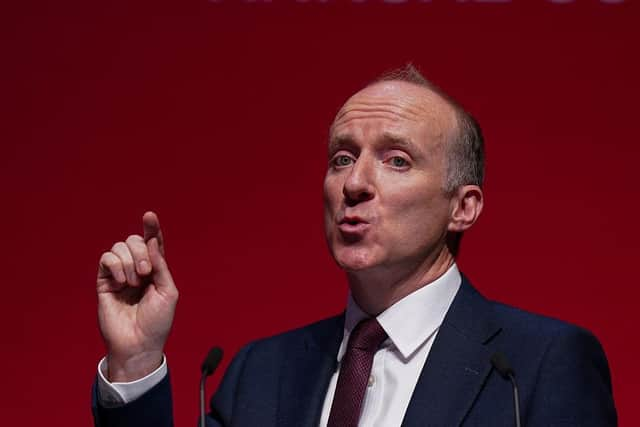
In recent years the ridiculous policies at Holyrood have come from the Greens and SNP. Now, not to be outdone, Labour's Scottish leader, Michael Marra, has jumped on the bandwagon to rejoin the European Union in order to try to make Scottish Labour more relevant, bond with Andy Burnham and outdo the SNP.
What all these politicians have conveniently missed is that the EU has changed since we were a member – and not for the better. The EU is no panacea for the problems in its own member countries, as the recent Europe-wide riots have demonstrated, and the costs for membership will be too high for any perceived gains.

What this debate about EU membership actually does, for both Labour and the SNP, is divert attention away from the actual current government problems and our inability to improve them. We need politicians who can actually solve our pressing everyday problems, not focus on giving us more.
If this is proving to be well nigh impossible just how does potentially adding another suffocating layer of European rules help? If Labour, the SNP, Liberal Democrats and the Greens keep looking to Europe for “salvation” does this not strongly imply these parties think they are incapable of doing this on their own?
Gerald Edwards, Glasgow
Wrong direction
Michael Marra and Jackie Baillie were in The Scotsman yesterday wishing us to either get closer to the EU or join it – but have they thought this through?
The EU is about sharing sovereignty, sharing power, hence joining would see some powers go upwards towards the EU from Britain.
Where does this sit with Andy Burnham's wish for more devolution downwards, and closer towards the people? Surely this is the opposite?
William Ballantine, Bo'ness, West Lothian
Lower prices
During the current cold snap there is only a minuscule output from Scottish wind farms, an amount insufficient to keep the lights on in Scotland.
Why do politicians continue to support a generating technology that cannot meet consumer demand ?
The result is a doubling of electricity prices to provide the necessary gas turbine output that is so expensive that all energy intensive jobs are departing from Scotland.
Surely the answer is to cut the green levies to ensure electricity is delivered at a price that matches that of the charges on the European mainland?
Ian Moir, Castle Douglas, Dumfries & Galloway
Time to talk
On the day of the revelation by ITV News that an 81-year-old woman with terminal cancer was left for 48 hours in a Welsh hospital storeroom cupboard, laid across some gathered-together chairs, Gerald Edwards (Letters, 10 November) focused all of his ire, seemingly due to NHS shortcomings, on the SNP and the Scottish government.
Given that UK government funding of the NHS in England dictates the level of funding available in Scotland and Wales, surely those who favour sustaining an apparently failing constitutional status quo should be keen to engage in objective discussion, rationally based on comprehensive context.
Could the apparent reluctance to engage in broader debate be due to the fact that there is a reliance on the BBC’s Reporting Scotland and selective media channels for news or is there a wish to avoid, or divert from, having broad debate because of the realisation that objective rational discussion would undermine arguments against enabling the people of Scotland to determine their own destiny?
This is not to say the SNP and Scottish government could not, and should not, do more to progress the health and well-being of the people of Scotland. But, as with drug deaths, where the UK has the highest number of drug deaths in Europe (with Scotland and deprived areas of England and Wales recording the highest numbers), objective and rational debate must include assessment of drugs policy, which is still controlled by the UK government.
Or put another way, if the arguments for retaining the current constitutional arrangements are strong, then open debate within comprehensive context should not be feared.
If, as many believe, it is time for fundamental change, then hopefully we can engage in constructive debate, whether that is around independence for the nations or some form of federalism.
Stan Grodynski, Longniddry, East Lothian
Enough bluster
The SNP may well be in favour of “independence”, but just how many of the electorate in Scotland are truly in favour of such a radical change? Let us never forget that a more dynamic party under the leadership of Alex Salmond was unsuccessful in convincing voters that it was the best way forward for Scotland. Has anything really changed since 2014? Nicola Sturgeon saw the light and resigned from office, leaving good old John Swinney to have another bash at the leadership role.
But have we Scots really embarked on the build-up to another referendum? And would the UK government agree to such a poll? I think not.
What would be more acceptable to the majority of Scotland's electorate would be vast improvements in all aspects of administration emanating from Holyrood. Far too much time is spent by the SNP debating matters over which they have no powers. We Scots want action – not bluster.
Robert I G Scott, Northfield, Ceres, Fife
Kill monopoly
The true division in Scottish governance is not between nationalism and unionism, but between bureaucratic monopoly and democratic pluralism – any other description is obfuscation.
Over 25 tears, Holyrood has centralised services from policing to municipal taxation. From ferry failures to life-threatening A&E delays, eliminating regional autonomy has destroyed the comparative benchmarks that expose administrative failure. Ministerial dismissals of these crises as mere “operational matters” translate in plain Scots to “it wisnae me”. Meanwhile, depressed council election turnout simply measures a devalued vote.
Centralisation is a deliberate strategy to entrench power. It allows the Scottish government to control the narrative, suppress transparency, delay scrutiny and insulate itself from accountability for chronic failure.
Real reform demands two structural steps: decentralisation to autonomous regional bodies to restore operational benchmarks and institutional learning; and devolution of genuine tax powers to councils to restore direct democratic accountability.
We must dismantle the central monopoly, not merely change its managers.
Gavin Findlay, Boghead, South Lanarkshire
Bedding down
I agree with Dr Fiona Hunter of the Royal College of Emergency Medicine (your report, 7 November) that one measure to improve the problems of A&E departments is to “speed up discharges and open beds”.
This could be done by putting extra money into social care by transferring patients waiting for packages of care to empty beds in private care homes rather than extra ambulances and A&E departments.
(Dr) Roger Smith, Edinburgh
Airport success
Further to recent letters on The Scotsman’s Fit To Fly series, we arrived home to Edinburgh Airport from Athens at 11.30pm on Thursday 29 October. While the passages and steps to the Arrivals Hall were dreary and unwelcoming in the extreme, our luggage was on the carousel immediately, our taxi was waiting and we were home in Fairmilehead by 12.15am.
Nothing could have been faster or more efficient. Only the surroundings spoiled the experience!
Isabel Graham, Fairmilehead, Edinburgh
More cuts coming
Conservative MSP Stephen Kerr shares the SNP government’s concern about, in Kerr’s words, “reducing the BBC’s commitment to Scotland” (Perspective, October 29) but his colleague Murdo Fraser claims the outgoing BBC Scotland channel has failed to attract enough viewers to make it sustainable, with further BBC devolution unnecessary, no doubt concerned about undue political influence.
BBC Scotland Director Hayley Valentine was recently asked on Scotcast whether there was political interference in her job.
Recent BBC consultation revealed that around half of Scots felt the BBC was politically biased. Ms Valentine tactfully dodged the question but did not deny that her predecessor had a “torrid time” with the then first minister.
That would have been Nicola Sturgeon, who still appears on the BBC speaking for the SNP.
Mr Kerr need not worry about any loss of Scottish content as Ms Valentine expressed a passionate commitment to Scottish broadcasting, including cultural commissions and storytelling that would otherwise be lost.
More cuts are inevitable, so it’s all the more disappointing that the BBC commissioned an advert focused on entertainment with 90 celebrities at an undisclosed cost.
It needs to spend in Scotland what it raises here and not show more entertainment at the expense of charter commitments to educate and inform.
Neil Anderson, Edinburgh
Write to The Scotsman
We welcome your thoughts – NO letters submitted elsewhere, please. Write to [email protected] including name, address and phone number – we won't print full details. Keep letters under 300 words, and in the body of the email – no attachments – and avoid 'Letters to the Editor/Readers’ Letters' or similar in your subject line. If referring to an article, include date, page number and heading. No poems.
Comments
Want to join the conversation? Please or to comment on this article.