
Reader's Letters: Health Secretary out of touch with A&E crisis
Health secretary should be on top of A&E crisis, believes reader
Scottish Health Secretary Angela Constance showed her ignorance about how A&E works when she said the public should play their part by going to A&E only when necessary (“A&E services face collapse as winter hits, SNP warned”, 4 November).
Yes, some present themselves with trivial complaints. But this has always been so, and unless human nature changes it will continue. I worked for six months in a central London A&E many years ago and the phenomenon was active then. I remember an RAF officer whose condom had broken and was in a state because if he had contracted an STD it would be goodbye to his promotion prospects.
But when I became a corridor patient earlier this year my medical advisers gave me no choice in the matter. I diagnosed that my wait there was caused by too few doctors, nurses, and hospital beds.
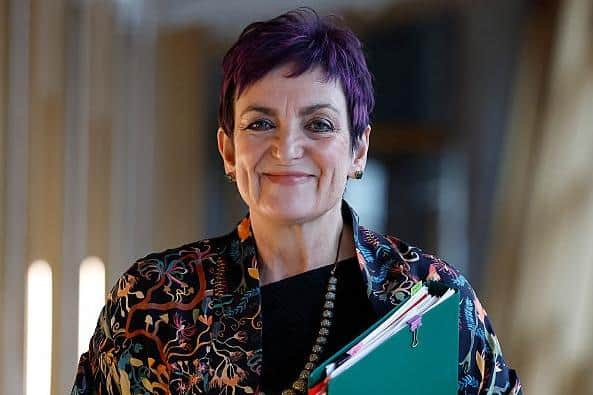

Angela Constance assures us action is being taken, but all that has been proposed so far is the merger of health boards, which will take managers away from trying to solve the A&E problems caused by too few resources.
It would be wise for me to reserve a corridor space for my next trip to hospital!
Hugh Pennington, Aberdeen
A&E shame
The latest figures on Scottish waiting times at A&E make grim reading, with only 64.9 per cent of patients seen within the four-hour target in September, down from 66.6 per cent in August. We have heard from so many SNP health ministers that measures were in hand to improve this dreadful situation but the simple truth is that waiting times just get worse year by year.
The grim reality in Scotland is that with winter approaching our Ambulance and A&E services will be under even more pressure and patients will die in ambulances and corridors waiting for treatment – a direct reflection of the SNP’s inability to meet their responsibilities for the government of NHS Scotland.
Dennis Forbes Grattan, Bucksburn, Aberdeen
Phone failure
At my address, by no means “remote”, we experience not-infrequent power cuts in stormy weather. Tens, if not hundreds of thousands of addresses served by electrical lines carried on timber poles are in this situation.
Some years ago, during both Storm Frank and Storm Arwen, we had no electricity for three days, but we did have an old-fashioned analogue phone and thus could phone SSEN for updates and receive calls from our family. About a month ago our analogue phone service was switched off, and so we now rely on mobile telephony. In the recent Storm Boelo we had a power cut of 24 hours. We had a phone signal and internet courtesy of 4G for the first hour or so until the transmitter battery gave out.
For the first time since we had a phone installed in this property when we moved in 47 years ago, we were cut off. No possibility of contacting anyone, emergency services or family. And no signal anywhere in Banchory either, a sizeable community. This inadequacy of digital communications is experienced throughout Scotland by those who do not live in city conurbations. The replacement of analogue copper-connected phone lines by digital fibre thus represents regress, not progress.
Those planning comms networks have to realise that the storms we are increasingly experiencing cause power outages that often last days, not hours, and that mobile transmitter batteries should be specified to maintain a service for the duration.
Ken Gow, Bridge of Canny, Banchory, Aberdeenshire
Lost output
One vital piece of data missing from The Scotsman Editorial of 3 November is the cost of pumping CO2 into caverns in the North Sea.
My estimate is that about 50 per cent of the power station output will be lost in pumping the gas away from the plant. That means a 2GW power plant will only provide 1GW of electricity for the consumer, although energy bills will still include the cost of pumping the CO2. The result is a doubling of the unit price of electricity for Scottish consumers, meaning net zero costs continue to make Scottish householders poor and Scots business units unable to compete with their rivals in China, the EU or the USA!
Perhaps SSE can provide the necessary data for Scottish consumers?
Ian Moir, Castle Douglas, Dumfries & Galloway
Standing room
Jackie Baillie lauded John Healey’s budget in The Scotsman (Perspective, 4 November), applauding him for “abolishing standing charges on energy bills”. He did no such thing!
He abolished standing charges on gas bills, although some of the savings will be eaten up by higher charges for each unit of gas consumed, but the elephant in the room is standing charges on electricity bills, which he did not abolish.
These are much more significant for the average customer than the standing charges on gas. Standing charges on electricity bills in Scotland are about 60p per day – over £200 a year; Furthermore, the standing charges on electricity in Scotland are typically 50 per cent higher than in London, for example.
Given he didn’t abolish standing charges for electricity, perhaps Mr Healey could make a start by having a uniform electricity standing charge across the UK, as was the case for gas? Then Jackie Baillie would have something to applaud. He might go further with promised reforms in 2027 but, as is typical, promises but no detail to the extent he could have easily been speaking as an SNP MSP!
Brian Barbour, Haddington, East Lothian
Higher bills
William Loneskie argues that the Scottish government is missing a trick by not going back to burning coal for energy (Letters, 3 November). Canny John Swinney may have a cunning plan but that would be political suicide given power generation costs from coal are higher than gas, which in turn is more than twice that of onshore wind.
I guess Mr Loneskie would, like many other man-made climate change deniers, want Scotland to go back to the Industrial Revolution and burn more carbon. Research by UCL claims wind power generation reduced UK bills by over £100 billion net of subsidies from 2010-2023. If we follow Mr Loneskie’s logic bills would be even higher through relying on gas or coal.
Neil Anderson, Edinburgh
Good intentions
Ian Johnstone (Perspective, 4 November) suggests Donald Trump is more comedian than statesman. This article then morphs into a statement that populist parties on the Right and Left of politics generally focus on fringe subjects such as Immigration and the Trans issue, with nothing to add about the big issues facing our country.
What is interesting to me is that the two issues mentioned are probably two of the top ten ordinary people feel government haven't tackled, taken seriously enough or is at odds with the general population about. In other words, call them populist issues because they genuinely are issues that people feel strongly about and it is right that alternative parties keep them on the agenda.
Thinking about the issues Trump has led the USA, into most of them probably started from good intentions when viewed simplistically, then morphed into calamity as events unfolded.
Imposition of tariffs is one where the intention was to restore manufacturing and skills that had been offshored to low-cost countries. It is obvious that countries that had an eye on the long-term impact of offshoring now realise this has been negative in the extreme on jobs, wealth and skills.
However, tariffs do not in themselves help, whereas looking as to why offshoring was felt to be necessary by business and manufacturing and tackling those issues (eg lowering energy costs to be competitive) would attract industry, with subsequent increase in growth – all-important right now in the UK.
United States voters have indicated that they have had enough of the President’s forays into the wider world and, I suggest, are looking not for change exactly but are sending a strong message that the direction of travel and outcomes do not chime with what has been the general ethos of being an American.
A Lewis, West Linton, Scottish Borders
Unfair bill
It’s hard not to agree with Murdo Fraser in opposing slavery reparations (Perspective, 4 November). There are many arguments as to why this is so, for example, children are not responsible for the sins of their grandfathers.
As former Archbishop of Canterbury Justin Welby said, financial reparations would be a “vast fine on the entire British people for a crime they did not commit”.
William Ballantine, Bo'ness, West Lothian
Widows might
The recent grant of approval for conversion to a hotel of the old Scottish Widows building in Dalkeith Road, Edinburgh spells disaster for this iconic building. The deep hexagonal plan is not suitable for subdivision into hundreds of tiny bedrooms with endless corridor access and I cannot see how room partitions of about 150mm can successfully abut the slender window wall mullions around the perimeter.
If it is commercially viable it could become a grand indoor leisure centre offering snooker, table tennis, roller skating rink etc, all based on the previously approved plan for office upgrading. In this way the architectural characteristics of the building would be saved.
David Pretsel, Edinburgh
Write to The Scotsman
We welcome your thoughts – NO letters submitted elsewhere, please. Write to [email protected] including name, address and phone number – we won't print full details. Keep letters under 300 words, and in the body of the email – no attachments – and avoid 'Letters to the Editor/Readers’ Letters' or similar in your subject line. If referring to an article, include date, page number and heading. No poems.
Comments
Want to join the conversation? Please or to comment on this article.