
Readers' Letters: Burnham has no authority to bow down before the EU
Reactions to Andy Burnham’s EU ‘reset’
It is with horror that I hear our unelected Prime Minister claiming he is getting the best deal for Britain and that it's his duty to do what he is doing. Well, Lord Halifax thought much the same way in 1940, but luckily, we had a PM called Winston Churchill who had no intention of bending the knee to any foreign power.
Labour have allowed the EU to cherry-pick our rich fishing grounds which have been severely damaged by foreign fishermen in return for nothing.
Now, Andy Burnham wants us to become “rule-takers” with his latest deal, subjecting our farmers, students and around 80 per cent of our taxes, among other matters, to EU red tape after we voted to decide things for ourselves.
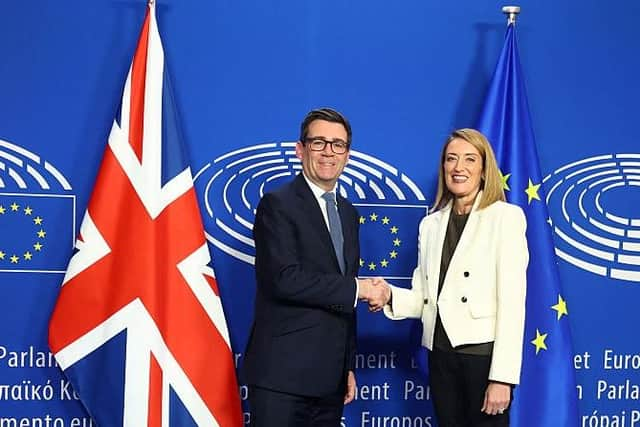

The EU, sniffing success when their Labour supplicant tells them what he wants before he even starts negotiations, have announced that he will have to accept what the EU wants if he wants to change the existing agreements with Brussels.
The correct term for such negotiations is "surrender". Before the first step on that route takes place, the Prime Minister and his government are duty-bound to resign and call a general election. The UK did not vote for the agreements he and the EU are forcing on us.
Here’s the thing. The Europeans as a whole depend upon the UK’s nuclear umbrella for protection from Russia. However, the French do not offer their fellow Europeans shelter under their nuclear weapons. A good starting position would be for the UK to withdraw that protection. What good does protecting them do us, after all? Then – and only then – should we start discussing any deals.
Andrew HN Gray, Edinburgh
Rejoin EU
The UK–EU summit is anticipated to cut red tape on food and drink trade, confirm our return to Erasmus+ and make progress on a youth experience scheme for under-30s. All of this is welcome. Together, though, they quietly admit what ministers still won’t say: Brexit has cost us dearly.
UK food and drink exports to the EU fell from £20 billion in 2019 (in today’s money) to £15bn in 2025, a drop of around a quarter. Over the same period, exports to the rest of the world held steady. The Food and Drink Federation says the decline is “not part of a global trend”. The Office for Budget Responsibility still expects Brexit to leave the economy around 4 per cent smaller in the long run.
The cost isn’t only economic. A generation of young people lost the right to live, work and study across Europe that their parents took for granted. A time-limited scheme, with numbers still to be agreed, is a poor substitute for freedom of movement.
We are now rebuilding these links piece by piece. To get the food deal, Britain will follow EU rules that we no longer help write. Each “reset” brings us a little closer to where we started, on worse terms.
It would clearly be easier, and better for our farmers, businesses and young people, simply to rejoin the EU and take back our seat at the table.
Alex Orr, Edinburgh
Definitive wins
An interesting article from Martin Roche (Perspective, 19 November), but I have to disagree with him on one point, where he wants another EU referendum with the pass mark being 50 per cent plus one. In a major issue of constitutional importance, this is not enough to ensure the issue is put to bed.
If you use a referendum to vote about other issues – eg, the popularity of the government of the day – there may be a low turnout.
To ensure there really is majority support, we need a higher hurdle than 50 per cent – this should have been in place for the last EU one, and should be in place for a Scottish one. A narrow majority means the issue will rise again!
William Ballantine, Bo'ness, West Lothian
Scandal fallout
The fallout from the Grampian NHS allegations is starting to resemble a nuclear cloud (“Swinney under pressure as police probe patient deaths at NHS Grampian", 20 November). Right at the centre appears to be a hapless SNP where neither the First Minister nor the health secretary looks to have had any clue as to what has been going on.
Either they were not informed, did not remember being informed or simply allowed important correspondence to bypass them. Not only is this shocking but this is simply too serious an issue for the usual casual SNP responses. Someone in authority must take the full responsibility but someone in government ought to, too. Who is going to be swept away in the tidal waves that must follow?
Gerald Edwards
Glasgow
Is this a first?
“Swinney apologises..." (Scotsman, 20 November). Now there's something we don't read very often. Here's hoping it's the start of many more to come. I can provide him with a list if his memory fails him.
Elizabeth Towns, Edinburgh
Neets zero
The Milburn Review will simply hit a brick wall in Scotland as the Holyrood net zero policy cuts the number of jobs north of the Border.
The drive to decarbonisation through net zero simply deindustrialises business units as the increase in green jobs fails to match the loss of fossil fuel opportunities.
This problem is compounded by the choice of wind power by Holyrood as the base load supply of electricity generation on the Scottish grid.
It would appear that politicians were unaware of the STEM data that, if there is no wind, then there will be electricity. That resulted in a plethora of English gas turbines required to sit on stand-by to keep the lights on north of Hadrian’s Wall.
The double generation system results in a doubling of energy prices, meaning it is cheaper to import fossil fuel to Grangemouth as the refinery could not compete with those in Holland, Mossmorran could not match competitors in the Ruhr, the Motherwell steel plant found it cheaper to import steel slab from Kazakhstan than the UK or the EU and bus operators find it cheaper to buy from China than Falkirk.
The loss of jobs from the North East is well highlighted as Holyrood prefers to build wind turbines that fail to operate when there is no wind to utilising fossil fuel at Grangemouth and Mossmorran.
When will Holyrood politicians accept that net zero policy only results in a loss of jobs for Neets when their Green Transition fails to deliver? Surely it’s time to ditch net zero and replace it with an ALAEP policy ( as low as economically possible).
After all, what other parliament would build an oil rig costing hundreds of millions of pounds only to see it sit idle, rusting away in the North Sea when, just over the horizon, Norway adopts the Trump message to "drill, baby, drill”, meaning more job losses for Neets?
Ian Moir, Castle Douglas, Dumfries & Galloway
Ferry luxurious
I have just seen the showcase presentation video of MVLoch Indaal as she prepares to leave her Turkish shipyard and I have to agree she is a fine vessel, but does the slightly over two-hour crossing to Islay warrant a Titanic-esque staircase (how do you hold both rails?), honeycomb walls and adjustable tables, among many other clever, expensive and time-consuming construction details.
People even seem to survive the longer crossings without such necessities. I have great respect for Calmac as they already are, I don’t believe they need the “wow” factor.
A reliable, robust, functional sea bus, not a scaled-down cruise liner, is all that’s required.
David Griffiths, Isle of South Uist, Outer Hebrides
Turn on the worms
I was most interested by Katharine Hay’s article (“Rewilding bid for Rannoch pinewood”, 18 November) about the challenges faced by crofters in the Highlands as wild boar damage their fields in the search for tubers and earthworms.
Some of The Scotsman’s older readers may recall the books written by Colonel Jim Corbett (Man-Eaters of Kumaon etc), a domiciled member of the British Raj who lived in northern India for most of his life; he was a hunter and successful businessman, but in 1915 he bought a derelict village and its land close to his childhood home.
When he took possession of the village, most of the houses were in ruins, the land was weed-strewn or had reverted to a semi-scrub forest. At first he cleared the fields of cover and stones, and put in new pig-fencing at his own expense.
However, Jim Corbett was not a farmer so did not realise just what was involved or that nature moves in when humans move out. The biggest problem was the local tribe of wild pigs which could devastate a field in a few hours. The wire fencing proved to be ineffective as the hogs either pushed them over or burrowed underneath
Pigs, for all their artfulness, cannot climb a vertical object because they cannot lift their back legs up. All it takes to keep a pig in his pen is a wall he cannot push over that is higher than his chest, when he is standing on his hind legs. So Jim built a stone wall nearly six feet high surrounding the village and all its fields, which proved to be an effective deterrent.
Highland crofters could protect their property by following a similar example by excavating a deep, wide ditch around the entire croft and using quarry waste to recreate the stone wall. Doubtless, approvals will need to be obtained and monetary grants might be available for those areas most vulnerable. Such a proactive approach might be more acceptable to Holyrood rather than bleating for compensation.
Duncan Grant, London
Write to The Scotsman
We welcome your thoughts – NO letters submitted elsewhere, please. Write to [email protected] including name, address and phone number – we won't print full details. Keep letters under 300 words, and in the body of the email – no attachments – and avoid 'Letters to the Editor/Readers’ Letters' or similar in your subject line. If referring to an article, include date, page number and heading. No poems.
Comments
Want to join the conversation? Please or to comment on this article.