
Helping young people with disabilities in to work must be done with support - not cutting finances
Alyn Smith, MSP, says much of what Milburn recommended this week is already a work in progress in Scotland.
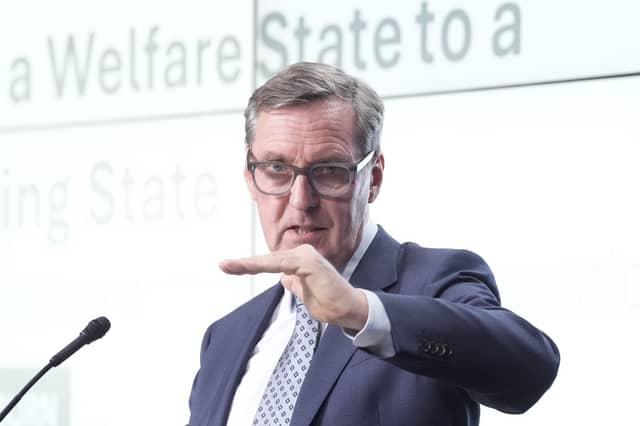

It was a big week for skills and employability with the publication of the long-awaited Milburn Report. After decades of confusion in UK Government skills, employment and welfare policy, the review has underlined the need for sustained action to improve opportunities for young people.
To his credit, Milburn acknowledges that his report is about England and does not apply directly to Scotland. But his prescriptions are of obvious interest, and how they are implemented could have significant consequences for our budget, for good or ill.
So I have taken a few days to read it carefully.
Tom Arthur, Scotland's Minister for Business and Fair Work, and I met Alan Milburn a few weeks ago. We got on well. I like his style, which may surprise those who see politics as a purely partisan pursuit.
We agreed that every young person must be given every opportunity to access education, training or sustainable employment.
Where I also strongly agree is that support needs to respond to young people's individual circumstances. Scotland already has established approaches, and we should continue to ensure the offer is clearer and coherent, with support focused on the individual, especially those who have been harder to reach.
Opening up apprenticeship opportunities is a big part of the answer – and I note that Milburn’s interim report stated around 40 per cent of apprenticeship starts in Scotland are made by people aged 16 to 19, compared to around 20 per cent of 16 to 18-year-olds in England.
Equipping people with the skills to build the lives they want is central to our ambition for Scotland. But with big chunks of the relevant powers reserved to Westminster, the Milburn Report gives us a chance to have a proper discussion about where those powers should lie.
I want to see DWP employability functions and budgets devolved, along with the Apprenticeship Levy, so we can tailor them to Scottish circumstances. Having those powers in Holyrood would allow us to align incentives better and get more people into work.
I do have a significant caveat. Supporting young people with health conditions and disabilities into sustainable employment is the right ambition, but this should be achieved through tailored support and opportunity, not by cutting the essential financial support they rely on.
Read more: Andy Burnham’s attempt to save our young generation could be his greatest achievement – Brian Wilson
We will carefully assess the implications of any reserved welfare changes for people in Scotland, devolved services and the Scottish Budget. Having already cut Scotland's budget by £650 million in real terms next year, further cuts as a result of this review would be unacceptable. Scotland must not be financially disadvantaged as a consequence.
Scotland has already done a lot of thinking in this area. The Withers Review of our skills landscape remains highly relevant, and we are implementing it. In fact, Scotland has already embedded a great many of the central principles Milburn proposes for England – including stronger vocational curriculum and qualifications, tracking of young people’s activity and joined up support wrapped around them to help them particate. In this year’s exam results, Scotland’s young people achieved a academic rises across the board coupled with a record number of vocational awards in subjects like childcare, construction and personal finance.
Qualifications in these courses, which are preparing them for the world of work, are up 121 per cent since 2019.
His report says: "By the early 2030s, there should be a fully functioning statutory participation system in place: a Youth Opportunity Scheme in every place in England, legal Opportunity and Support Guarantees, strategic authority accountability, common data and standards, and funding organised around the participation objective."
Scotland introduced a Young Person's Guarantee, which we have since integrated into our ‘No One Left Behind’ approach to simplify the landscape. This is person-centred, flexible and works alongside other organisations to ensure holistic wrap around support to the individual.
We have also boosted college funding by 10 per cent this year and increased apprenticeship funding by 10 per cent. We will expand apprenticeships further, funding at least 150,000 places over this parliamentary term.
Our Programme for Government commits us to publish a single national skills plan by the spring, with a new skills planning model due within weeks. Together, they will align skills investment with economic need, support the green and digital transitions, boost productivity and create clearer pathways into well-paid, sustainable jobs.
From April, new powers for the Scottish Funding Council will bring national training programmes, apprenticeships and work-based learning into one institution. That will help us deliver a more coherent range of incentives across schools, colleges, universities and other providers.
Much of what is being recommended by Milburn for education in England, the SNP have been pursuing in Scotland for years.
Our existing skills and employability provision provides a strong foundation on which to build.
Read more: How Scotland can become one of the world’s most innovative small countries – Sir Jim McDonald
Even without the full levers that independence in Europe will give us, we must do our best with the resources we have, and I will. I want everyone in Scotland, whatever their background and wherever they are from, to have the opportunity to build the life they want.
Scotland's skills sector is key to delivering that, and I will work with anyone to help make it happen.
MSP Alyn Smith is the Minister for Innovation, Technology and Tertiary Education
Comments
Want to join the conversation? Please or to comment on this article.