
With Donald Trump's army of M16-toting geese set to enforce new name for Atlantic, what's next? – Ian Johnston
Scotland and the UK may be less resistant to the temptations of Trumpian diplomacy than we’d like to think
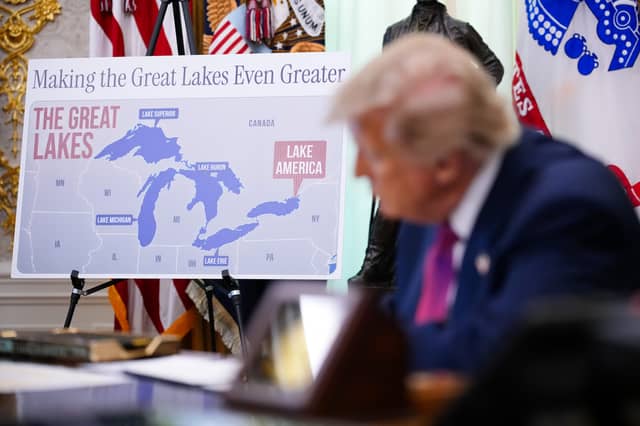


In the not-at-all wonderfully weird world of Donald J Trump, somehow it is appropriate for the President of the United States of America to post an AI-generated video of a flock of M16-toting Canada geese, each with Trump’s trademark blond hairdo, marching to the shoreline of ‘Lake America’ and firing off a volley of warning shots, presumably towards all those who object to his new name for Lake Ontario on the Canadian border.
These militant ‘Donald Ducks’, fresh from a covert operation defending the newly christened ‘Gulf of America’ (Mexico), may soon have a new mission, with Trump saying: “If you think about it, we have a gulf and we have a lake. Now, all we need is an ocean. So maybe we'll have to change the name of the Atlantic and/or the Pacific.”
Clearly, two American Oceans would be confusing, so presumably that leaves an opening for, yes, you guessed it, the Trumpianic Ocean. It’s the obvious solution. Whether trans-Trumpianic relations would be damaged by any failure on this side of the pond to use the Atlantic’s new name would then become be a laughable topic for serious discussion in Whitehall.
The ‘Big Beautiful Lake’
Of course, renaming oceans might have been Trump’s little joke, but it’s increasingly hard to tell. We once laughed, uneasily, about his ambitions to annex Canada and Greenland, but no longer. This is international diplomacy that owes less to the likes of Talleyrand, Metternich, Holbrooke and Albright, and more to the two-year-old toddler who remains ensconced in Trump’s brain and insists everything belongs to him.
If only someone had told America’s pettiest president that the word ‘Ontario’ derives from an indigenous Wendat word meaning something along the lines of the ‘Big Beautiful Lake’, he might have just changed his mind, given the ‘Big Beautiful Bill’ that has formed the core of his agenda. It seems the use of Trumpian adjectives long pre-dates the man himself (and are similarly accurate, with Ontario the smallest of the Great Lakes).
Another name-change Trump appears to be pondering could even more serious. Asked if he was reviewing America’s long-standing support for UK sovereignty over the Falkland Islands, he said recently: “I always review every position – that’s just one of many.” If he starts talking about “Las Malvinas”, we’ll know his political ally and fellow populist, Argentinian President Javier Milei, has persuaded him that Falkland islanders’ opinions, along with ideas about self-determination and democracy, don’t count.
Two Canadianos to go, please
There is, of course, a long history of changing the names of things for political reasons. When France sensibly decided to stay out of the 2003 Iraq War, indignant Americans, seeing this as an act of betrayal by a country they had helped liberate in the Second World War, changed French fries to ‘freedom fries’, although the latter name was quietly dropped by cafes in the US House of Representatives three years later.
Efforts to persuade people to ask for a Canadiano, not an Americano, as a rejoinder to Trump appear to have been even less successful, sadly, at least in the coffee shops I occasionally visit.
Famously, the Royal Family’s surname used to be Saxe-Coburg-Gotha, thanks to Queen Victoria’s beloved husband, Prince Albert, being the son of Ernst, Duke of Saxe-Coburg and Gotha (Victoria herself was the last of the House of Hanover). However, the image problem for this name created by the First World War prompted a change to Windsor, although not until three years after the conflict began.
In Scotland, names have been fairly stable for some time, with the appearance of Gaelic ones at train stations like Margadh an Fheòir (Haymarket), An t-Àrd-ruigh (Airdrie) and Sràid na Banrighinn (Glasgow Queen Street) among the most noticeable new arrivals of recent years.
This has, I’m sure, proved to be a roaring success, rather than a pointless waste of time in areas that haven’t spoken Gaelic, if they did at all, for centuries. But is it political?
I can’t help the sneaking suspicion that it’s less to do with the promotion of the language and more about creating a sense of foreignness between Scotland and England. ‘We say things differently here.’ Except that, for the most part, we don’t, not that much anyway.
READ MORE: Andy Burnham: I will call out Donald Trump
A modern-day Tower of Babel
If Trump-style toddler diplomacy takes off in this country – perhaps after a Reform UK election win – what might be next? Clearly, relative to Scotland and the UK, the North Sea is more like the East Sea. This could prove confusing for people in Denmark and Germany, but they’ll just have to get used to it after we bribe, berate and cajole Google maps into adopting it.
They could, of course, retaliate by insisting it be called the West Sea, with Google’s long-suffering cartographers forced to fudge it with the “East/West Sea” – a bit like Derry/Londonderry, aka ‘Stroke City’, in Northern Ireland. Perhaps we could persuade the Faroes to claim it should be the South Sea, thereby creating the cartological marvel that would be the North/East/South/West Sea.
Sorry. Quite clearly, that would be just plain silly and some will no doubt argue that I am wilfully engaging in ‘reductio ad absurdum’. However, the point I’m getting around to making is that having a shared name for something has a practical purpose.
If we all invent our own names for things, life will start to get confusing – with the resulting misunderstandings potentially having real-world consequences.
We could be witnessing the beginnings of a real-life Tower of Babel parable as humanity abandons international co-operation and splinters into bitterly divided, competing nations that pursue their own narrow interests to the detriment of all, while obstinately refusing to speak each other’s language.
Comments
Want to join the conversation? Please or to comment on this article.