
Two months to save US democracy? Facing election defeat, Donald Trump poses a real threat – Henry McLeish
Donald Trump is flirting with the use of dangerous tactics to thwart the democratic will of the American people
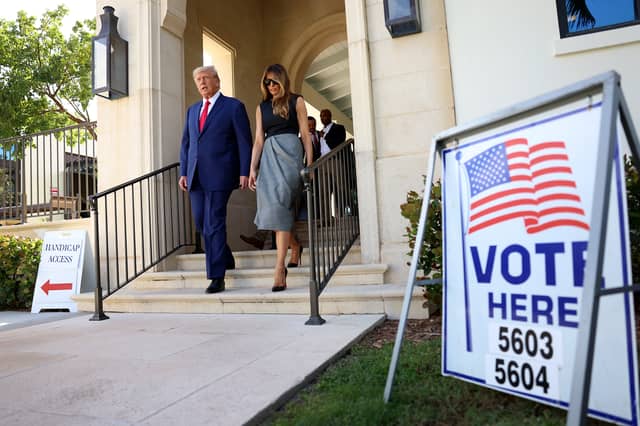


The US midterm elections are now just over two months away, with voters set to elect members of Congress, 36 state governors, local administrators and officials. Overshadowing all of this will be America’s verdict on President Donald Trump, his grip on his core group of ‘Maga’ supporters, the absence of a functioning Republican party, and the Democrats’ factionalism and poor leadership.
The big question is whether the Democrats can overcome their problems to regain control of Congress and put an end to the White House’s assault on the historic checks and balances so crucial to US democracy. However, this country is a more complicated political landscape than party propaganda might suggest and the elections on November 3 will be influenced by more than the slump in the president’s approval ratings.
Trump has shown he will stop at nothing to avoid defeat and personal humiliation. In normal circumstances, presidents who lose control of the House of Representatives and the Senate achieve ‘lame-duck’ status, which, in this case, would end the unprecedented tyranny of his second term in office.
Trump to declare ‘national emergency’?
But these are not normal circumstances. Trump could declare a national emergency to halt the election or declare election fraud and attempt to block the new Congress. He could accept the result but then continue to ignore Capitol Hill as before, while doubling down on government by executive order and ‘divine right’.
In a recent interview, Wayne Allyn Root, a right-wing commentator, asked Trump if he would “declare a national security emergency” over the elections. “Let me just say, stranger things have happened, OK? I’ll leave it at that,” Trump replied. He is preparing the ground to impose a national emergency to contest the will of the people.
Progressives will, however, take heart from the fact that on only four occasions since 1902 has the president’s party gained congressional seats in the midterms – and Trump’s approval ratings have plummeted to a new low, amid signs that he is increasingly out of step with public opinion. “... his administration is filled with multimillionaires and billionaires to a degree unmatched by his predecessors. Outside the White House bubble, warning lights are flashing,” wrote MS Now journalist Charlie Herman.
In primary elections, Trump-backed candidates are losing out to moderate Republicans. His assault on US heritage and institutions, such as the Lincoln Memorial Reflecting Pool, the Smithsonian and the Kennedy Centre, along with the White House ballroom fiasco and the planned vanity arch to be built on the Washington Mall have offended the sensitivities of many ordinary Americans. Minorities are also moving away from Trump, with the brutality of immigration police force ICE a factor.
Servicing a US national debt of $40 trillion has its political challenges, as has Trump’s amassing of billions of dollars of family wealth while in the White House.
In denial about his unpopularity
His war of choice against Iran has perplexed Americans and, with no end to the conflict in sight, the prospect of further US humiliation is growing as the midterms loom. The consequences of the war for gasoline prices, the cost of living, and the defence budget have reinforced a growing sense of anger about the diminishing importance of the US in the world.
Facing defeat, the president can appear to be in denial, suggesting his party has nothing to do with him and voters simply misunderstand him. But he has strong links with America’s billionaire tech oligarchs, who are keen to support him, investing vast fortunes in the midterm campaigns.
Trump, with Republican party help, also seems to be preparing a comprehensive plan to undermine the elections. Voter suppression tactics seek to deny or frustrate people’s attempts to access polling stations, with a focus on African Americans – this is pre-1960s racism. The Department of Justice, now a wholly owned subsidiary of the White House, has even been trying to remove registered voters from electoral rolls in compliant states.
The myth of voter fraud
Redrawing electoral boundaries of congressional seats is another method, with five new House of Representative seats likely to vote in a Republican having been created.
Pushing the myth of electoral fraud, Trump is desperate to introduce mandatory ID to prove citizenship before voting, under the Safeguard American Voter Eligibility Act, known as the “Save America Act”, which is currently stalled in the Senate.
Faced with an unpopular president and a Republican party in chaos, the Democrats should have a clear path to victory in November, but this is not guaranteed. They are mired in internal disputes about the future direction of the party, disappointing leadership in both chambers of Congress, the apparent lack of a US-wide narrative about the future of America, and a fundraising crisis.
Democrats’ shift to the left
Of particular significance in this election year is the growing success of the ‘Democratic Socialists of America’ wing of the party, seen during primary clashes between traditionalists and leftists.
This is a progressive movement that has injected fresh energy and ideas. It is pushing the needs of working-class voters and also their own brand of populism. But will that help or hinder the Democrats in a country of such spectacular diversity?
Trump is understandably seeking to portray this shift to the left as a new ‘red scare’, rooted in communism. This has raised the spectre of a return to the McCarthyism of the late 1940s and 50s, where people were dragged before an “Un-American Activities Committee” in Congress and blacklisted. The respected Pew Research Centre, which monitors public opinion, suggests the Democrats have a “modest advantage” ahead of the elections but adds that “there is a more nuanced picture”.
The midterms will provide a verdict on the state of America’s politics and its governance. But there is a bigger question: will democracy in America actually survive?
Henry McLeish is a former First Minister of Scotland
Comments
Want to join the conversation? Please or to comment on this article.