
Why it's North Sea engineers, not idealist eco-warriors, who will deliver net zero
The UK can use its North Sea heritage to lead the world in managing the decline of hydrocarbons while scaling up low-carbon alternatives
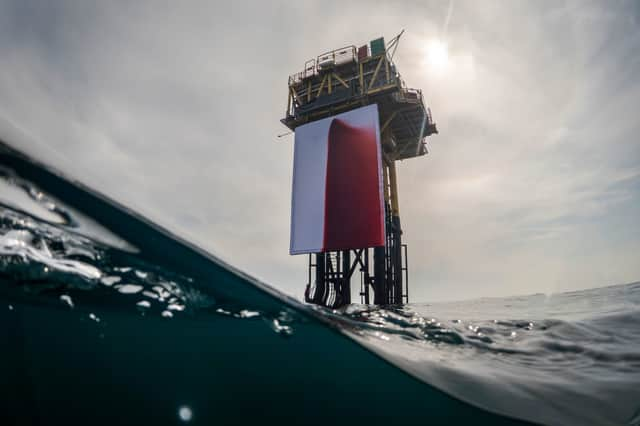
Two stories from the past few weeks tell you everything you need to know about the UK’s confused approach to energy transition. The first was a Greenpeace protest on Shell’s Skiff platform in the North Sea, where activists draped a vast artwork demanding an end to oil and gas production.
The second was news that Britain will soon be relying on imported liquified natural gas to meet 60 per cent of its gas needs, as shipments of LNG, primarily from the United States, plug the gap left behind by an accelerated decline in North Sea production. These tales highlight the gulf between the conversation we are having, and the one we need.
The protest grabbed headlines, but the truth is it did nothing to answer the hard questions: where will our energy come from tomorrow, how do we keep bills affordable, and how do we fund the technologies that will deliver net zero?
Meanwhile, as North Sea production declines, reliance on LNG shipments increases as we become ever-more dependent on imports to keep the lights on. This dependence comes at a huge cost.
READ MORE: 3.2 billion more barrels of oil and gas in North Sea than government estimates, says report

North Sea tax revenues falling
In 2022, the UK spent nearly £120 billion importing oil and gas, almost 4 per cent of GDP. That is money flowing out of the UK economy to fund public services in other countries, instead of being reinvested at home.
The flaw in our current approach is already showing up in the numbers. North Sea tax receipts are falling sharply, as investment dries up under the weight of the windfall tax.
READ MORE: Rosebank and other North Sea oil and gas fields could be given green light under new guidelines
Without investment, production falls faster – which makes us more dependent on imports – which means less tax for the Treasury. It’s a vicious cycle, and one that is weakening both our energy security and our economic resilience.
And here’s the bit that is so often overlooked: those imports are not necessarily cleaner. Gas shipped from the US or Qatar typically comes with a carbon footprint four times higher than gas produced here in the UK, where operators are subject to some of the toughest regulations in the world.
Undermining the drive to net zero
So, when activists call for an end to North Sea production, they are not accelerating the transition, they are undermining it. They risk leaving us poorer, more dependent on others, and no closer to hitting our climate targets. It is the kind of argument that sounds simple on a banner, but unravels the moment you test it against the real-world demands of how a modern economy functions.
This week, tens of thousands of delegates have gathered in Aberdeen for the Offshore Europe Conference, the single biggest energy event in the UK calendar. Ministers, chief executives, engineers, and innovators are here to discuss the future of the North Sea and the role it will play in the transition.
And yet, outside the conference halls, the same binary arguments dominate the headlines: “shut it all down” versus “drill, baby, drill”. Neither captures the reality of the choices we face.
Walk around Offshore Europe and you’ll hear a very different conversation. It is not about clinging to the past. It’s about how the skills, infrastructure, and tax revenues generated by the North Sea can be harnessed to deliver a successful transition.
It’s about carbon capture, hydrogen, offshore wind, and how the supply chain adapts. And it’s about how we manage our remaining oil and gas responsibly while building up alternatives at pace. That balance is absent in national debate.
The middle ground
Too often the discussion is reduced to slogans. Campaign groups reduce it further, to stunts. Offshore Europe is where the difficult but necessary middle ground is being carved out – by the people actually tasked with keeping the UK’s energy system running while also cutting emissions.
And the truth is, people working in and around the North Sea are not climate laggards. They are some of the very people driving the innovations that will make net zero possible.
At D2Zero, we see first-hand how this balance is being struck. Our company Score is working with operators every day to reduce emissions in the North Sea – cutting leaks, improving efficiency, and applying innovations that shrink the industry’s footprint.
These are practical steps that make a difference now, not in some distant future. And this kind of impact isn’t confined to offshore or one region. Another D2Zero company, Kelton, recently completed a project for National Gas and its HyNTS programme, a UK initiative to repurpose the national gas transmission network for hydrogen.
With decades of experience and a reputation as a leader in flow measurement for the oil and gas sector, Kelton is now applying its expertise to help shape the infrastructure of a low-carbon future.
Energy systems of the future
This is what a just transition looks like: not switching one system off overnight and hoping something else appears, but using what we have today to build what we need tomorrow.
It maintains energy security, protects skilled jobs, and reinvests in domestic capabilities to strengthen the economy. It recognises that the same welders, engineers, and technicians who keep our offshore platforms running today are the ones who will build and maintain the energy systems of the future. The energy transition will not be delivered by stunts. It will be delivered by engineers, innovators, and policymakers willing to make pragmatic choices.
And timing matters. Offshore Europe is happening at a moment when the stakes couldn’t be higher. UK North Sea output is declining at 11 per cent a year. LNG dependence is rising. Bills remain high. Net-zero targets are looming. There is no room for shallow debates when the economic, environmental, and security costs of failure are so stark.
The opportunity, however, is huge. Done right, the UK can use its North Sea heritage to lead the world in managing the decline of hydrocarbons while scaling up low-carbon alternatives. Done wrong, we risk becoming dependent, poorer, and less secure.
That is the art of the possible – and it is the only art worth talking about.
Nicola MacLeod is general counsel and director of corporate affairs at clean energy group D2Zero
Comments
Want to join the conversation? Please or to comment on this article.