
Why Andy Burnham’s EU reset will come back to bite him – Brian Monteith
From universities to food imports, Labour’s new EU ‘deal’ is storing up trouble for the government
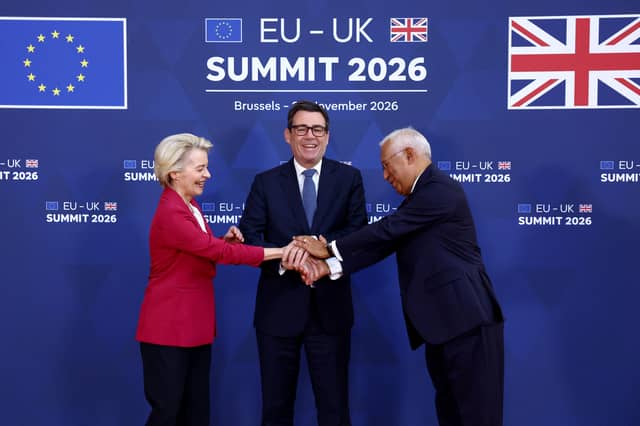


The Prime Minister’s feel-good vibes are unwinding. Instead of bringing the country together as a new leader when he had the chance, we’re already dividing along the same lines as before the 2016 EU referendum. That event become an open wound that suppurated for three years until the 2019 general election.
Even after that there have been many who have picked away at the scab of our relations with the EU in an effort to bring down the Tory governments. Despite us ending up with a deal that heavily favoured the EU – exemplified by but not limited to the fishing sell-out and a separate arrangement enforced upon Northern Ireland – there have still been many who have sought to undermine it by preventing the slightest divergence from EU rules and arguing for us to be closer to Brussels.
The result is we now have an emboldened Prime Minister, with less of a personal mandate than the First Ministers sitting in Edinburgh, Cardiff or Belfast, who has not only delivered a worse “reset” than what his predecessor Sir Keir Starmer said he was prepared to accept, but has also gone back on his word not to consider opening up the debate about the UK applying to join the EU afresh.
A Kafkaesque non-deal
Last Friday’s unveiling turned into a humiliation of our naïve Prime Minister, who was turned over and made to look an innocent abroad. He ended up with a Kafkaesque result of deal that wasn’t a deal; no legal texts were published to confirm the details and the EU announced it was conditional on a further British concession of reducing EU student tuition fees that will cost our universities at least £1.1 billion.
Worse still, with the prospect of such a Black Friday bargain saving an average of £17,000 per student per annum, the number of EU undergraduates will most likely grow, consequently denying thousands of the finite number of places to our own home applicants.
Andy Burnham may have thought he had cause to celebrate, but from now until the next general election, he faces a political hangover caused by his own self-indulgence. Burnham’s mistitled reset resembles Labour’s recent Budgets, which tend to unravel as the days pass and the damaging details seep out. It's like a Terry's chocolate orange. Once you throw away the fancy packaging and give it a slap, it begins to fall apart.
Already a queue of businesses and their representatives is forming to raise their objections to what it means – including the British Retail Consortium saying it won't cut the cost of living, a point made previously by a number of grocers.
Nigel Jenney, chief executive of the Fresh Produce Consortium, has warned new EU-style checks on fruit and vegetables imported from outside the EU could add more than £300 million a year in costs and 5 per cent in prices affecting blueberries, citrus fruit and sweet potatoes.
More astounding is how the Treasury’s own figures show that as the claimed GDP growth of 0.5 per cent will be matched by an additional growth in immigration, the GDP gain per head of population will be the astonishing figure of zero per cent. Then, when you add to that the cost of the tuition fees concession, it must mean the official figures will eventually show the reset costs us more than any benefits.
Every day that passes the whole exercise appears worse for the economy as more detail seeps out, never mind the question of giving away control of setting our own laws – which weakens our opportunity to innovate and undermines democracy by killing political accountability.
300 tonnes of foul food
It would be a nonsense to think the political fallout will be something indulged only by those of a right-of-centre persuasion. The likely closure of the Sevington Inland Border Facility in Kent will mean the loss of 1,500 direct and indirect jobs that must surely stir the public sector unions. Sevington has seized 300 tonnes of foul and dangerous food since its opening in 2024 after inspecting only one in 1,000 lorries from the EU. Other inspections that would add to the total are also carried out in Dover.
Anthony Baldock, who chairs the Association of Port Health Authorities, said officials "didn't really know what was coming across the Channel" before Brexit made the checks possible and has urged the government to retain the current "risk-based" system and "the freedom to set our food laws”. Baldock has argued a recent outbreak of African swine flu in Finland was an example of why he believes they are needed. Other threats such as foot-and-mouth disease pose a real hazard, with no one wanting to see the likes of the 2001 catastrophe return.
Earlier this year, the Commons Environmental, Food and Rural Affairs Committee published data highlighting how 18 per cent of flagged consignments of animal-origin such as meat or dairy were not taken to Sevington despite being directed to by the digital systems once they entered the Port of Dover, meaning they went through without being checked at the Border Control Post for dangerous diseases.
We should be looking to tighten our border controls of food imports, not weaken them to the lower standards offered by the EU’s dynamic alignment.
Ironically, as Labour backbenchers find their voice and complain about Burnham’s reset, not only is it showing all the potential to be a catastrophic political failure, it could yet give Nigel Farage an issue where he can reconfirm his lead in the polls over Kemi Badenoch.
Snatching defeat from the jaws of a possible general election victory is one reset Andy Burnham is surely not bargaining on for Labour.
Brian Monteith is a former member of the Scottish and European parliaments and a member of Britain Unbound’s Advisory Council
Comments
Want to join the conversation? Please or to comment on this article.