
Shocking new poll finding about Gen Z men suggests battle of the sexes is about to get nasty
Some 13 per cent of men born between 1946 and 1964 believe a woman should obey her husband, compared to 31 per cent of those born between 1997 and 2012
Has feminism failed? Or is the startling revelation that nearly a third of young men think that a wife should always obey her husband more a wail of despair from a generation of lost boys than an outburst of misogyny?
A survey carried out by Ipsos and the Global Institute for Women’s Leadership at King’s College London reveals stark differences between generations of men when it comes to gender roles. Old people – that is anyone who lived through the 1960s and 70s, when second-wave feminists upturned gender stereotypes and won major legislative victories including equal pay – are much more progressive in their attitudes.
Only 13 per cent of Baby Boomer men (born between 1946 and 1964) believe a woman should do what she is told by her husband, whereas 31 per cent of Gen Z men (born between 1997 and 2012) hark back to the bad old days when a wife did what she was told by the man of the house.
READ MORE: When will John Swinney stop ignoring real screams of women trapped in Scotland’s sex trade?
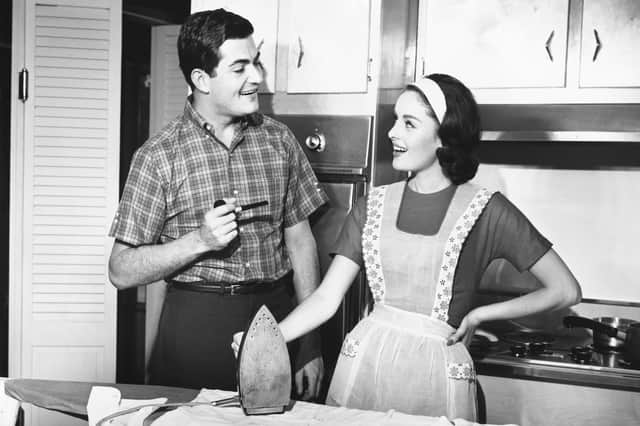

Feminists have a fight on their hands
The research, carried out across 29 countries, including the UK, the USA and Australia, also reveals that a fifth (21 per cent) of young men think that helping with childcare makes you “less masculine”, compared to only 8 per cent of Boomers, who, to be fair, have probably discovered the joys of being a grandparent.
And almost a quarter (24 per cent) of Gen Z men agree that a woman should not appear too “independent” or “self-sufficient”, compared with 12 per cent of Baby Boomer men.
The good news is that more than half of Gen Z women consider themselves to be feminists, but with such entrenched views among their male peers, young women may well have a fight on their hands to hold onto the rights secured by their grandmothers, let alone win the battles still to be fought.
The statistics speak for themselves. Sexual violence is on the rise. The motherhood penalty is real – ten years after childbirth, a woman will earn about a third less than fathers, a gap that will also have a negative impact on her pension savings.
The burden of care for the elderly and other vulnerable groups falls largely to women. Scotland’s 2022 Census shows that 60 per cent of unpaid carers are female. And women still carry out most of the household chores, from cooking to cleaning, a state of affairs which no doubt delights the lads who hanker after a trad wife.
The bitter – but necessary – battle over the definition of sex that has dominated the national conversation about equality over the last decade has sometimes obscured the structural inequalities that still leave women and girls at a disadvantage. Many young feminists, in thrall to ‘progressive’ theories about gender identity, argued that their sex was simply a costume that could be worn by anyone, including men.
But real life is not RuPaul’s Drag Race, and while girls may be beating boys in the classroom and the majority (59 per cent) of university students are women, any woman who has children, whether a lawyer or a hairdresser, will find that motherhood has a negative impact on her career prospects and earning power. Her sex matters.
Gender-based political divide
And what young men think about equality matters too, because recent studies suggest it is reflected in their voting patterns as much as their social attitudes. Analysis by the Financial Times, among others, shows that there is a growing political divide among young people, with Gen Z women more progressive and liberal than their male peers, who are increasingly conservative, particularly on social issues, including immigration.
An ideological gap has opened up between young men and women which may persist throughout their lives, and who can predict what impact that will have on politics and society?
One thing is certain, the backlash against women’s rights evident in young men is not a failure of feminism. Indeed, “she made me do it” is an age-old excuse for men’s bad behaviour. Women are not to blame for young men embracing populist politics and traditional views about sex.
The reasons are many and varied, from the growth of violent pornography freely available on every boy’s smartphone to a growing sense of social isolation. Young men generally have fewer friends than women, and toxic male influencers on social media offer lonely lads a form of twisted companionship, a sense of belonging. Economic uncertainty, where AI threatens professions once seen as lifetime careers, and the growing spectre of a global war also feed into young men’s anxieties.
The Andrew Tates of this world
Faced with an uncertain future, perhaps it is little wonder that Gen Z men hark back to a bygone era when men were ‘men’ and women wore pretty aprons in the kitchen and sexy lingerie in the bedroom. But fear of the future is no excuse for misogyny.
Women are not responsible for the Andrew Tates of this world, for the Iran war, for the growing number of reported rapes and sexual assaults, for the persistent pay gap between men and women. Yet despite the challenges they face, young women still see progress, diversity and equality as values to aspire to, not to shun.
Tomorrow is International Women’s Day. It may have morphed into little more than a corporate branding exercise, but its roots in the battle for women’s suffrage, for better pay and conditions and for peace are as relevant today as they were in 1909, when the Socialist Party of America declared the first national women’s day.
With young men lurching to the right and in favour of traditional roles for men and women, the battle of the sexes may be about to enter a new, more aggressive phase. Feminists, young and old, need to buckle up.
Comments
Want to join the conversation? Please or to comment on this article.