
Grangemouth and Mossmorran no more: Why deindustrialisation isn't the way to hit net zero
A just transition to a net-zero emissions economy is still realistic and achievable, but there is no time to lose, say Satwat Rehman and Dave Reay
As co-chairs of Scotland’s Just Transition Commission, we have travelled all over Scotland for the past four years. We’ve spoken to more than 900 people and all kinds of organisations, from crofters to global asset managers, oil majors to family-run fishing firms.
Our message today is clear: we can still make this transition in a way that truly benefits Scotland’s people and places. But right now we are not on track, and we can’t reduce our emissions fairly if it means losing our industrial base.
We’ve heard it in church halls, on ferries between remote islands, on buses in Dundee, at major industrial sites and vast peat bogs. Government needs to do much more to deliver this transition faster and fairer.
That starts by implementing the realistic and practical recommendations in our report today. These address a set of core issues, from a new skills strategy for Scotland to making the uptake of electric vehicles fairer so it’s not just wealthier households that benefit.

Never again
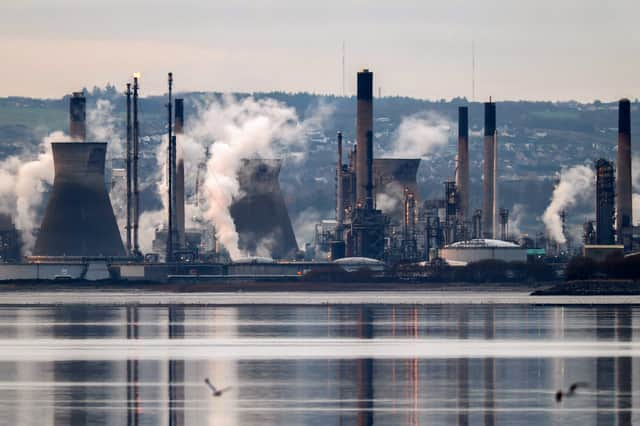
Top of the list are proper plans to support workers, communities and crucial supply-chain businesses linked to our high-emitting industries: Grangemouth, Mossmorran, and the North Sea workforce. Our warning today is stark.
As it stands, we are at risk of further repeats of unplanned closures. In the most extreme cases, this has meant workers turning up for work in the morning to find their access has been shut off. This simply cannot be allowed to happen again.
Our Commission has found a remarkable degree of consensus around a fundamental question facing Scotland’s governments: There is no just path to net zero through deindustrialisation.
Our current path risks an economy with minimal manufacturing, an overreliance on imports, and the further dwindling of the already diminished industrial base and the skilled workforce we need to deliver a prosperous transition as we ramp up growth areas, from renewables to retrofit, peatland and nature restoration.
Employers must act responsibly
Government doesn’t hold all the cards, so needs to use every lever at its disposal. This means a much more proactive approach, requiring employers to act responsibly around conversion and closure, and empowering local authorities to act.
The nature of our energy industries means people in Scotland are exposed to commercial decisions from multinational private companies. This is true both offshore in oil and gas, which has a highly fragmented ownership pattern, and on-shore as we have seen with single major employers closing industrial assets in Grangemouth and Mossmorran.
The exact timing of industrial change, including closures, may not sit with government, but a lack of proper advance planning around these changes is unacceptable, morally, socially and economically.
The work of the Grangemouth Future Industries Board has – better late than never – begun to show promising signs in attracting investment and new sustainable industries to the area. This promises the possibility of a credible economic future in their local area to young people like the apprentices we spoke to at Forth Valley College. We now need to see lessons from Grangemouth applied so that government can get ahead of predictable changes with credible plans for economic renewal.
Progress so far not good enough
We are an independent expert advisory group with members drawn from business, industry, trade unions, environmental and community groups and academia. We are tasked by the Scottish Government with providing scrutiny and advice to make sure the benefits and burdens of the major changes involved in Scotland’s climate neutral transition are shared as fairly as possible, and making an annual assessment of progress towards a just transition to a low-carbon economy.
It is greatly to the Scottish Government’s credit that they support initiatives like ours. A just transition requires confronting difficult, complex issues through serious democratic engagement. In October, First Minister John Swinney told government and civil society leaders at the Commission’s Just Transition Summit that he intends to renew the Commission for the next Holyrood term, highlighting its constructive role in facilitating “open and candid conversations”.
In that spirit, we all need to recognise that progress to this point has not been good enough. Instead of planning for success, we are reacting to crises. The proposed planning work for core economic sectors, including the energy plan, has fallen short of what is needed.
Fuel poverty and job insecurity
Macro-economic headwinds and the challenging fiscal picture have made progress on just transition issues more difficult but also even more critical. The cost-of-living crisis Scotland has experienced since the Covid pandemic has been largely driven by high fossil gas prices, with the marginal pricing of energy limiting the positive effect that the expansion of renewable supply could otherwise have in reducing fuel poverty and lowering electricity costs for households and industries.
A business-as-usual scenario risks building a country where people continue to live in some of Europe’s leakiest buildings, and endure high levels of fuel poverty, deepening job insecurity and in-work poverty, and the undermining of efforts to reduce child poverty. It risks worsening rural depopulation at precisely the moment that we need to ensure communities in rural and island areas have the services and support they need to deliver much of the new infrastructure for sustainable industries.
The results in terms of community and social cohesion are deeply concerning and chillingly predictable. The anger and division caused by continued disorderly and unmanaged industrial change risks critically undermining the broad social license required to realise a resilient, prosperous and low-carbon future.
This Commission has found resounding evidence that people across the country are up for the challenge. A just transition for Scotland remains realistic and achievable, but there is now really no time to lose.
Satwat Rehman and Professor Dave Reay are co-chairs of the Just Transition Commission
Comments
Want to join the conversation? Please or to comment on this article.