
Why appalling state of some Edinburgh and Glasgow cycle lanes amounts to roads apartheid – Alastair Dalton
More councillors need to ride their own cycle networks to see the damage at first hand

If there’s one fun activity you can do to stay fit and active through the winter that can be integrated into your daily routine, it’s cycling.
But it’s not fun if you don’t feel safe on the roads – and that’s likely to put a lot of people off trying it again, perhaps for the first time since childhood.
Unlike novice drivers, who build up their confidence and skills by taking lessons and passing the test, most adults returning to the saddle after a long gap take to the roads with little preparation and, I dare say, a fair amount of trepidation.
READ MORE: The boy who smiled for the first time at school after getting on a bike in pioneering scheme


Separate traffic lights for cyclists
I remember vividly doing just that – riding a bike on a busy road for the first time since teenage years, with the unnerving experience of cycling between parked cars on one side and a stream of fast-moving traffic on the other. You get used to it, but that prompted me to plan my routes along quieter and traffic-free streets, even it meant a longer, less direct journey.
However, in cities such as Edinburgh and Glasgow, there is less and less need to do that because segregated cycle lanes are springing up everywhere, such as on routes into the city centres.
Examples include the City Centre West to East Link in Edinburgh, and the multi-route Avenues project in Glasgow, such on Sauchiehall Street in the city centre. Some even have separate traffic lights for cyclists to further improve safety at junctions.
All this is a major improvement compared to cycle lanes on the carriageway, which are often just painted lines. On segregated routes, the cycle lane is separated from the road by a kerb, or forms part of the pavement. Ironically, cyclists’ biggest risk using these is wayward pedestrians straying into the lanes – or other cyclists.
Cycle lane tarmac quality
More segregated lanes is a hugely welcome step. They give cyclists their own safer road space, as well as acting as prominent way of promoting cycling. It’s what Amsterdam has had for decades, and, as I’ve noted before, busy sections like near the top of Leith Walk in Edinburgh are starting to feel like such cities.
But – and this is a big But – very few people will be able to get from A to B on segregated lanes alone. For virtually every cycle journey, however much you try to avoid busy roads without segregated lanes, it will prove impossible.
However, in my experience, it’s far worse than that, as older cycle lanes may well be all but invisible or in a decidedly poor condition, if not also litter, leaves and debris-strewn. I would go so far as to describe the worst examples as roads apartheid – smooth running for cars while cyclists have to put up with bumpy, rutted surfaces.
I believe where that has occurred, councils have got their priorities all wrong. The condition of cycle lanes should be as good as or better than that of the main carriageway – not the other way round.
There are two classic examples of this on routes I regularly ride in Glasgow and Edinburgh. In Glasgow, a busy road in the West End was resurfaced a few months ago unlike most of its cycle lanes, which are separated by low-slung oval plastic ‘armadillos’.
This seems absurd to me, and I hope motorists following me can see why I ride on the main part of Clarence Drive whenever possible rather than being jolted along the cycle lanes. But Glasgow City Council told me: “The cycle way is in satisfactory condition compared to the main carriageway, minor snagging works will be done and the location will be kept under review as part of the regular inspection process.”
A challenge to councillors
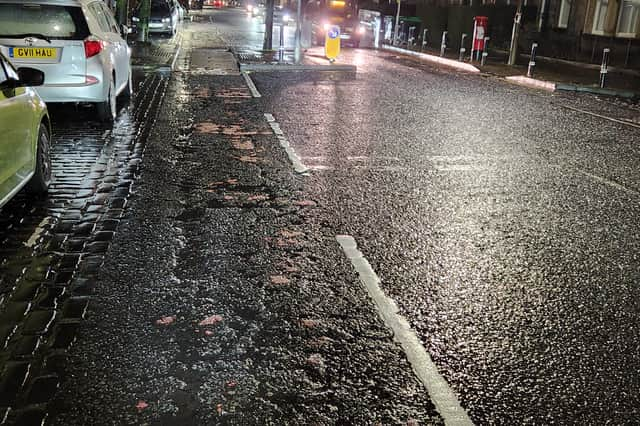
Over in Edinburgh, a cycle lane along McDonald Road, off Leith Walk, is so uneven in places you have to keep your bum off the saddle to avoid risking serious discomfort – or keep to the main part of the road.
This is also self defeating since the cycle lane bypasses sections where the road is narrowed to one lane to slow traffic, which has to give priority to vehicles from the other direction. The City of Edinburgh Council has yet to respond.
My message here I think is clear – it’s all very well building pristine, high-profile new segregated lanes – they are fantastic advertisements for getting on two wheels. But that spending absolutely must not be at the expense of maintaining the existing network, which every cycle lane is part of.
I’ve previously described this appalling neglect as looking like “archaeological evidence of a past civilisation that once encouraged cycling”. Thankfully, some of the examples that triggered that thought have since been improved, but in some places you only have to venture slightly further along the same cycle lane to find things as bad if not worse.
On a section of busy Crow Road, also in Glasgow’s West End, the lanes are deeply rutted, with their white lines and green paint pretty much disappeared. Councils may be more strapped for cash than ever, but if there’s money for new cycling infrastructure, money must also be allocated for what’s already there.
It makes me wonder if anyone at the two cities’ councils actually rides their own cycle networks. More councillors should jump on the new electric hire bikes their local authorities have provided and see for themselves.
Comments
Want to join the conversation? Please or to comment on this article.