
When is the next Full Moon 2026? How to see December’s Christmas Eve Cold Supermoon - how it got its name and what’s a supermoon?
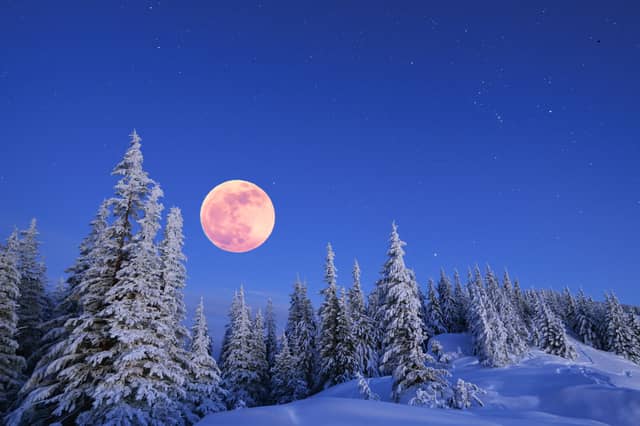

There’s not been a Christmas Eve sight like it in over 200 years.
It’s a sight that has inspired myths, superstitions and awe through the centuries - when the night sky is lit up by the seemingly-perfect glowing sphere of a full moon.
We experience one full moon every month (and occasionally a 13th - the so-called Blue Moon, which we had earlier this year), with each one given a different evocative name.
Here's how to see the next one of 2026 - which is also a big and bright Supermoon.
What is a full moon?
A full moon is when moon appears as a complete circle in the sky. The moon produces no light of its own, so this only happens when the moon is on the opposite side of the Earth to the Sun - meaning the whole of the near side of the moon is fully lit up.
When is the Cold Moon in 2026?
The next full moon or ‘Cold Moon’ will reach its peak on Tuesday, November 24, at 1.28am. This time only applies to the UK however as when the full moon rises and sets depends on where you are on the planet. Don’t worry if you’re in your bed when it’s at its peak - it’ll still appear full over the entire evening and night of Christmas Eve.
Why is it called a Cold Moon?
Like many of the names we give to the full moons, the Cold Moon has its origins on the the other side of the Atlantic, being used by Native Americans. The originators of the name are apparently the Mohawke tribe, who saw the moon herald the start of the coldest part of the winter, when times were at their toughest.
Why do full moons have different names?
Full moon names are often attributed to Native American tribes that would give them nicknames to keep track of they year as they didn’t record time using months found in the Julian or Gregorian calendar. Most of the names were linked to a specific event, for example the Worm Moon relates to a time of year when the ground starts to thaw and worms are able to wriggle up to the surface.
Other moons like the blood moon were thought to be caused by Jaguars who attacked the moon and left it bleeding hence the red colour. These lunar systems and their names differed between tribes but it seems Colonial Americans adopted some of these names and incorporated them into their own calendar systems.
What is a Supermoon?
A Supermoon is a phenomenon that occurs when the full moon or new moon coincides with the moon's closest approach to Earth in its orbit, known as perigee. Because the moon is closer to Earth during this time, it appears larger and brighter than usual, hence the name. It means that the moon appears up to 14 per cent larger and 30 per cent brighter than when it’s at its furthest from Earth.
How rare is Christmas Eve Full Supermoon?
The last time there was a full moon on Christmas Eve was in 2007, but the last time there was one this close to Earth was over 200 years ago - so it’s a real once-in-a-lifetime moon.
Make sure you don't miss a moment of breaking news from across Scotland by signing up to our free newsletter here.
Comments
Want to join the conversation? Please or to comment on this article.