
Northern Lights Scotland 2025: Here's how to see the Aurora Borealis this autumn - and why it's the perfect time for them
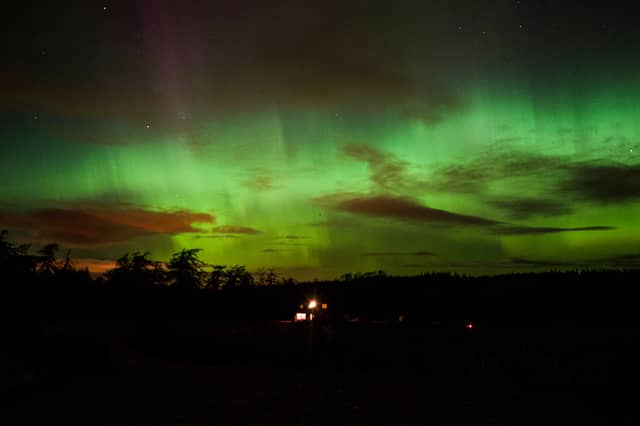

The next few months are likely to be busy for Aurora hunters.
It’s a phenomenon that has caused excitement, awe, joy and even fear over the centuries – the brilliant multi-coloured Northern Lights that occasionally illuminate the dark skies of the Northern Hemisphere.
This week much of the UK had the chance to witness the magical dancing lights, and those in the know say there should be plenty of other opportunities this autumn in Scotland.
Here’s everything you need to know.
What are the Northern Lights?
The Northern Lights, also known as the Auroroa Borealis, are moving patterns of green, blue, purple and red caused by solar storms on the surface of the sun, which create clouds of electrically charged particles that are forcefully expelled.
Some of these particles collide with the Earth, with some becoming caught in the planet’s magnetic field, where they are attracted to the north and south poles.
This collection of particles collide with atoms and molecules already present in the atmosphere, heating them up and causing them to glow – creating the spectacle.
Where can you see the Northern Lights?
Essentially, the closer you are to the North Pole, the higher your chance of seeing them - hence the popularity of places like Iceland for aurora hunters.
However most of Scotland is in the zone where they are – in theory – regularly visible. The further north you go, the more likely they are to appear. If you live in Aberdeen or Inverness, the chances are you will have seen them at some point.
What caused the Northern Lights this week?
A fast-moving coronal mass ejection (CME) left the Sun late on Saturday night (August 30), sending a release of plasma and magnetic field from the sun’s corona towards Earth. It arrived late on Monday, September 1, creating the perfect conditions to view the Northern Lights from further south than usual - meaning they could be seen across much of Scotland (clear skies willing).
Will I be able to see the Northern Lights tonight?
On Tuesday, September 2, the Met Office says there is still a chance to see the Northern Lights, but that it will probably be restricted to the far north of Scotland.
Why is 2025 such a good year for the Northern Lights?
The Sun has a solar activity cycle that lasts roughly 11 years, fluctuating between periods of low activity and high activity. When its activity is at its highest there will be more sunspots, coronal loops and the solar flares that lead to the Northern Lights being seen. In 2025 the solar activity is set to be at its maximum, with the emission of solar particles peaking. The optimal conditions for Aurora Borealis will continue into 2026, with the next peak arriving in 2036.
Where is the best place to see the Northern Lights?
You have a chance of seeing the Aurora Borealis wherever it’s dark with clear skies - as far away from artificial light as possible.
Once you’ve found a spot to watch from start looking towards the northern horizon and avoid the temptation to play with your phone - letting your eyes get used to the darkness instead.
Of course you need to be lucky, but a regular check of the Aurora Watch website, which measures the latest amount of solar activity, will let you know if they are likely to appear anytime soon.
Good luck.
Comments
Want to join the conversation? Please or to comment on this article.