
408 refresh adds style, quiet confidence and comfort

Striking flare green fastback looks great and rides smoothly, but modest range, fiddly tech and tight rear headroom frustrate slightly, writes Jim McGill
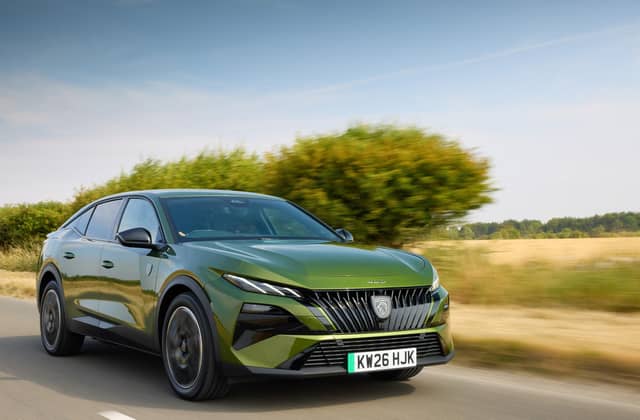
In front of me is the latest e-408 and it’s looking resplendent in its new Flare Green. It’s a bold, attractive colour and perfectly suits the car’s fetching fastback new look. Very stylish. So now, 30 years on from selling my loyal little Peug which I used to commute daily from Dundee to Aberdeen, what’s the modern-day driving experience like in a Peugeot? Time to find out.
Now I have to say right from the start that I have a past history with Peugeot. Back in the day, we’re talking 1991, I commuted daily from Dundee to Aberdeen — yes, before the A90 was fully dualled — for work, leaving home before 6am. Joy of joys. A 130-mile daily round-trip. And I did it for eight years.
My mode of transport? A brand new, metallic green Peugeot 106 diesel.
I loved it. It was super economical and reliable. It never put a foot wrong in the 120,000 miles we covered together. In the end I was sad to see it go, but life moved on and the daily commute stopped.
Fast-forward. In front of me is the latest e-408 and it’s looking resplendent in its new-for-2026 Flare Green. It’s a bold, attractive colour and perfectly suits the car’s fetching fastback new look. Very stylish. So now, 30 years on from selling my loyal little Peug, what’s the modern-day driving experience like in a Peugeot? Time to find out.
Tell me more about the Peugeot e-408
The 408 was launched by Peugeot back in 2023 as a crossover coupe-SUV sitting somewhere between the 308 hatchback and larger 5008 SUV. And while its launch was received positively, it didn’t exactly set the heather alight in terms of UK sales.
This year the car has been given what the company calls a ‘refresh’. Buyers can choose between a full-electric model, a petrol-assisted hybrid or a plug-in hybrid model. My test car is the full electric model.
So what’s new? Well like so many facelifts now you need to look really closely to spot the difference. Externally there’s a revised front-end with more striking LED headlights; and the daytime running lights now boast a more sleek ‘three-claw’ design connected by LED strips incorporated into the newly-sculpted fresh grille. And sitting pride of place in the centre, on all models apart from the entry-level, is an illuminated Peugeot shield.
Lights are a big thing with the facelift. So as not to detract from the impressive new daytime lights, the Peugeot designers have concealed the main headlights in the large gloss-black air vents lower down in the redesigned bumper. Clever. And remember that illuminated Peugeot badge. Well tucked behind it is the car’s proximity radar. As if all that wasn’t enough, you also get new alloy wheel designs.
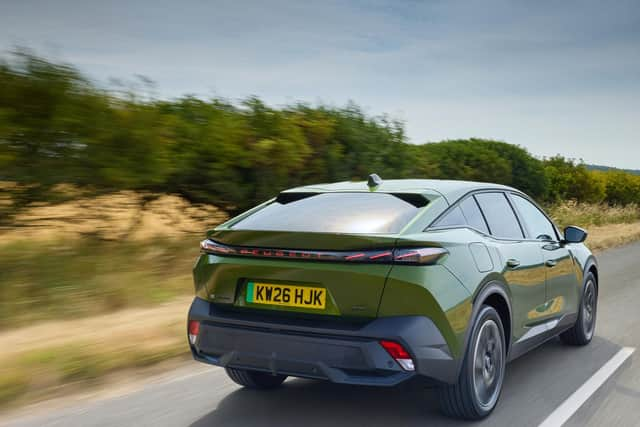
At the rear there’s more illumination touches. The 408 gets lit-up lettering across the rear integrated into a transparent strip across the tailgate which, in turn, connects the new three-claw tail-lights.
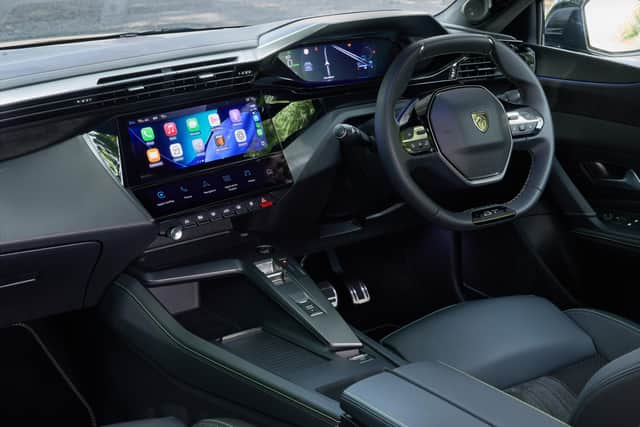
Inside the cabin you get an updated instrument cluster with new graphics and revised seat fabrics.
Oh. And the Flare Green palette is now the standard paint colour. It’s a sort of ‘like it or lump it’ scenario. That said, the 408 has always been strong on attracting individuals who want something a bit different from the usual family SUV. To be honest, I actually like the colour. Peugeot says it should change hue depending on the light conditions, shifting towards more of a yellow tone in sunlight and deep green in shadows. I didn’t notice any difference. But it’s certainly way better and more attractive than all the variations of grey that we see on our roads today.
Power unit, range and charging
This facelifted e-408 gets the same 58.2kWh battery and 210bhp front-mounted e-motor as before. But the 2026 model benefits from new aerodynamic tweaks which have boosted range, now up from 280-miles to 283 on a single charge. Not exactly sector-leading, but adequate for the average daily driver.
The facelift now also gets the ability to pre-condition the e-408’s battery so it’s at the optimal temperature for a rapid charge. Where it really helps is, if you set a charging station as the destination in the sat-nav, the Peugeot will cleverly automatically begin pre-conditioning the powerpack.
The Peugeot’s 120kW peak charging speed again isn’t class-leading, but it’s swift enough to charge from 20-80% in around 30-minutes, similar to rivals such as the Skoda Elroq and Kia EV4.
Equipment and prices
You can choose from three trim levels: Allure, GT and GT Premium. Prices start at £34,195 for the entry-level Allure which includes a decent level of standard kit including a 10-inch central touchscreen, heated front seats, a high-mounted digital driver display behind Peugeot’s familiar small steering wheel, rear parking sensors and a reversing camera.
Step up to the GT, which adds upgraded driver assistance functions, an illuminated front grille, more advanced LED headlights and an electric tailgate and you’ll be paying around £36,595.
The range-topping GT Premium, which I’m driving, starts at £39,095. In addition to Alcantara trim, a 360-degree camera system and a Focal premium sound system, the car gets a heat pump. And that’s significant, because being particularly useful on an electric car it not only can be used to heat the cabin in cold weather, but it can also help reduce the amount of battery energy. An acceptable double-whammy.
Importantly, the e-408 qualifies for the Government’s £1500 Electric Car Grant, meaning the entry-level Allure is currently actually available from £32,695. That’s a lot of car for the money. The GT and GT Premium fall to £35,095 and £37,595 respectively.
What’s it like to drive?
There’s no denying the Peugeot e-408 is built for cruising. In the positive use of the word, it’s a car for wafting along the motorway in serene comfort. It’s lovely. But despite initially feeling pretty sporty when you set off thanks to its weighty steering and firm brakes, it’s unlikely to ever set your heart racing, but it’s never been intended to be that sort of car. Sure you can tuck it into corners when you head to your favourite A-road, and the good news is it will continue to feel reasonably composed. But it does roll more than the hybrid version.
It’s a heavy car at 1806kg, so it lacks a tad of outright agility, but it grips well and aided by its titchy, dinky steering wheel — again, I like Peugeot’s take on small-diameter steering wheels — the steering inputs feel very direct. The steering is on the light side, which is perfect when it comes to positioning the car in town and car parks, but out on the road you initially have to be aware when you come to slow corners that your steering input is enough to position the wheels in the right place. You quickly get the hang of its idiocyncracies. Another positive is the fact the steering weights up at speed, making motorway driving a pleasure.
But its major plus point is the level of refinement and comfort. No matter what speed you’re travelling, the cabin remains a hushed place to be. Plus the ride is basically super-smooth until, like so many cars, you come crashing down into one of the UK’s deep potholes.
But that challenge is aided by a suspension set-up which does exceptionally well at soaking up the imperfections on our roads. The ride is on the firm side, which as I’ve said previously is my preferred set-up, but it’s always compliant.
Performance wise it’s plenty quick enough to deal with everyday driving. If you’re commuting, it has enough mid-range poke to comfortably handle normal overtaking. The brake regeneration system — which offers three options, one of which is ‘off’ — is controlled via paddles behind the steering wheel, and not tucked away behind a touchscreen. Brilliant.
Inside the cabin
Not much has changed in the cabin, which is no bad thing because the original was excellent. What we do get are some new updated graphics for the 10-inch driver’s display. There’s also a boost in quality thanks to new fabrics and materials dotted around the cabin, plus you get a driver-monitoring camera on the windscreen pillar to watch for fatigue or a distracted motorist.
Personally I’ve never been a lover of these systems, and my sentiment isn’t confined to that of the Peugeot. They tend to ping you an ‘alert’ even when you glance just to look at the rear-view or side mirrors, and when you’re wearing sunglasses they can be a real intrusive pain.
On the positive side, on the top-spec models the new fabrics and materials include aluminium, Nappa leather and Alcantara, each of which enhances the cabin.
Another thing that remains is Peugeot’s rather unconventional i-Cockpit layout. It requires the driver to read the instrument cluster by peering over the top of the small but chunky octagonal steering wheel. Sure it contributes to ensuring you keep your eyes on the road ahead, but being 5ft 9in finding the right driving position is a scutter. I either had to set the steering wheel too low down so it was almost in my lap, or raise the driver’s seat so high I felt I was perched too close to the ceiling. In the end I opted for the former, but it wasn’t ideal.
All that said, the standard driving position is already set on the high side, which is a bonus as it gives a really good view of the road. Plus there’s a myriad of adjustable positions for both the driver’s seat and steering wheel.
At the heart of the cabin is the same 10in central touchscreen as before, but while it looks good with its sharp graphics, the infotainment system is on the ponderous side and a bit of a fiddle to use. Thankfully Apple CarPlay and Android Auto are standard. My test car, being the GT Premium, was fitted with Peugeot’s ‘i-Toggles’ shortcut buttons. These large customisable buttons allow you to easily switch between various menus, as well as between CarPlay and Peugeot’s own software. Easy-peasy.
There are a number of physical switches below the i-Toggles panel, including one which allows you to deactivate some of the driver-assistance features simply by pressing it for around a second. Simple. Why do so many other manufacturers not offer this solution? But then annoyingly and in complete contrast, even daily functions such as adjusting the cabin’s temperature require you to go into the main touchscreen. Honestly, some times you just want to bang your head against the window!
Space for occupants is mixed. There’s ample room upfront, but thanks to the rakish lines of the e-408, six-footers in the rear are compromised for headroom. For a family though, three teenagers should fit comfortably across the back benchseat, plus there are two sets of Isofix mounting points for younger families.
Bootspace
Both the pure electric and plug-in hybrid versions can accommodate 471-litres of detritus, which is less than the 408 Hybrid which can swallow 536-litres. Frustratingly there’s no ‘frunk’ or enough underfloor storage elsewhere to house the charging cables, so they have to take up bootspace.
Verdict
There’s lots to like about the Peugeot e-408. It’s a bit of a headturner stylistically and is definitely a refreshing take on an SUV. Throw in its premium feel and high level of comfort, especially on a long journey, and it’s very positive.
Then you need to factor in its so-so range and charging speed. Technology has come a long way since the original was launched in 2023 and the Peugeot tech definitely languishes behind.
But focus again on the pricing — the 408 Hybrid starts at £31,995 with the entry-level electric e-408 now £32,695 — and suddenly, especially if you’re likely to do more shorter journeys than long, the e-408 becomes an interesting consideration. Certainly worth having a look.
Fact box
Peugeot e-408
Price: From £32,695 (including Govt Grant)
Engine: Single electric motor with 58.2kWh battery pack
Transmission: Single speed, front-wheel-drive
Power / Torque: 207bhp / 253lb/ft
Top Speed / 0-62mph: 99mph / 7.7secs
Range: 283 miles (WLTP)
CO2: 115g/km
Dimensions (L/W/H in mm): 4687 / 2062 / 1485
On sale now: Visit www.peugeot.co.uk