
Alan Carr makes changes to his Scottish castle plans - because of bats


Bats have become central to the work at Carr’s new pile in the Borders
Television celebrity Alan Carr has moved to protect bats at his new Scottish castle.
Carr has been renovating Ayton Castle in the Scottish Borders since he bought it for £3.25million earlier this year after winning Celebrity Traitors.
The move sparked controversy when Carr was accused of "cultural appropriation" but he later said he had turned down the chance to buy a baron title and have his own tartan.
But a scheme to change a former potting shed and ancillary buildings on the historic site into a community cafe and estate shop had hit a snag - over the potential of roosting bats.
The council is still considering the application but Carr's representatives have now produced fresh drawings to illustrate the measures taken to resolve the issue.
These include creating bat bricks into a wall in a bid to "satisfy ecological report recommendations."
The changes are designed to give bats a sheltered space to roost in and will built into the wall when it goes up.
In addition, Carr has now added a new timber frame shelter with a slate roof to the design to provide a "nesting ledge for swifts."
Malcolm Ginns, an ecology officer at Scottish Borders Council, previously wrote: "There is potential for the potting shed to host roosting bats and a daytime bat assessment should be undertaken."
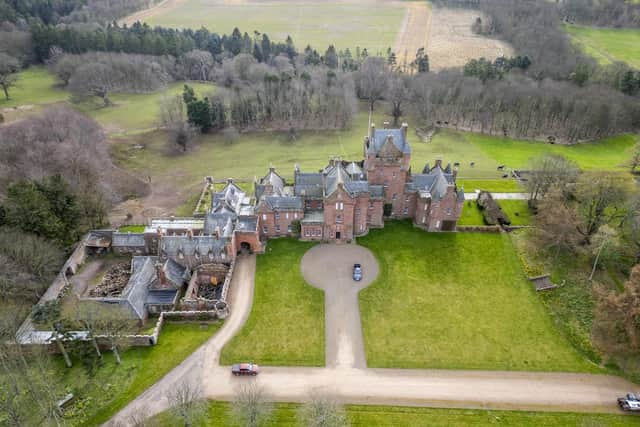
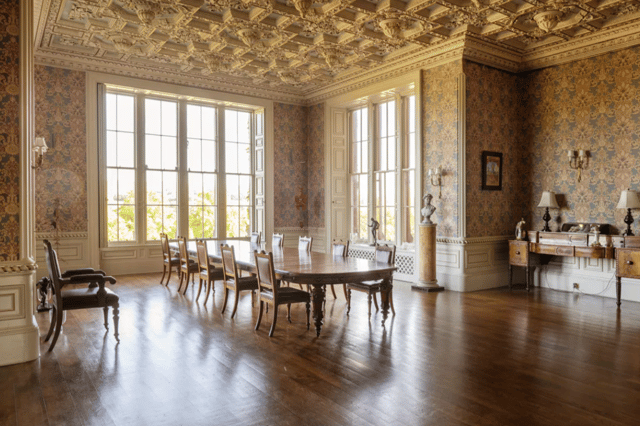
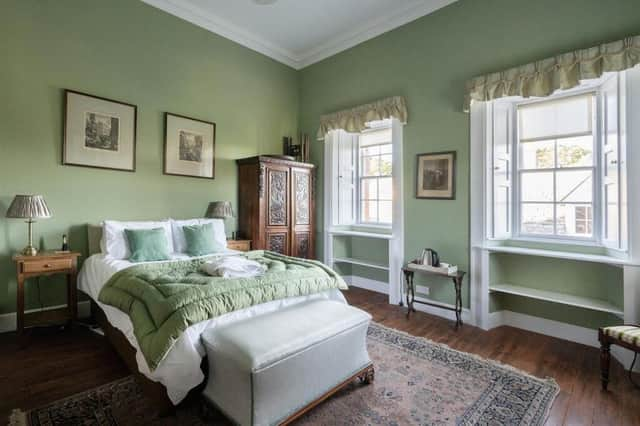
The castle close to the English and Scottish border boasts 17 bedrooms, nine bathrooms, a five-storey Great Tower, turrets, a private chapel and 106-acre listed gardens.
Carr revealed previously he was ready to relocate permanently and his renovation is being filmed as part of a Disney+ documentary.
His current proposal seeks to convert some derelict traditional buildings into the community cafe and estate shop.
This will include repair and conservation of the existing fabric while also creating a new space to house the cafe at the listed property.
In response, Carr's representatives previously said a full survey was being carried out and a full report on the outcome will be submitted once it's complete.
They said: "Full awareness of the existing building's historical significance is addressed and maintained and the adaptive use proposal sits well within the guidance issued by HES, allowing a long term sustainable purpose for these estate buildings.
"The proposal halts the further decay of these buildings and promotes a well-suited option for adaptive reuse."
They added: "It is recognised that the building location presents potential for habitation by a potential variety of species.
"To address this, an ecological study has been commissioned to determine the presence of any species within or adjacent to the buildings.
"Tweed Ecology are currently undertaking a 3-stage survey and their full report will be submitted shortly after the last stage survey has been concluded."
No public comments have so far been submitted as part of the application.
Carr's representatives acknowledged some work had previously been done by the former owners without consent and that some retrospective applications may have to be submitted in the future.
They added: "Some essential repairs have been undertaken which in some cases may not have seen full reinstatement by the previous owners.
"Whilst this has no direct bearing on the potting shed application, the new owner and applicant is aware of these instances and is keen to work with SBC to ensure all permissions are retrospectively in place and work undertaken to fully reinstate significant features."
The potting shed was described as being in a "general state of disrepair with severe dilapidation" with missing doors and windows which render the building open to the elements.
Ayton Castle itself was originally associated with a medieval fortified tower or peel, linked to the powerful Home family.
Its position near the English border made it strategically important, and in the late 15th century it was considered one of the strongest places between Berwick and Edinburgh.
In 1497 it was captured by the English, and the nearby village of Ayton gave its name to the Treaty of Ayton, signed that same year.
The earlier stronghold was later replaced by a more classical country house, which burned down in 1834.
The estate was subsequently bought by William Mitchell-Innes, a banker connected with the Bank of Scotland, who commissioned the present castle.
The building seen today was created between 1845 and 1851 by architect James Gillespie Graham, with later additions by David Bryce and James Maitland Wardrop.
Carr had previously back-tracked on claims he was to become a baron in his new castle and says he turned down the chance to buy the title.
He had been accused of 'cultural appropriation' after pledging to become a ''baron with his own tartan''.
His comments on a podcast sparked a backlash among some locals - who accused him of being an 'invader' and engaging in 'cultural appropriation'.
A spokesperson for Disney+ later confirmed that he had the chance to buy the title of Baron with the castle purchase - but opted not to.
They added the ''gates will remain open for dog walkers and ramblers''.
The Disney+ spokesperson said at the time: "Alan Carr is very much looking forward to making Ayton his home and getting to know the local community.
''The gates will remain open for the dog walkers and ramblers to continue enjoying the estate grounds.
''Alan hopes to host a few events at the castle to help cover the running costs, showcasing Ayton's stunning backdrop and the surrounding area, with as little disruption as possible."
Carr previously said in the podcast: "It is my home, I have bought it, and I'm selling up and moving up there. I'm 50, I want a change.
"I've got the survey now, and I'm waiting for the keys to come. It's a lovely community, really small, and I want it to be magical.
"I'll be a baron, and I get my own tartan."
Comments
Want to join the conversation? Please or to comment on this article.