
'Deeply concerning' lack of engagement with Scotland's fishing sector as offshore wind farms more than double
Fishermen have warned they are being squeezed out of fishing territories in the rollout of more offshore wind farm projects.

Scottish ministers have been accused of blanking the fishing sector and ignoring public sentiment as the number of operational offshore wind projects are set to double.
Seven wind farms are in operation off Scotland’s coast, according to Crown Estate Scotland (CES), with another 11 consented or under construction. A further 26 are in the planning or the pre-planning stage.
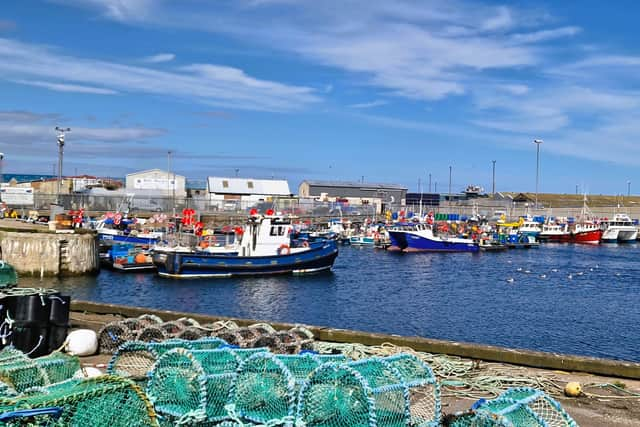

The Scottish Fishermen’s Federation (SFF) warned the Scottish Government’s “rapid industrialisation” of the country’s seas was causing serious harm to the fishing sector.
The organisation also claimed ministers were ignoring public sentiment after an SFF survey this year showed 86 per cent of the public said food production was just as important as energy production, and that Scotland’s fishing sector should be protected.
Nevertheless, fishermen have repeatedly voiced concern over being squeezed out of important fishing territories due to further industrialisation of Scotland’s seas.
The industry’s concerns were raised at the SFF’s annual dinner in Edinburgh on Thursday, which was attended by rural affairs secretary Mairi Gougeon.

The SFF’s latest frustration with ministers comes after discussions were had between CES and London-based firm Offshore Solutions Group to use part of the Moray Firth - an important estuary for fishermen - for the storing of offshore wind turbine bases.
The Moray FLOW-Park project would see huge floating foundations temporarily anchored at two five-mile-long stretches of the estuary during construction or bad weather, an area roughly equivalent to 5,600 football pitches.
The SFF claimed no consultation was carried out with fishermen. The federation’s chief executive Elspeth Macdonald said the project would be hazardous for other fishing vessels and part of the site would be positioned directly over established fishing grounds used for decades by inshore vessels that do not have the capacity to fish further afield.

Fishermen in the area, according to the SFF, said the development could see fishing “finished for good”.
A spokesperson for CES said the project was in the early commercial discussion phase and it was not CES’s role to conduct a consultation with all potentially relevant stakeholders.
The spokesperson said: “Such early-stage agreements do not mean that a proposal will go ahead and during this initial scoping phase other activities, including fishing, can continue. If a developer subsequently decides to submit a formal consent application, this proposal would be subject to the usual comprehensive process of Scottish Government regulators and local planning authorities before any lease can be considered.”
In a speech at the annual dinner, Ms Macdonald criticised the Scottish Government’s approach to renewable energy and its impact on the fishing industry.

“The Scottish Government’s ARROW programme – Acceleration and Regulatory Reform of Offshore Wind – is focused on ways to make it faster, easier and cheaper for the industrialisation of Scotland’s seas, building vast wind farms with very limited understanding of how they will change the environment, and knowing through its own assessments, which confirm what we have been telling them for several years, that if the government goes ahead as planned, then it will do long-term, significant damage to our industry,” she said.
“If impacts on fishing cannot be avoided, then there must be financial compensation to fishing. The ball is in the government’s court.”
The SFF has previously called for a moratorium on further consents to offshore wind farms until the concerns of the industry have been properly addressed.
Scottish Conservative MSP Tim Eagle said: “This lack of engagement from SNP ministers is deeply concerning. Our fishing and coastal communities are rightly concerned about the impact offshore wind projects are having on stocks and on their livelihoods, but they feel they are being ignored.”

Speaking ahead of the SFF’s annual dinner, Ms Gougeon said: “I understand the challenges facing the fishing industry and concerns regarding the increasing pressure from offshore wind.
“This government has a fundamental role to play in managing the marine space and ensuring the interests of all marine users, including our world renowned fishing industry, are properly considered.
"We will continue to work together across all sectors to manage our marine space, and help ensure the fishing industry can continue to thrive.”
Comments
Want to join the conversation? Please or to comment on this article.