
Why we line old sandstone walls with Scottish hemp
Insulation expert Calum Farquhar on choosing a Scottish-made material over cheaper foam board for old stone walls
Unrendered sandstone soaks up the rain that Scottish weather drives into it, then gives the moisture back to the air when the weather dries. Our tenements and villas have run that cycle for over a century. If you line the inside face with insulation that blocks moisture, rain still gets in from outside but has no way back out.
We set up the company in 2021 and work out of East Kilbride. We started it because Scottish buildings and Scottish weather kept getting insulation designed for English houses. We still had to decide what to put against those walls, and foil-faced plastic foam board was the cheaper option. Foam board does a good job in the right place, and we fit it under underfloor heating and in some roof spaces. On bare stone it seals the inner face and traps that moisture in the wall, where it can lead to dry rot.
We went with a hemp insulation made here in Scotland. On a sandstone wall we strip back to the stone, coat it in a thin layer of lime to fill the hollows, fit two layers of hemp inside a timber frame and cover it with breathable board, ready for two coats of lime plaster. Hemp and lime take moisture in and let it go again, so a stone wall insulated from the inside keeps drying the way it always has.
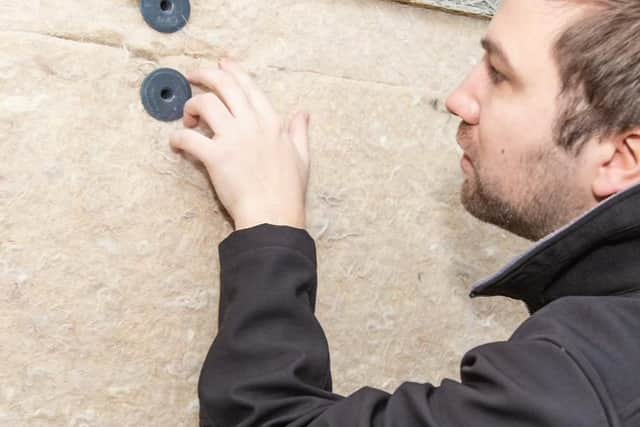

The choice has a price. Hemp and lime are dearer to supply and fit than board, which can put our quote above others a customer has in hand. I accept that, because on unrendered stone the hemp system is the right call for the customer.
Training is where the decision shows most. We employ six installers in Scotland and train them on the job, each with an NVQ or SVQ for every type of insulation they fit. A breathable wall needs care, and the mistakes hide behind the plaster. Skipping that lime coat leaves air pockets where condensation can form. If old lath and plaster stays behind the frame, the timber can rot from the inside, and the wrong paint at the end seals the whole wall shut, so every customer gets guidance on breathable paint or limewash. A specialist lime plasterer works with us on every one of these jobs. I also overestimate the time on each job so nobody on the team feels rushed.
We are not the cheapest company for most of what we do, and now and then we turn away a job where the brief is the lowest possible cost with the customer supplying their own materials. Demand for this kind of work centres on sandstone flats and villas in the West End of Glasgow and on Glasgow's Southside, and those owners have usually done their homework before they call. Many arrive worried about trapping moisture in the wall.
The conversation I owe every customer includes the downsides. The system eats about 120mm of floor space along each insulated wall. Saving ornate cornicing is rare once the wall comes back to stone, though a plasterer can recreate it. Too much insulation brings its own risk: a colder outer face, where rain soaked into the stone can freeze and thaw, cracking the sandstone and loosening the lime mortar. That is why we design each build-up for the wall type rather than fitting as much as will go in.
Calum Farquhar is a co-founder and director of Insulation Installers Scotland
Comments
Want to join the conversation? Please or to comment on this article.